How to audit your sales AI stack for overlap, unused seats and real ROI

- Start with the list you can build this week. Every AI tool in the stack, with its owner, seats and renewal date. Add each tool's login report and mark where two tools do the same job. Invoices and admin consoles are enough.
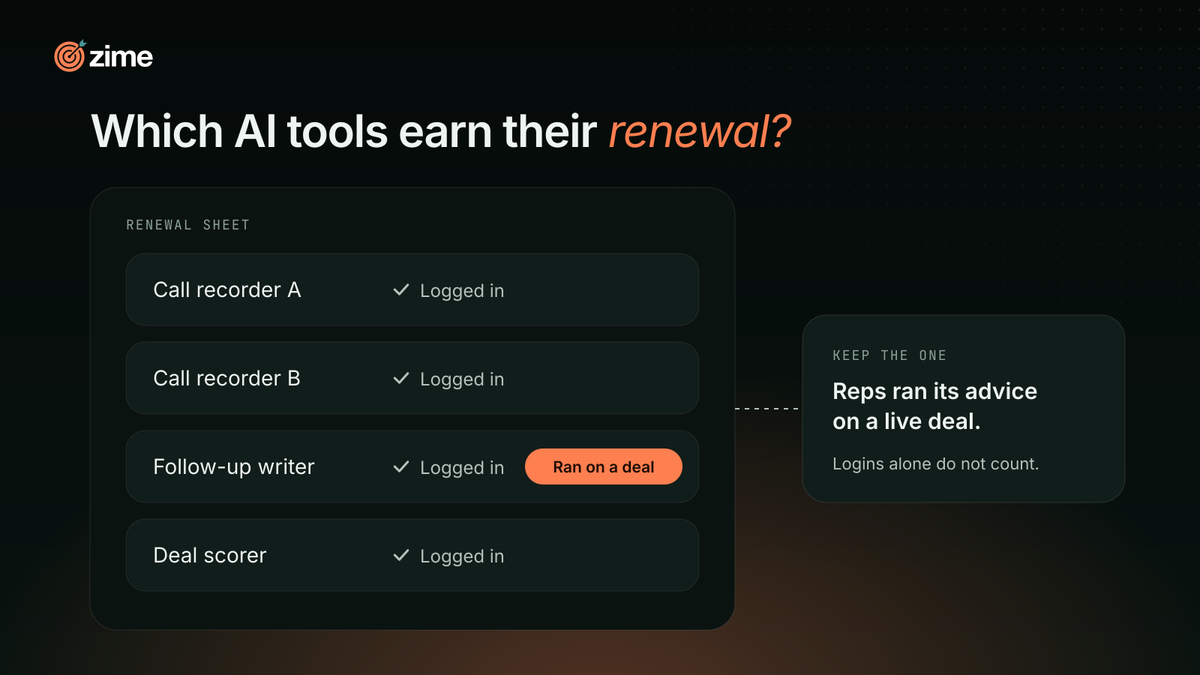
- But a login report cannot show which tool changed how your team sells. A rep can open three tools a day and run none of their advice in front of a buyer. Whether the guidance ran on live deals is the hard part of the audit, and the part a renewal should rest on.
- And most tools in the stack were not built to show it. Each reports what happened on its own calls or its own pipeline. None holds what your best reps would do next in this deal, or what you decided this quarter. So the advice gets read, and the tool cannot say whether it was run.
- That missing piece is what a behavior graph adds. It is a model of how your best reps win, including what never shows up in a transcript, plus your strategy and past deals. It gives each rep the specific move for this deal. Each move a rep runs is counted against the deal it touched.
- So renew on moves run, not seats used. Keep the tool whose guidance reps ran on deals that moved a metric you own, and consolidate the overlap around it. Keep your CRM and call recorder. You will know the guidance ran, because each run ties to a deal and to the strategy behind it.
It is renewal week. Maya, your RevOps lead, sends the sheet on Tuesday night. Eight AI tools, each with an owner, seats and a renewal date. The login column is mostly green.
Three of the tools record calls. The CRM shows win rate flat for two quarters. On Thursday, the CFO asks which ones to cut.
You sponsored this stack, and it does real work. But the sheet only shows who opened each tool. Of these eight, which one changed what your reps do on a live deal?
Three cuts that look right and still miss
Most audits run one of three cuts. Each finds real waste, and each has a tell.
Cut by logins. Drop the seats nobody opens. Across all software, Zylo's 2026 SaaS Management Index found the average organization uses 54% of its SaaS licenses. The tell is the tool every rep opens daily that changes nothing on a call.
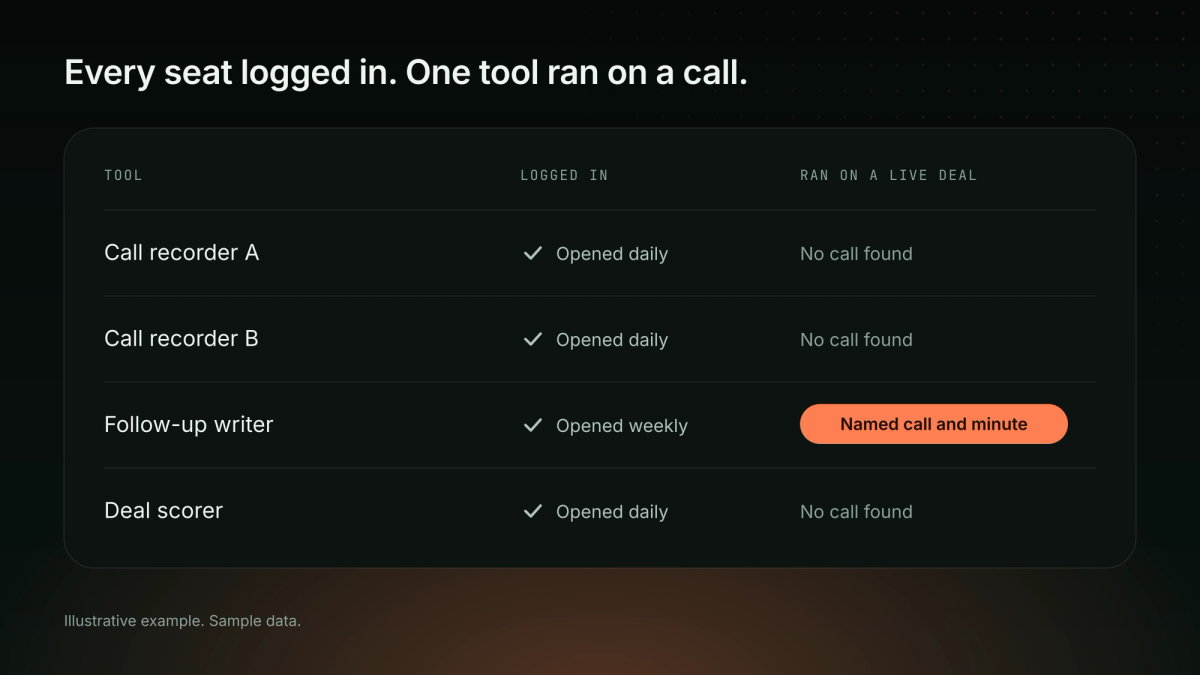
Chitresh Yadav runs sales engineering at Versa Networks: more than 100 SEs across four regions. His team already ran AI for prep notes and follow-ups. It showed him everything except what had changed.
"This is the dashboard I typically see, and it is drowning me."
Chitresh Yadav, VP and Global Head of Sales Engineering, Versa Networks
More visibility was not his problem. Knowing what ran was.
Cut by overlap. Three tools record calls, so keep the cheapest. The tell: two tools can summarize the same call while only one hands the rep a move.
Cut by cost per active user. Divide spend by people who logged in. The tell is a low cost per seat on advice nobody acts on.
All three cuts grade the tool. None grades the deal. In a Gartner survey of 227 chief sales officers, 31% cited difficulty proving the ROI of AI-driven tools as a top challenge for 2026. The test that settles a renewal happens on a call.
Audit the deal, not the tool
Start from deals. Three checks fit in a week, on data you already have.
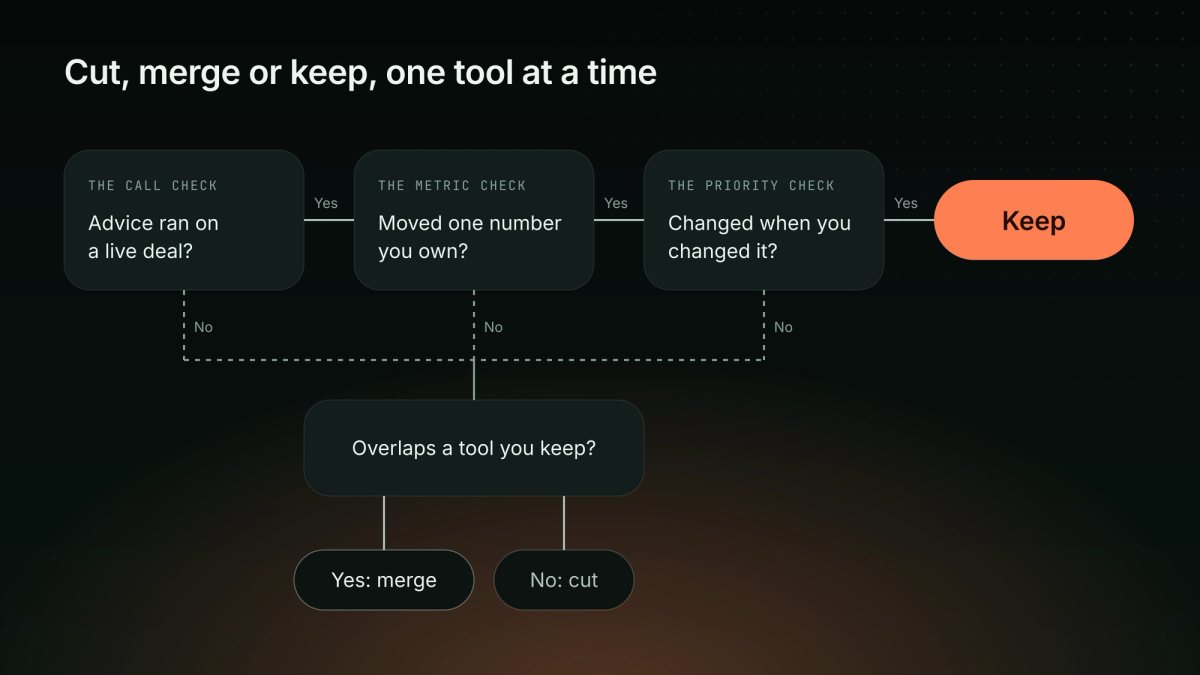
The call check. Pull twenty recent calls from deals that moved a stage. For each tool, ask where a rep used its advice. Pass: someone names the call and the minute. Fail: nobody can.
The metric check. Give each tool one number to move, such as conversion at a stage or hours in pipeline review. Compare reps who ran its advice with reps who did not. Pass: the number differs on deals it touched. Fail: no difference, or no way to split.
The priority check. Tell the field this month's priority is multi-threading into finance. Read each tool's advice the next week. Pass: it changed. Fail: it did not.
Ameeth Dubey at Atomicwork saw an earlier internal build stall here. The tool worked. Reps did not run it.
"This is what we tried to do with ChatGPT. The only problem is adoption."
Ameeth Dubey, Atomicwork
That is what the checks expose. A tool can be used and never run.
The table below turns the checks into a renewal scorecard, and a keep must pass the call, metric and priority checks.
| Check | What you look at | Keep when | Cut or merge when |
|---|---|---|---|
| Seats | Logins per seat | Eligible reps open it weekly | Seats idle for a quarter |
| Overlap | Tools doing the same job | It does the job best | A keeper does it too |
| Call | Twenty recent calls | You can name the call and minute | Nobody can point to one |
| Metric | One number, ran versus did not | It differs on deals touched | No difference |
| Priority | Advice after a priority change | The advice changes | The advice stays the same |
The call check decides most renewals. A tool that fails it but overlaps a keeper becomes a merge. One that fails it and overlaps nothing becomes a cut.
What a keep looks like
Most tools fail the priority check for one reason. They work from what is already in your data: calls, CRM fields, past deals. What your best reps would do next in this deal was never written there. Neither was this quarter's priority.
Conversation intelligence, sales engagement tools and in-house agents recommend next steps too. All of them recommend. The difference is where the recommendation comes from.
A keep needs a source that holds how your best reps win, the strategy you set and your past deals. Zime calls that model the Behavior Graph. Its judgment is elicited from your best people through FDE-run interviews and RLHF, including what never shows up in a transcript. In plain words, Zime's engineers interview your top reps and score each move until those reps would run it. The output is Behaviors: the specific move for this deal, with a winning deal behind it. Programmatic Adoption counts each one a rep runs, by deal and priority.
The table below compares the classes on Maya's sheet, and each does something real. Only one counts moves run against the priority behind them.
| What it does | License and spend tools | Call recording and pipeline analytics | Agents on a frontier model | Zime |
|---|---|---|---|---|
| Shows seats, logins and spend | ✓ | ✓ | Partial | ✓ |
| Captures and summarizes calls | ✗ | ✓ | Partial | ✓ |
| Finds win and loss patterns | ✗ | ✓ | Partial | ✓ |
| Recommends a next step | ✗ | ✓ | ✓ | ✓ |
| Carries best reps' moves and this quarter's priority | ✗ | ✗ | Partial | ✓ |
| Counts moves run per deal, by priority | ✗ | ✗ | ✗ | ✓ |
At Versa Networks, that count was the point. Within three months, 79% of SEs were running the right technical discovery, up from 20%. Brent Bair leads a regional sales team there.
"As I look at my team, the adoption rate has improved."
Brent Bair, Regional Sales Leader, Versa Networks
Adoption he sees on his own team is what a renewal needs. His CRO measured it in his calendar: Versa saw a 50% reduction in pipeline-review and coaching time.
"Zime is a huge win for all stakeholders; saves half of my time on coaching AEs."
Martin Mackay, CRO, Versa Networks
That is a number a CFO can hold a renewal against.
At MyAdvice, checklist adoption rose from 66% to 87%. Licenses went from 12 to 25. Chad Erickson, VP of Sales & Strategy, framed it around volume.
"When the volume increases, we see Zime as a critical part of the equation to allow them to be more efficient."
Chad Erickson, VP of Sales & Strategy, MyAdvice
A tool reps run is one a leader plans growth around.
So consolidate around the keep. Keep your CRM and the call recorder you trust. Merge tools whose only job the keep already does. Zime also fills CRM fields from calls and scores deals in pipeline review, so some line items fold into one. We have not published a savings figure yet; your scorecard will show it.
Next renewal, Maya's sheet has one more column: moves run on live deals, by tool and priority. The CFO asks the same question. You answer it in one line.
When a login audit is enough
With fewer than ten reps, one product, one motion and a strong AI operator, cut by logins and move on. The deal checks earn their week when roles, products and competitors multiply and priorities change every quarter.
Some teams pass the priority check by building the missing piece themselves. If you go that way, put the ops hours it takes on the audit sheet too.
Make day 90 answer the question. Keep the tools and agents you bought. Zime adds the layer that turns your strategy into Behaviors every rep can run, each tied to the strategy that authorized it. Live in 7 days on your own data. Bring one priority from this quarter, and see the Behavior it becomes. Book a demo →
FAQ
How do I audit our sales AI stack for overlapping tools, unused seats and real ROI before renewal?
Pull each tool's seats, logins and overlap first; that finds idle seats. Then check twenty recent calls for each tool's advice, split one metric by reps who ran it, and change one priority to see whose advice follows. Keep what passes and consolidate around it. Zime counts the moves reps run, by deal and priority, from a Behavior Graph: a model of how your best reps win plus your strategy.
How are CROs measuring ROI from AI sales tools?
Most start with time saved and logins, which show activity. A firmer measure ties each tool to one revenue number on deals where reps ran its advice, against deals where they did not. At day 90, show how many eligible reps ran the priority's moves. Zime's benchmark is 80% of eligible reps within 90 days.
If we consolidate, do we have to replace our CRM or call recorder?
No. Keep the record system and the recorder your team trusts. Merge only tools that repeat a job your keep already does, such as summaries or CRM updates. An all-in-one platform or enablement suite earns its seats the same way: by passing the call check.
What happens to the audit when my strategy changes mid-quarter?
Run the priority check again. With Zime, forward-deployed engineers encode the new strategy in your Behavior Graph, the model of your best reps' moves and priorities. The moves change with it, and the count shows whether the new priority ran.
What should I ask any vendor before consolidating onto it?
Can you show which recommendations reps ran, deal by deal? Does your advice change when I change a priority? What happens to my data if I leave? What has consolidation saved customers like us, and where is that published? Zime has no published savings figure yet.