Your annual plan is set. Who drives execution once the AI rollout starts?

- Give each strategy one owner who answers for deals, not rollout. That is how a CRO closes the strategy-execution gap once the AI rollout starts.
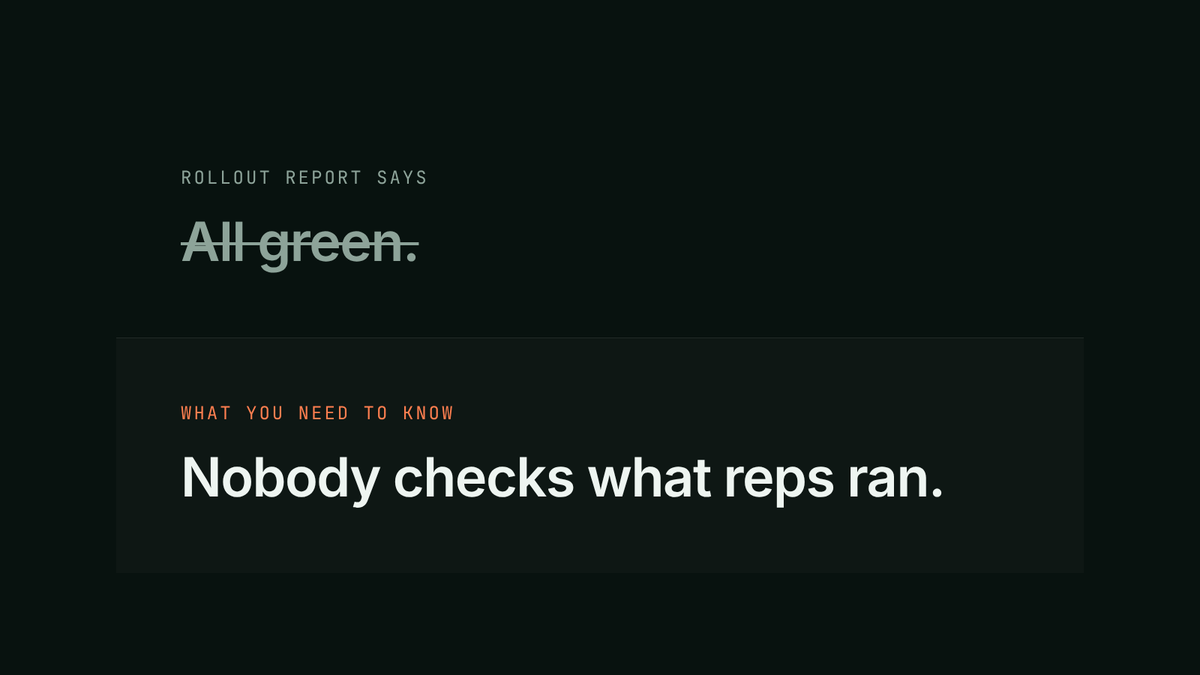
- The gap opens because every owner reports what they shipped. Seats live, courses passed and agents launched all show green, while nobody checks what reps ran with buyers.
- Underneath, nobody broke the strategy into what each role does. So the new AI has nothing specific to deliver, and the gap stays invisible in every report.
- So the owner writes those behaviors down first, then reads two numbers. Behaviors are what a rep does at a given moment, taken from the reps who win. Each week: how often reps ran them, and whether those deals moved.
- By week ten, each owner keeps, rewrites or coaches. Zime runs that read: it delivers the behaviors before each call and counts who ran them.
It is the second Monday of January. As CRO, you signed a plan in December with three strategies.
Attach the new security add-on. Get a second stakeholder on every enterprise deal. Register every partner deal. The AI rollout started last week.
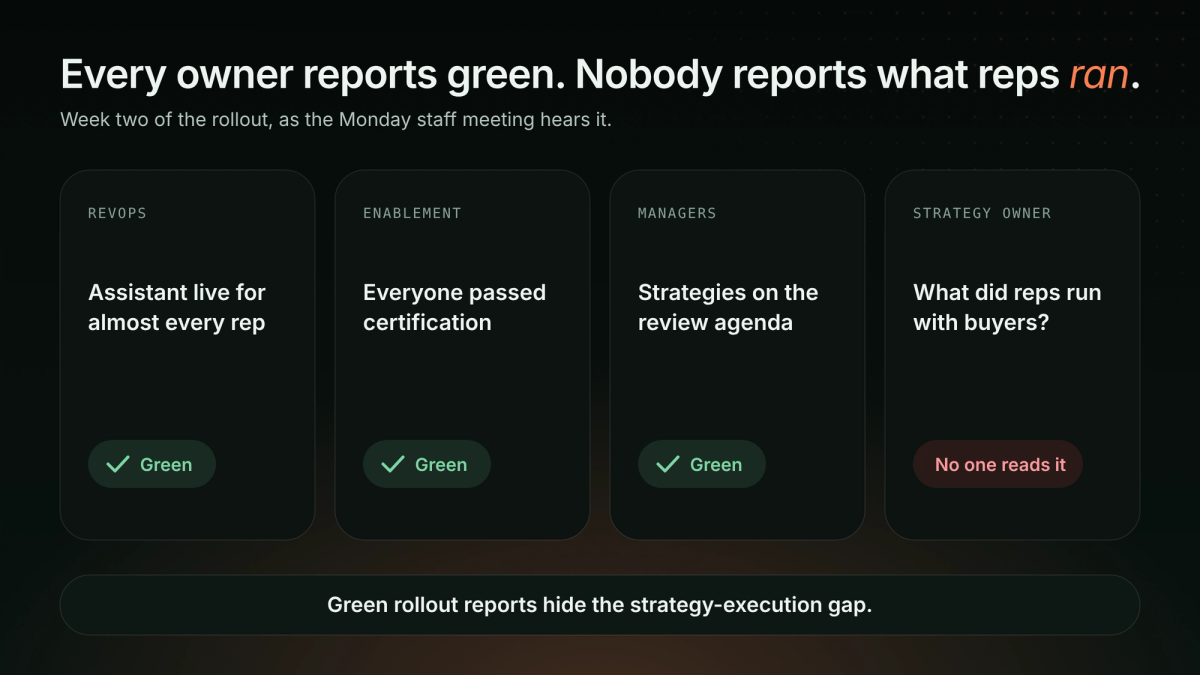
At staff, RevOps says almost every rep has the new assistant. Enablement says everyone passed certification. Managers have the strategies on the review agenda. Every update is green.
Then you ask what the board will ask in April. Which of these is moving deals? Nobody in the room owns that answer. So who drives execution from here?
Give each strategy one owner, the sales leader whose number it moves. That owner answers for how often reps ran what the strategy asks on live calls, and whether those deals moved. That is how you close the strategy-execution gap.
RevOps runs the tools, enablement the content, managers the coaching. The owner reads it all in a weekly review taken from the calls. Versa Networks ran its technical discovery strategy this way and saw a 12% increase in technical wins. Zime runs this weekly read for revenue leaders from your recorded calls.
Why the strategy-execution gap opens after rollout
Every owner in that meeting did their job. Planning tools hold the targets, and enablement platforms and training partners hold the content. Call recorders and in-house agents on Claude or ChatGPT recommend next steps. None was asked to own whether reps run the plan.
In Spencer Stuart's survey of nearly 100 B2B CROs, the most common leaders of corporate AI efforts were the CEO (25%) and the CTO (22%). So the rollout often reports to someone who does not own the number.
The root cause sits upstream of every tool. Nobody broke each strategy into what each role does on a call: what the AE asks when the add-on comes up, what the SE shows.
Without that, each owner measures what they shipped. Seats live. Courses passed. Agents launched.
That is the strategy-execution gap: the plan is clear, and nobody can see whether reps run it.
Chitresh Yadav runs more than 100 SEs across four regions at Versa Networks. His team already had dashboards and in-house agents:
"This is the dashboard I typically see, and it is drowning me. When I go to my org level, I'm drowning because it shows everything."
Chitresh Yadav, VP and Global Head of Sales Engineering, Versa Networks
A dashboard that shows everything still cannot say which SEs ran the discovery his strategy needed. Zime starts there: its team interviews the reps who win, including what never shows up in a transcript.
Drive execution in five steps
1. Name one owner per strategy, not per tool. The landmine is default ownership: whoever deployed the tool reports on execution, and reports seats. The channel leader owns partner registration. RevOps owns the tools and data.
In Zime, each strategy is set up with its owner in CRO Initiatives.
2. Write down the behaviors before the AI ships. The landmine is an assistant with nothing specific to run. A behavior is what a rep does at one moment in a deal: trigger, action, reason and role. Interview the three to five reps who already win with it: when does it come up, what do you say, why, and what does the buyer do next?
Zime's team runs these interviews and holds the answers in the Behavior Graph.
3. Roll out one strategy to one team, then stagger. The landmine is everything to everyone in week one, which loses the comparison. Give the strategy to a random half of the team first, the rest four weeks later. With six reps, three go first.
Ranjan R Reddy's Bureau sells identity decisioning to fintechs and banks; its product updates used to sit in Jira, Confluence and spreadsheets:
"We improved our ARR by 10% with Zime seamlessly getting our product releases to our sales team in the form of just-in-time Actions."
Ranjan R Reddy, Founder & CEO, Bureau
The release worked because it arrived as something to do on the next call. In Zime, behaviors reach reps in a prep note before each call, in Slack, Teams or Claude.
4. Make managers coaches, not inspectors. The landmine is a rollout that feels like surveillance. The rep sees the behavior to run, never a score, and the manager coaches the gap in the 1:1.
In Zime, reps don't see a scorecard; they get the exact behaviors to play. The leaderboard is what their managers see.
5. Review weekly on outcomes, not capabilities shipped. The landmine is counting what shipped.
Danielle Dacey runs sales support and business administration at SonicWall, which sells security through partners. Her team built Claude skills that approve discounts and deal registrations. Asked whether that saves cost or drives revenue, she said:
"I would say for my team at this state, it's probably more of a cost savings. But I think... with some of the other skills we're building out for frontline sales. Those are kind of like our revenue moving type of skills."
Danielle Dacey, Senior Sales Manager, Sales Support & Business Administration, SonicWall
She also keeps SonicWall's adoption tracker:
"they might have their calendar connected, but if they haven't actually recorded a call in three months, we'd wanna give them the boot"
Danielle Dacey, SonicWall
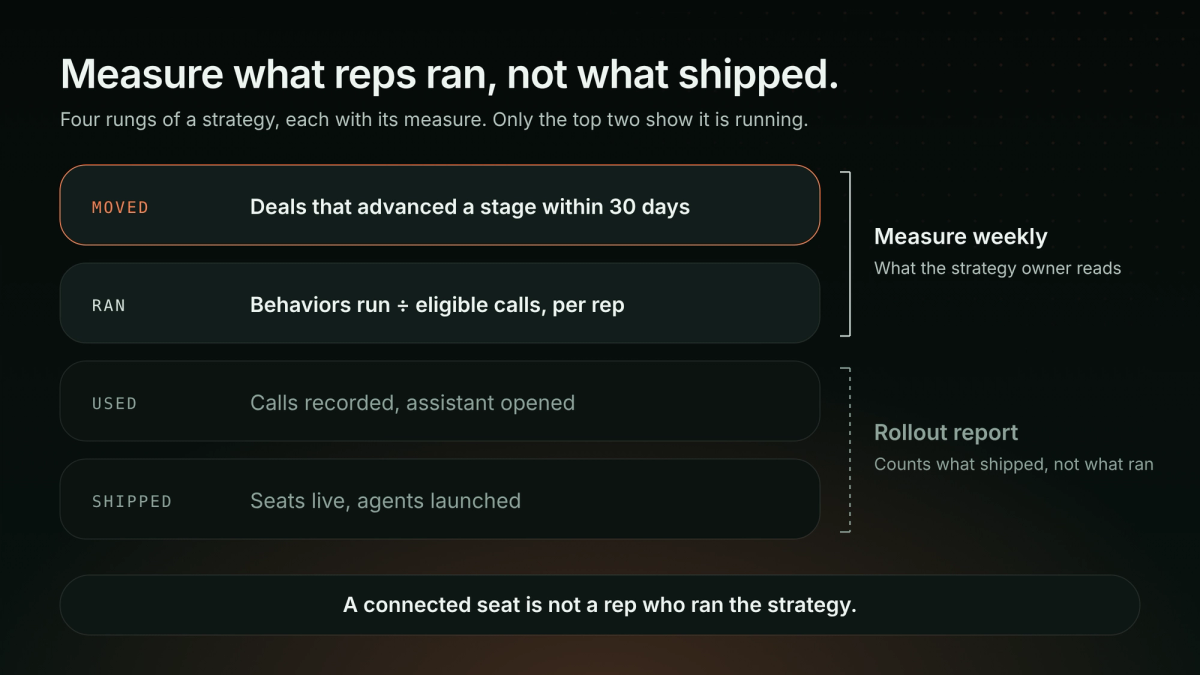
A skill that saves time is not a skill that wins deals. A connected seat is not a rep who ran the strategy. So the owner reads four rungs: shipped, used, ran, moved. Only the last two go in the review.
When strategy changes mid-year, rewrite the behaviors that week. Programmatic Adoption counts which behaviors ran on every eligible call, per rep, and Zime's engineers update them when strategy changes.
Check that execution is working
You can run this without new software. Pick one strategy and pull ten recent call transcripts per rep where its moment came up. Mark each: did the rep run the behavior? A mention is not a run; count it when the rep asked and the buyer answered.
Thirty days later, check whether each deal moved a stage.
Compare each rep's own calls, ran against skipped, so the rep is the same on both sides. Under three calls on a side is direction only. On a small team, read everyone monthly. What reps ran is the early signal; stage movement is the result, a month or two later.
The table below runs it on sample numbers for the second-stakeholder strategy, with the team staggered in halves. Illustrative example. Sample data.
| Group | Eligible calls | Ran the behavior | Advanced in 30 days when ran | Advanced in 30 days when skipped | Read |
|---|---|---|---|---|---|
| First half (live week 1) | 60 | 39 (65%) | 18 of 39 (46%) | 5 of 21 (24%) | Runs, and those deals move |
| Second half (live week 5) | 58 | 9 (16%) | 4 of 9 (44%) | 12 of 49 (24%) | Not live yet: the baseline |
Where the strategy is live, deals where reps ran it advance about twice as often. Both halves advance 24% of the time when it is skipped, so the gap is not the team. Roll it out to the second half.
Zime runs this read for every strategy.
How Zime drives execution on every call
Zime gets reps to run your CRO strategy on live calls, and shows each strategy owner who ran it and which deals moved. Could your RevOps engineer and a week of interviews do this for one strategy? Yes.
The standing job is different: keeping behaviors current as strategy changes, and counting them on every eligible call, all year. Your strategy runs on 1,000+ behaviors. Nobody has written them down, tested them or kept them current. Keep your planning tool, your recorder and the agents you built.
The table below maps each step to Zime.
| Step | What Zime does | Who acts |
|---|---|---|
| One owner per strategy | Sets up each strategy with its owner | The CRO |
| Behaviors first | Interviews the reps who win; Behavior Graph | Best reps |
| Stagger the rollout | Prep note before each call | Reps |
| Coach, not inspect | Managers see who ran it; reps see behaviors | Managers |
| Weekly outcome review | Counts runs per eligible call and deals moved | The strategy owner |
What week ten looks like
Same staff meeting, week ten. RevOps, enablement and managers report in one line each. Then each strategy owner speaks for two minutes.
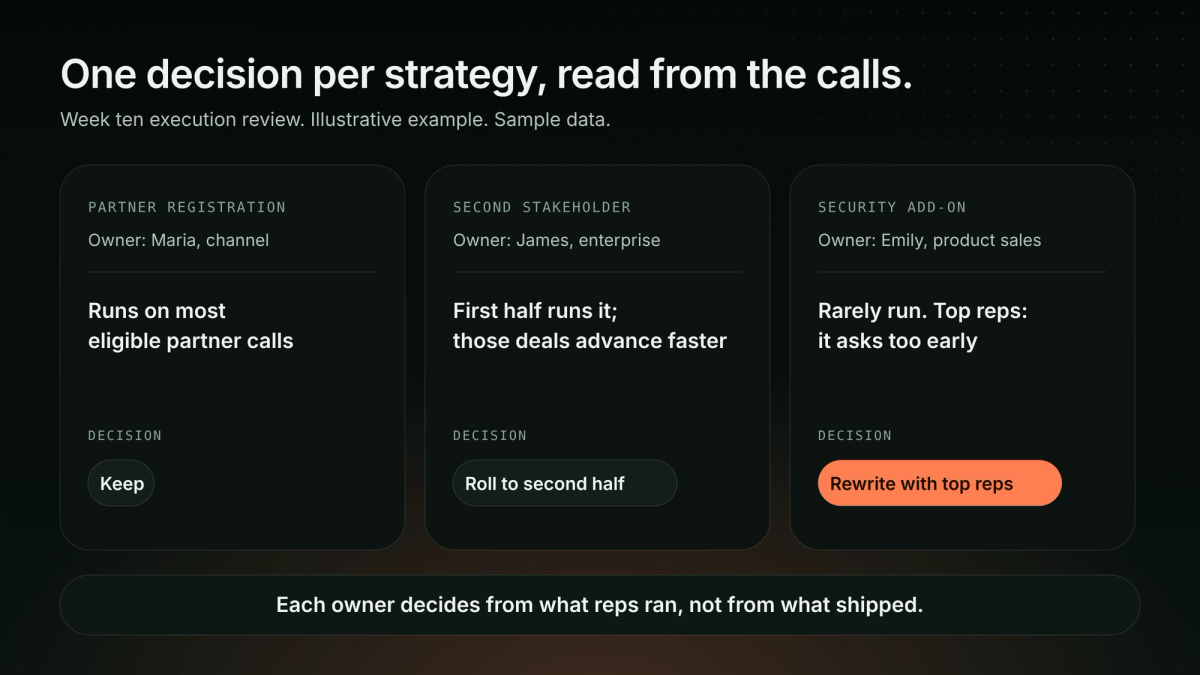
The channel leader says partner registration runs on most eligible calls. The enterprise leader says second-stakeholder deals advance faster in the first half, so the second half went live. The add-on owner says reps rarely run it. Two top reps told her it asks too early, so she rewrote it with them.
You leave with one decision per strategy: keep, rewrite or coach.
Martin Mackay is CRO of Versa Networks, which sells SASE in deals from $100K to $3M:
"Zime helped our sales team qualify deals more accurately and move them through the pipeline."
Martin Mackay, CRO, Versa Networks
Qualified deals that move are the outcome the weekly read tracks. The table below shows what four companies ran, and what moved.
| Company | What reps ran on calls | Published result | Source |
|---|---|---|---|
| Versa Networks | Technical discovery by SEs | 12% increase in technical wins | Versa success story |
| Bureau | Discovery and product releases | 30% increase in deal conversions | Bureau success story |
| SonicWall | A clear ask at the end of every call | 30-40% increase in reps making clear end-of-call asks | SonicWall success story |
| MyAdvice | The call checklist | Checklist adoption from 66% to 87% | MyAdvice success story |
No customer has published the time from rollout to first deal moved. The weekly read tells you yours. If your strategies are not yet written as outcomes, start with how CROs should plan 2027. To see the read on your own calls, book a demo.
FAQ
How do I close the gap between our sales strategy and what reps actually do in deals?
Give each strategy one owner, write down what each role does on the call before the AI ships, and roll out to half the team first. Then review weekly what reps ran and whether those deals moved.
What is the strategy-execution gap in sales?
It is the distance between the strategy leaders set and what reps do with buyers. In Supered's 2026 survey of 198 sales leaders, 89% reported a defined sales process and 36% said reps follow it consistently.
Should RevOps own execution of the sales plan?
RevOps should own the tools, data and report. The outcome belongs to the leader whose number the strategy moves.
How soon can I show the board results?
What reps ran shows in weeks. Zime's own benchmark is 80% of eligible reps within 90 days.
What does Zime do for CROs?
Zime turns each strategy into behaviors (what a rep does at a given moment, taken from the reps who win), delivers them and counts who ran them. Behavioral AI for Sales Execution: your strategy, running in every rep's workflow.