How should CROs plan 2027 when AI is changing how sales teams sell?
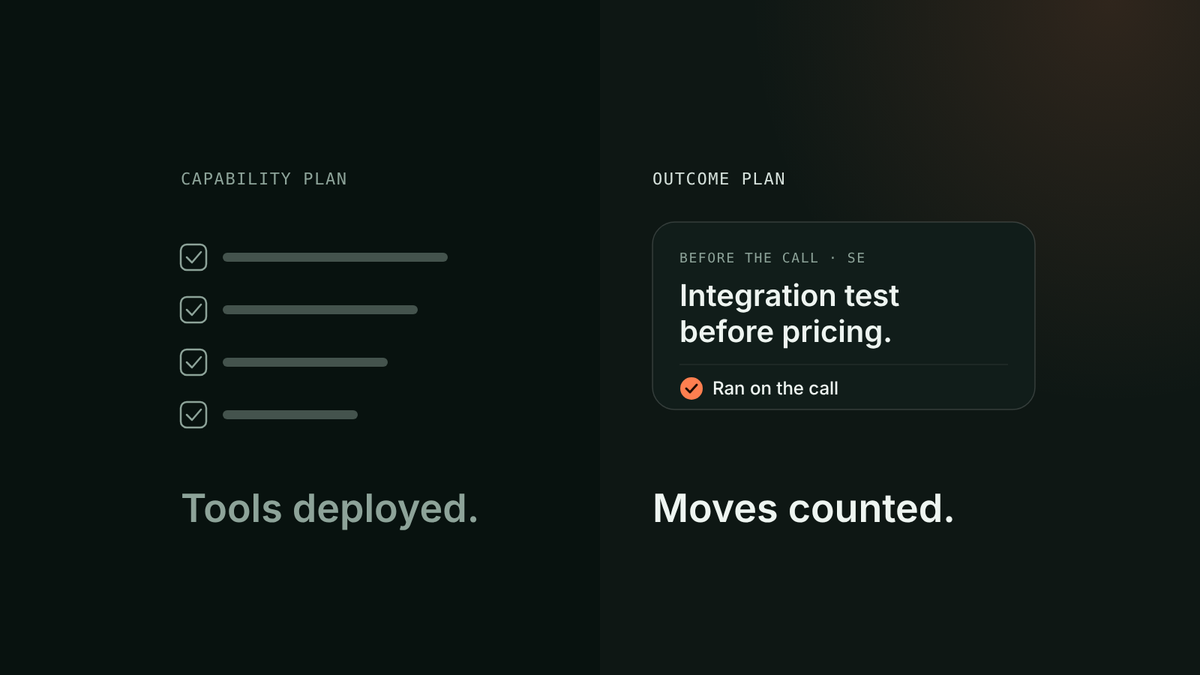

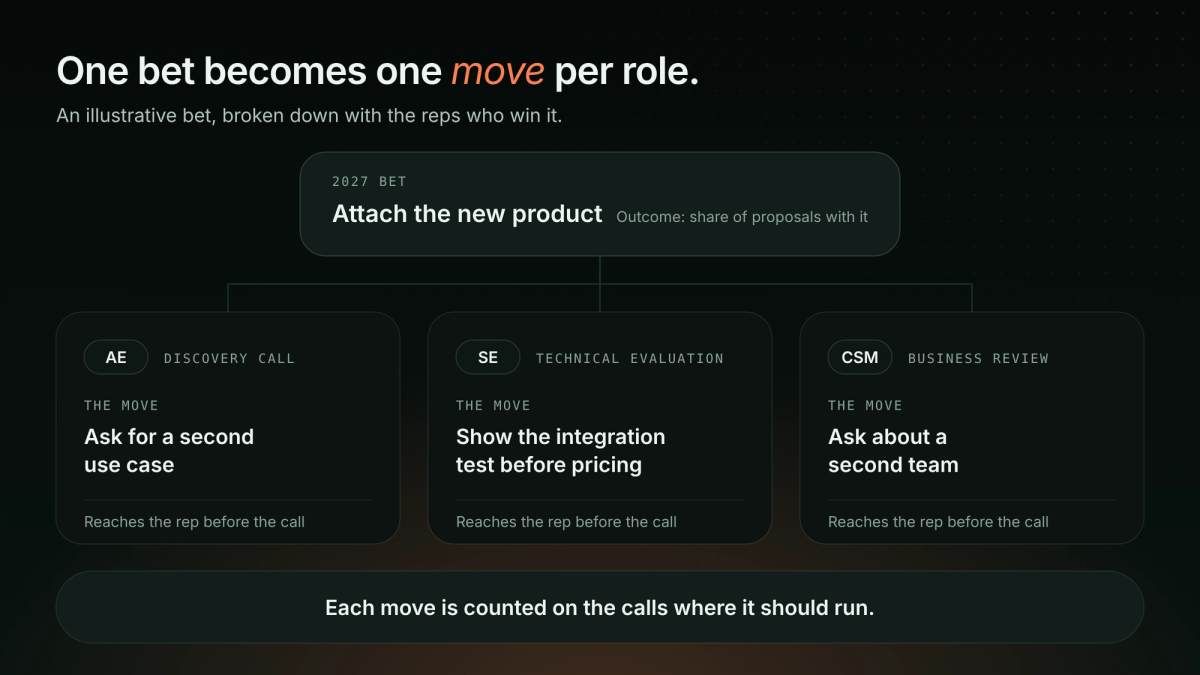
- Plan each 2027 bet as an outcome and the moves that reach it. Name the result, the moves each role runs, and where each move meets the rep before the call.
- The hard part is getting reps to run your strategy on live deals. A usage report shows logins and hours saved. It can't show which tool changed what reps do.
- Keep this year's AI work, because it carries the moves. Prep notes, call summaries and agents are how a move reaches the rep in time.
- Count the moves that ran on calls. By March you will know which bets ran, which deals moved, and which bet needs a new move.
- Zime runs that plan as behaviors every rep can run. Behaviors are the specific moves your best reps make, delivered before the call and counted each time they run.
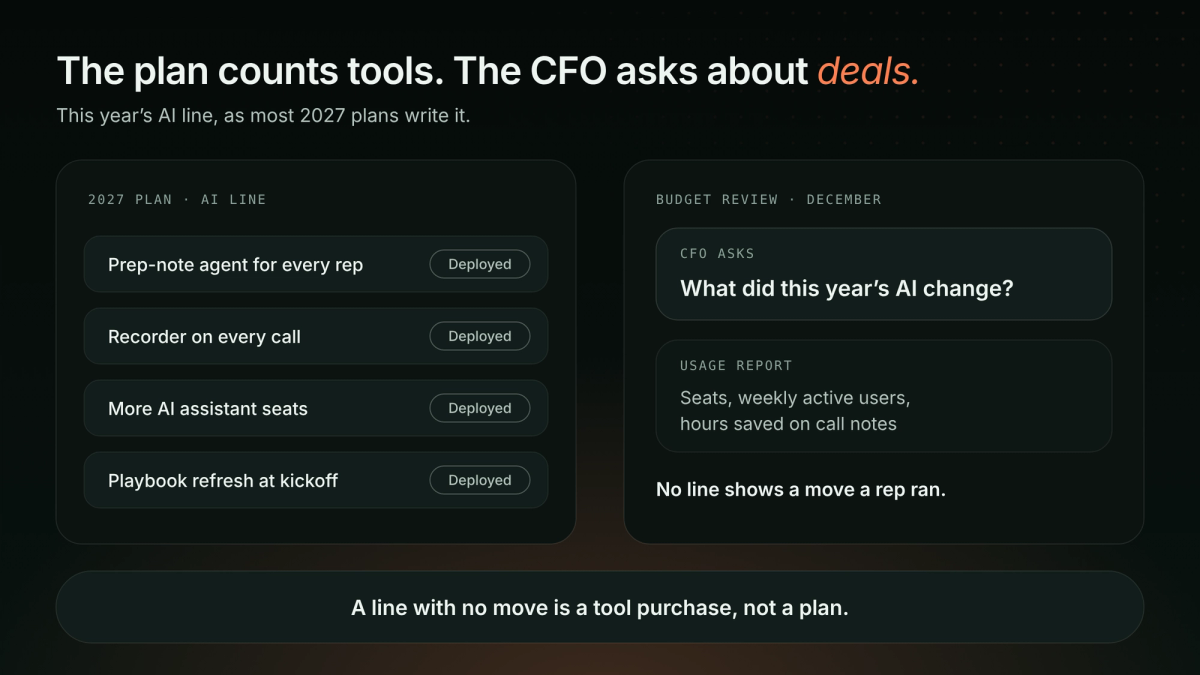
It is the second week of December. Your CFO is reading the third draft of your 2027 plan, and the AI line has grown again. In the budget review, she stops on it. What did this year's AI change?
RevOps sends the usage report: seats, weekly active users, hours saved. Beside it, win rate has barely moved. The report shows the tools were used. It can not show whether any of them changed what a rep did on a live deal.
So which AI changed how your reps sell? And how do you plan 2027 so you can tell?
Here is how. Plan each bet as an outcome first. Then plan the moves each role runs on live deals to reach it, and count how often they ran. The tools only carry a move to the rep.
Zime runs this method for revenue leaders.
At Versa Networks, the plan reached SEs as the moves they run in technical evaluations. Versa reports a 12% increase in technical wins.
Why this year's AI line is hard to defend
The work you sponsored is real. Reps walk into calls with prep notes. Managers stop writing summaries.
Your planning tool sets quotas, and your methodology gives reps one language. Your call recorder and in-house agents both recommend next steps.
The trouble is what they produced. In BCG's survey of 398 revenue leaders, 90% report meaningful use of AI in sales and revenue workflows. Only 13% report improved win rate. In a Gartner survey of 227 chief sales officers, 31% cited difficulty proving AI's ROI as a top challenge.
The gap sits in the plan itself. Most plans list capabilities: an agent for every rep, a recorder on every call. None says what a rep does differently on Tuesday's call.
Your strategy says "attach the new product." Nobody broke it into the AE's discovery question or the SE's test before pricing. The reps who win know those moves. Nobody wrote them down, so no tool could deliver them.
Mickey Singh leads sales enablement at Versa Networks, where more than 200 reps and 100 SEs sell in four regions. Reviewing a methodology rollout, he named the gap:
"...any methodology they look very attractive? But in reality, how much of them are executed in the real customer calls?"
Mickey Singh, Global Head, Sales Enablement, Versa Networks
A capability plan cannot answer him. A plan built on moves can. Zime holds those moves.
Plan each bet in five steps
1. Name the outcome. Write each bet as a number deals move. "Attach the new product" becomes the share of proposals that include it. Keep three to five bets.
In Zime, each bet becomes your strategy for the quarter. It is tied to the deals it should move.
2. Break each bet into moves, role by role. Sit with the three reps in each role who win that bet most. Ask about their last win: what did you do on the first call that others skip, and what would you never do?
Write each answer as a trigger and what the rep does. Martin Mackay, Versa's CRO, framed this work as two questions on a win-loss call:
"...one what do the most effective reps do in terms of moving a deal forward and then eventually closing it? And the second is why do we win versus lose?"
Martin Mackay, CRO, Versa Networks
His first question gives you the move. His second gives you the outcome to check it against, as a win-loss analysis beyond CRM loss reasons does.
Zime's team runs these interviews for you. They capture what never shows up in a transcript. The answers go into the Behavior Graph as behaviors: the move for this role and deal, with the winning deal behind it.
3. Deliver each move in the flow of work. Force Management's 2027 CRO planning guide warns that most of what planning communicates is forgotten within a quarter. So put each move where the rep already works: the brief before the call, the team channel.
This is where your AI line earns its place. Judge each tool by one test: does it put the move in front of the rep? Zime sends each behavior in a prep note before the call. A live prompt follows during it.
4. Count the calls where each move ran. For each move, count eligible calls and calls where it ran. Read transcripts, because a CRM field holds only what a rep typed. Transcripts miss off-call work, so a low count is a question.
Compare each rep with themselves: deals where the move ran against deals where it did not. The run rate shows within three to six weeks. Stage movement follows within the quarter. The full counting method has its own post.
Zime's Programmatic Adoption runs this count on every call.
Kenny Cao heads go-to-market strategy and operations at Skan AI. Looking at a new value proposition, he split training from doing:
"I want to understand how the team is delivering against the deck and against the new value proposition, right? It is more of an enablement understanding versus whether they've done it."
Kenny Cao, Senior Director, Head of Go-To-Market Strategy and Operations, Skan AI
Completion says the team was enabled. The run count says they did it.
5. Re-plan each quarter. Strategy moves mid-year, so review the moves quarterly. Keep moves that run and move deals, and rewrite moves that move nothing. Coach moves that never run.
When strategy changes, Zime's engineers update the behaviors.
Check that the plan ran
Try it before you buy anything. Take one bet and write five moves with three winning reps per role. Pull ten recent calls per rep and mark each move ran or not. On a small team, do one role and twenty calls, and read it as direction.
For a cleaner read, give the moves to half your teams in January and the rest in February. Then compare stage movement inside each rep's own deals. Zime runs this check on every call. Nobody pulls calls by hand.
Bureau sells identity decisioning to banks and fintechs, across several products. Kapil Bhagat ran its sales strategy and saw what a visible miss did:
"So this monitoring led to execution ... Having a dashboard where non adherence is called out improves execution."
Kapil Bhagat, AVP, Sales Strategy, Bureau
Seeing which move did not run turned the plan into a habit.
The table below runs the check on one bet with illustrative sample numbers. Two moves work, and the CSM move is not running yet.
| Role | Move | Ran / eligible calls | Moved a stage: ran | Moved a stage: not ran | Verdict |
|---|---|---|---|---|---|
| AE | Ask for a second use case | 26 / 40 | 14 of 26 | 4 of 14 | Keep |
| SE | Integration test before pricing | 21 / 30 | 12 of 21 | 3 of 9 | Keep |
| CSM | Ask about a second team at review | 6 / 20 | 2 of 6 | 4 of 14 | Coach first |
The CSM move ran on too few calls to judge, so coach it first. With fewer than three deals on either side for a rep, read the gap as direction only.
How Zime runs the plan in every deal
You could run the interviews once yourself. The standing job is keeping them current. Your strategy runs on 1,000+ behaviors. Nobody has written them down, tested them or kept them current.
Reps don't see a scorecard. They get the exact behaviors to play and win deals. The leaderboard is what managers see, and they use it to coach.
The table below maps each step to what Zime does and who acts.
| Step | What Zime does | Who acts |
|---|---|---|
| Name the outcome | Ties each bet to the deals it should move | CRO |
| Break into moves | Interviews winning reps, encodes behaviors | Zime and your best reps |
| Deliver | Prep note before the call, live prompt during it | Reps |
| Count runs | Behaviors run per eligible rep, by deal and bet | Managers coach |
| Re-plan | Updates behaviors when strategy changes | CRO approves |
What March looks like
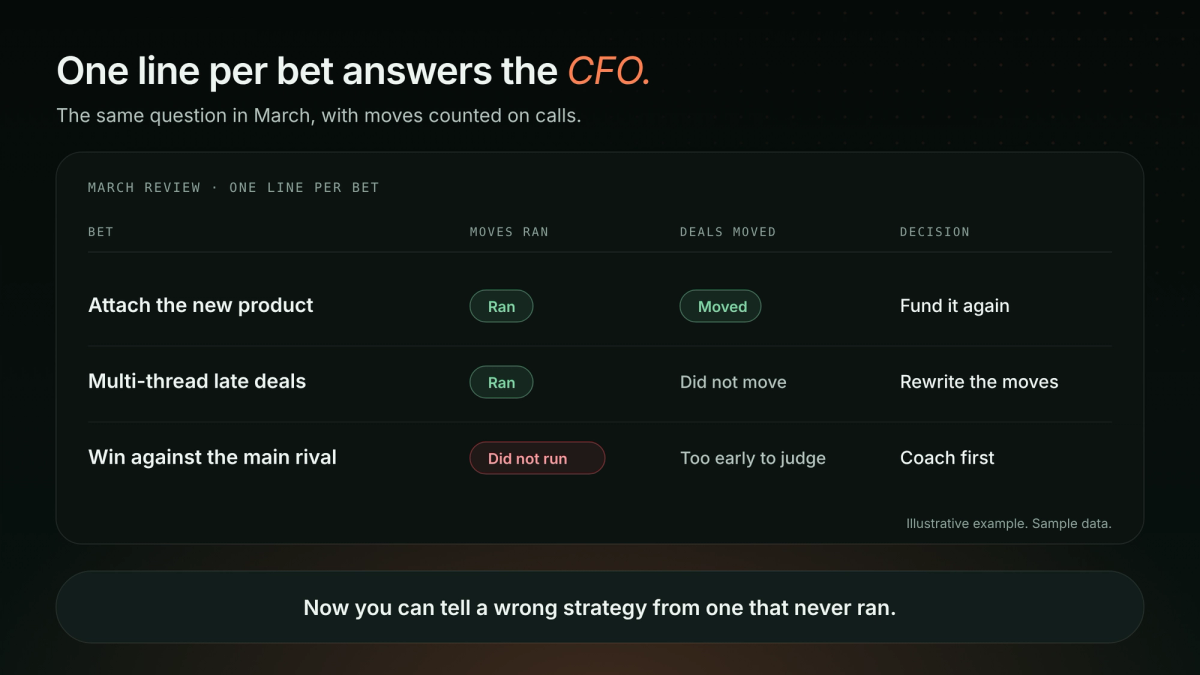
In March, the CFO asks the same question. This time each bet has one line in Zime: its moves, how often reps ran them, and which deals moved.
One bet ran and moved deals, so it gets more budget. One never ran, so managers coach it before anyone judges the strategy.
Early on, Kapil Bhagat had no data to take back to Bureau's reps. Then the moves became a number:
"I did not have the data to present to go back to my team ... But if this is percentage then improvement is possible."
Kapil Bhagat, AVP, Sales Strategy, Bureau
A percentage gives a team something to improve.
The table below lists what three customers measured after turning strategy into moves, each counted in deals or behaviors.
| Company | What it measured | Published result |
|---|---|---|
| Versa Networks | Technical wins | 12% increase in technical wins |
| Bureau | Deal conversions | 30% increase in deal conversions |
| SonicWall | Clear end-of-call asks | 30-40% increase in reps making clear end-of-call asks |
At SonicWall, the result is the move itself, counted on calls.
Now the board's question has an answer: was the strategy wrong, or never executed? Keep your tools. Plan the moves, and count them.
Bring one 2027 bet. See it run. Keep the tools and agents you bought. Zime turns one bet from your plan into behaviors your reps run before the call, and counts each run. Live in 7 days on your own data. Book a demo →
FAQ
How should a CRO plan next year's revenue strategy when AI is changing how the sales team works?
Plan each bet as an outcome, then the moves each role runs on live deals to reach it, then a count of how often they ran. AI tools only carry the move to the rep. Re-plan every quarter. Zime runs this method: it turns your strategy and your best reps' moves into behaviors, and counts each one reps run.
How are CROs measuring ROI from AI sales tools?
Most count logins and hours saved, which only show use. A firmer measure ties each tool to a move, then compares deals where it ran against deals where it did not, rep by rep. Zime's benchmark is 80% of eligible reps within 90 days, counted as behaviors run.
Will reps feel policed if we count runs?
No. Reps get the exact behaviors to play and win deals, never a scorecard. Only managers see the leaderboard, and they use it to coach the skipped move.
What happens to the plan when strategy changes mid-year?
Change the bet, then its moves. Zime's forward-deployed engineers encode the new strategy, and the behaviors reps get change with it.
What does Zime do for CROs planning 2027?
Zime is Behavioral AI for Sales Execution: your strategy, running in every rep's workflow. It turns each bet into behaviors, the specific moves your best reps make, delivers them before the call and counts each run. It is live in 7 days.