Clari forecasts the number. What helps reps hit it?
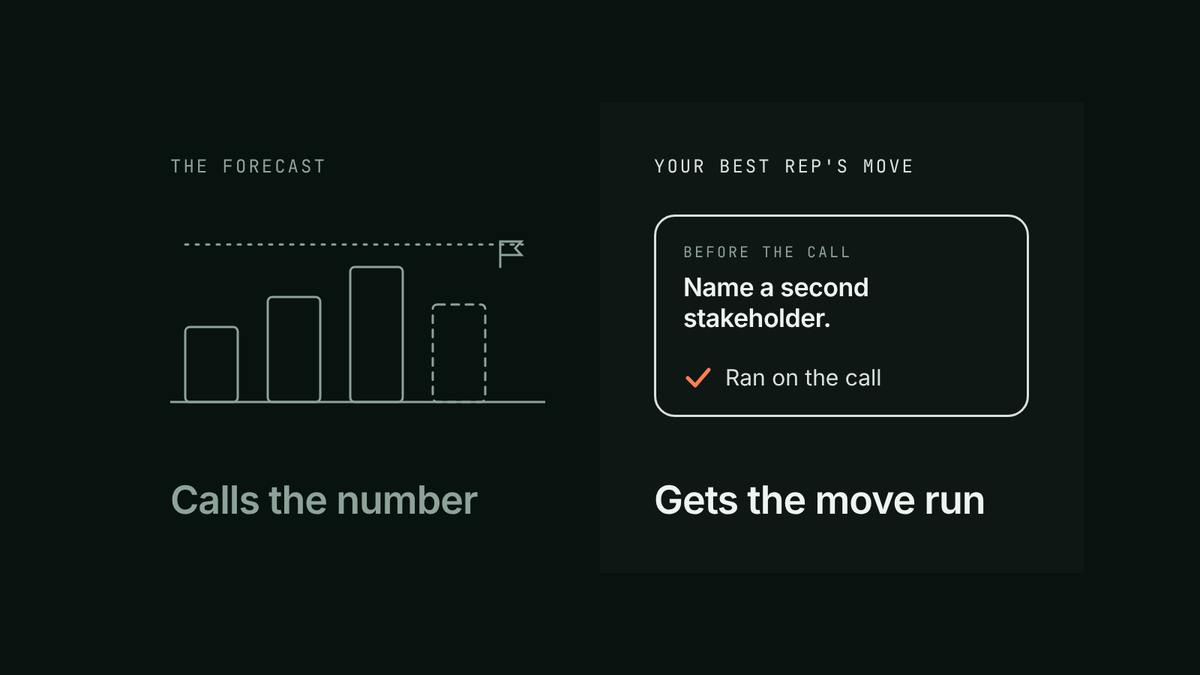

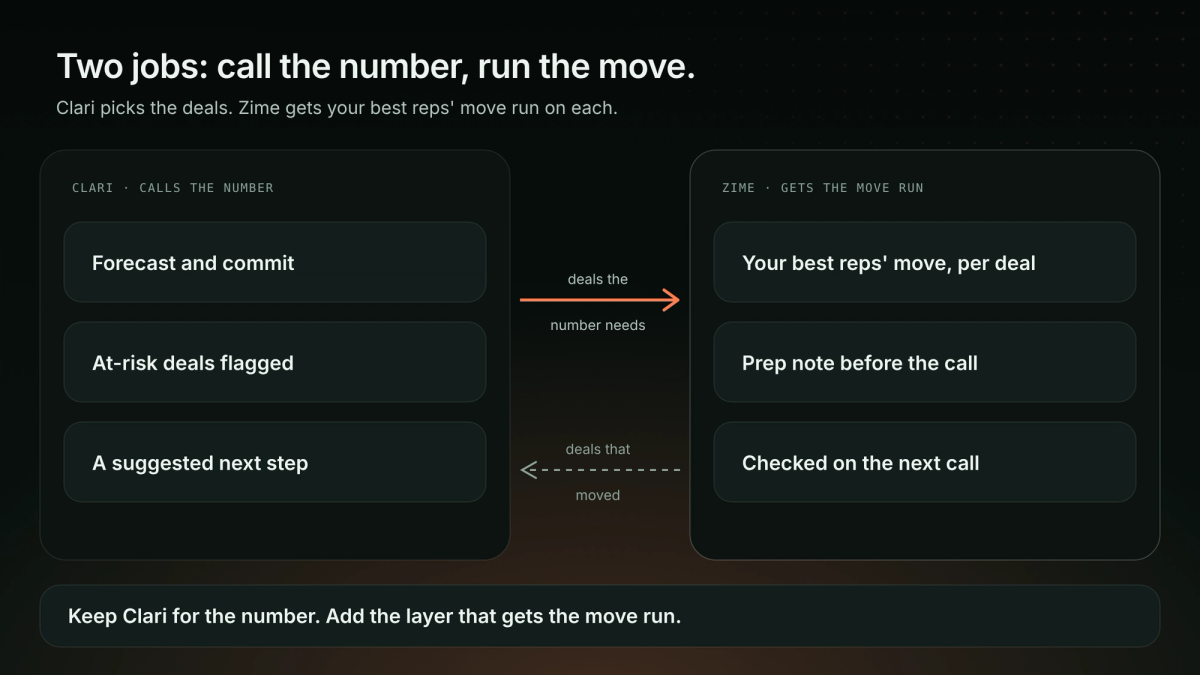
- Clari calls the number. Your best reps' moves hit it. Keep Clari for the forecast and the at-risk list. What saves a slipping deal is the move your top sellers run in that spot.
- The hard part is getting every rep to run that move. Clari can flag the deal and suggest a next step. It can't tell you the rep ran the move that wins it.
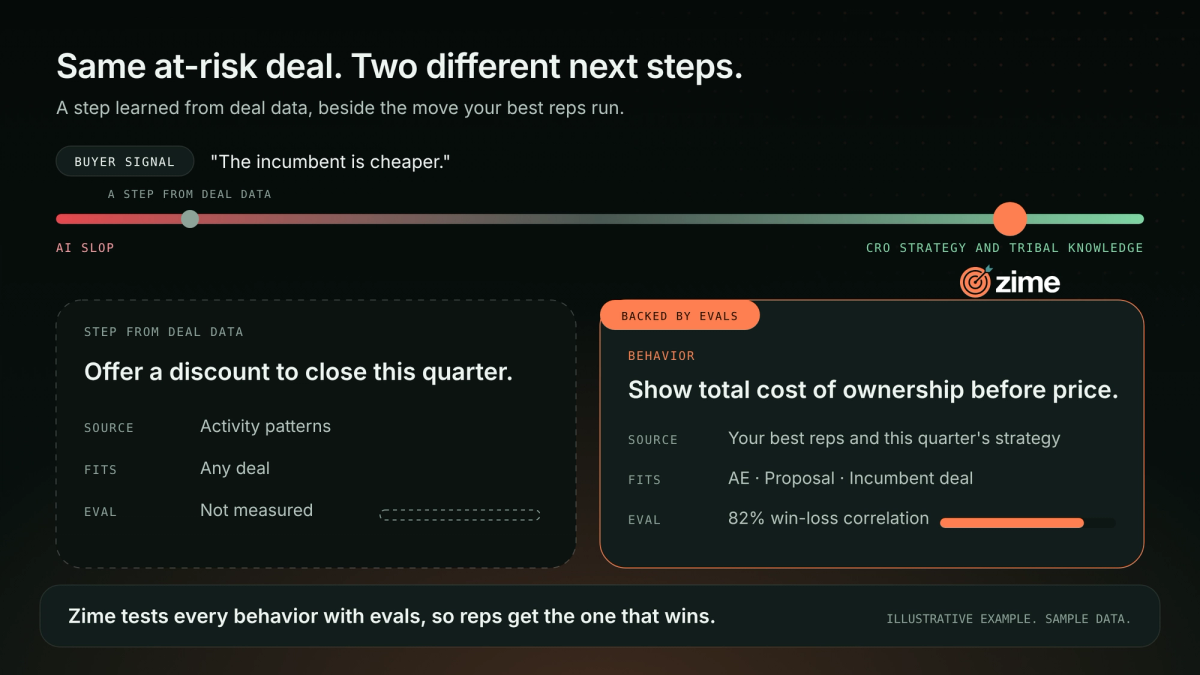
- That move was never written down to be found. It lives in your top reps' heads and this quarter's strategy, not in activity data. Tools that learn from data suggest what correlated.
- Zime turns that tribal knowledge into behaviors every rep runs. A behavior is the exact move for this role, deal stage and buyer, taught by your best people, including what never shows up in a transcript.
- So you check the call, not the dashboard. Zime shows who ran each behavior and whether the buyer moved. Versa got 79% of SEs running the right technical discovery within three months, up from 20%.
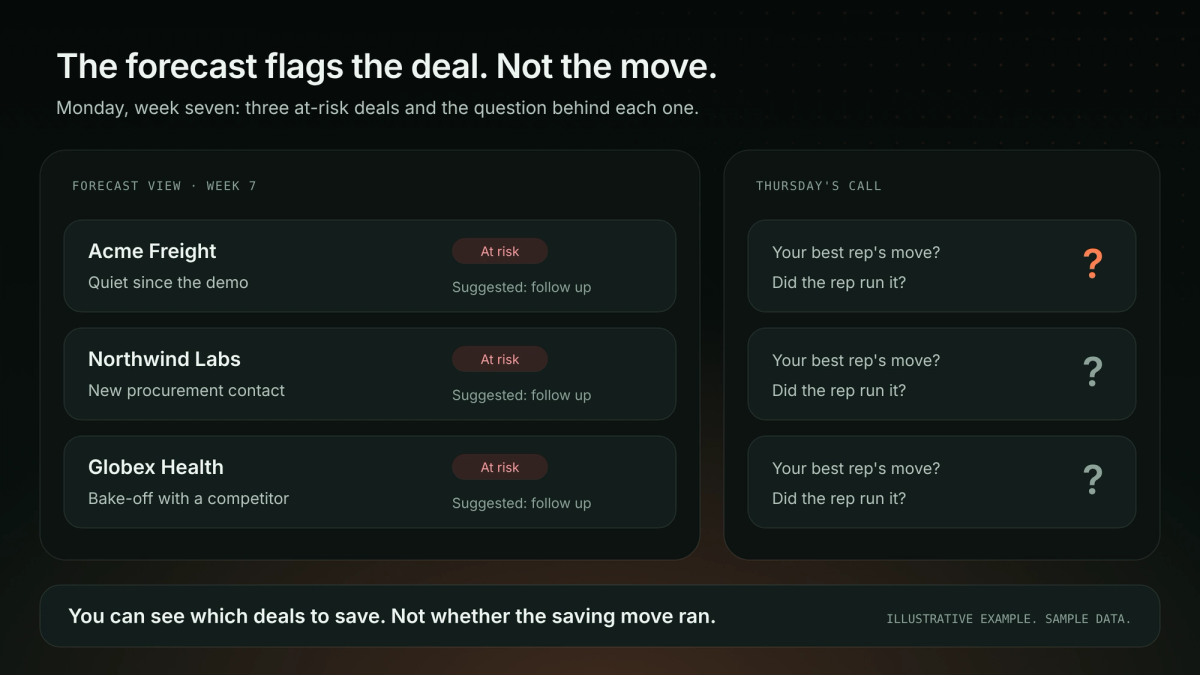
It is Monday of week seven. As CRO, you open Clari before the commit call. The forecast sits short of the number. Three late-stage deals carry a risk flag. One went quiet after the demo. One has a new procurement contact. One is in a bake-off with your biggest competitor.
Your managers say their reps are on it. Each deal even shows a suggested next step. What you can't see is the move each rep will run on Thursday, and whether your best reps would run it.
So the number is not the question. What gets those three deals moving is, and how you'd know.
Here is how. Keep Clari for the number. Write down the move your best reps run in each situation. Get it to every rep before the call. Then check on the next call that the rep ran it and the buyer moved. That is how Versa Networks got 79% of SEs running the right technical discovery within three months, up from 20% at the start.
Zime runs those steps beside your forecast. Behavioral AI for Sales Execution: your strategy, running in every rep's workflow.
The forecast flags the deal. Then what?
Clari is built to call the number, and it does that well. Its AI forecast reads historical deal data and live rep activity. Since its merger closed on 3 December 2025, Clari sells as Salesloft, with Clari Forecast keeping the name (Cirrus Insight). Salesloft says risks and gaps now "automatically trigger next best actions in the seller workflow" (Salesloft).
That work matters: in a 2020 survey, Gartner found only 45% of sales leaders and sellers had high confidence in their organization's forecasting accuracy.
So the forecast already recommends. It tells you which deal needs work. It doesn't tell you whether the step is your best reps' move, or whether the rep ran it.
Chitresh Yadav runs sales engineering at Versa Networks: more than 100 SEs across four regions, on deals that turn on a technical evaluation. Visibility was not his gap.
"This is the dashboard I typically see, and it is drowning me. When I go to my org level, I'm drowning because it shows everything."
Chitresh Yadav, VP and Global Head of Sales Engineering, Versa Networks
More signal reached his screen. None of it reached an SE on a live call as a move to run.
The table below sets four kinds of tool against what hitting the number takes. Only one puts your best reps' move on the deal and checks it ran.
| What it takes | Forecasting and inspection | Conversation intelligence | Agents on your data | Zime |
|---|---|---|---|---|
| Calls the number | ✓ | Partial | Partial | ✗ |
| Flags at-risk deals | ✓ | ✓ | ✓ | ✓ |
| Suggests a next step | ✓ | ✓ | ✓ | ✓ |
| The step is your best reps' move, for this quarter | ✗ | Partial | Partial | ✓ |
| Checks the rep ran it and the buyer moved | Partial | Partial | Partial | ✓ |
Hold the line about your best reps' move against Monday's three deals. Each has a move your top AE runs without thinking, and nobody typed it into a field.
That is the root cause. What your best AE says when procurement shows up late lives in her head. This quarter's strategy lives in a kickoff deck. Data can rank what correlated with wins. It can't recover a move nobody logged.
Five steps from at-risk to won
1. Start from the deals the number needs. Take this week's commit and at-risk list from your forecast.
2. Write down the move your best reps run in each situation. Sit with two or three top reps per motion. Ask what they do when a champion goes quiet, or a competitor offers a cheaper bake-off. Write it per role and stage.
Martin Mackay is CRO of Versa Networks. His teams sell against ten named competitors, on deals from $100K to $3M. His question:
"...what do the most effective reps do in terms of moving a deal forward and then eventually closing it?"
Martin Mackay, CRO, Versa Networks
No forecast answers that. The answer has to come from the people who win.
3. Get the move to the rep before the call. Put it where they already work, like a prep note in Slack.
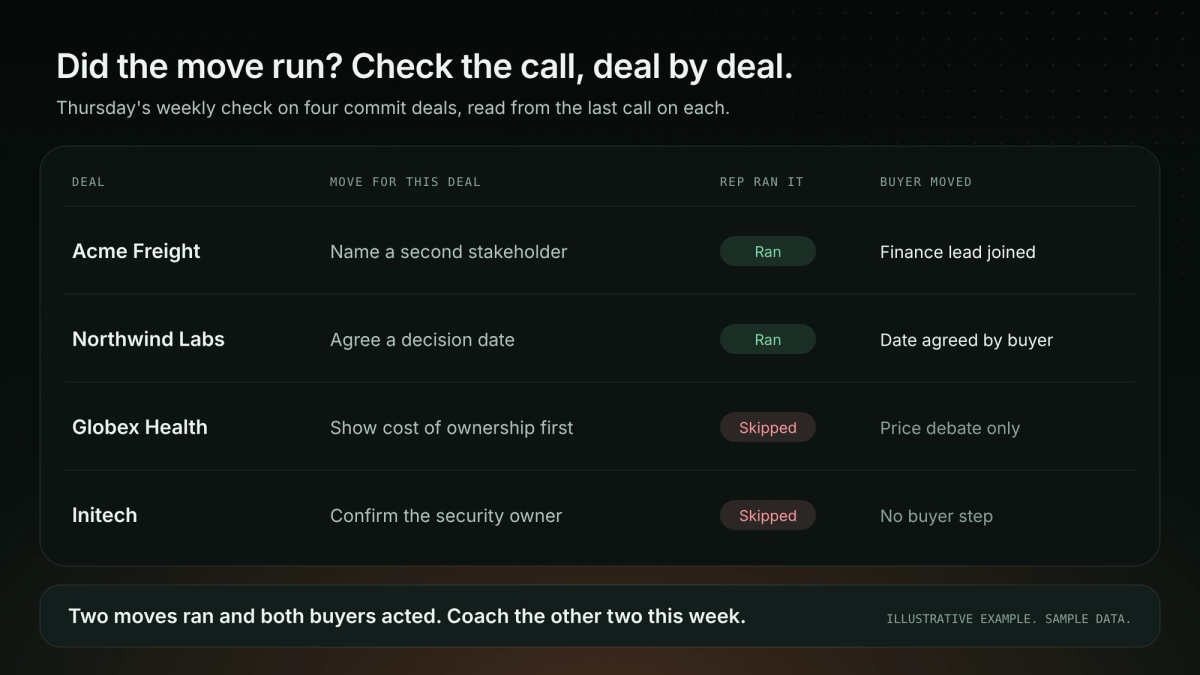
4. Check the next call. Did the rep run the move? Did the buyer do what it asked, like naming a second stakeholder?
Bureau sells identity decisioning to banks and fintechs, where discovery decides the deal. Kapil Bhagat runs sales strategy there:
"So this monitoring led to execution ... Having a dashboard where non adherence is called out improves execution."
Kapil Bhagat, AVP, Sales Strategy, Bureau
The check is what turns a written move into a run one. Count it as moves run over eligible calls, not logins.
5. Update the move when strategy or wins change. A new competitor makes last quarter's move wrong. Re-test moves against won and lost deals each month.
You can run this by hand with a shared doc. It stops scaling when moves multiply by role, stage and competitor.
How to know the move actually ran
Pull ten commit deals this week and read the last two calls on each. A deal passes when the rep ran the move and the buyer acted on it, in the buyer's own words. It fails when the next step sits in the CRM, typed by the rep, with no buyer voice behind it.
Then make it clean. Give half your teams the written moves now, the rest in three weeks. Compare each rep's own deals, ran against not ran, so the rep is the same on both sides. A rep with fewer than three deals on a side is direction only. To check a covered deal is real first, use the two call tests for pipeline coverage.
The table below runs that check on sample numbers. They are illustrative, not customer data. Deals where the move ran advanced far more often.
| Commit deals (illustrative) | Deals | Buyer confirmed the next step | Advanced a stage within two weeks |
|---|---|---|---|
| Move ran on the next call | 7 | 6 | 5 |
| Move did not run | 5 | 2 | 1 |
Five of seven advanced where the move ran; one of five where it didn't. Small numbers, so read them rep by rep.
The call also shows what the record hides. MyAdvice sells to medical, dental and legal practices, with many handoffs. Chad Erickson saw it on one account:
"Incredibly encouraging to me is that the Zime technology picked up on it… a needle in a haystack… it recognized there's something weird going on here."
Chad Erickson, VP of Sales & Strategy, MyAdvice
A field would have missed it.
How Zime runs the five steps beside Clari
Zime solves this for CROs: it gets every rep running the move your best reps run, and shows you it ran. Zime does not forecast, so Clari keeps the number.
- Encode. Zime's forward-deployed engineers (FDEs) interview your CRO and best reps. What they know becomes behaviors: the exact move for this role, stage and buyer. The Behavior Graph holds them. It combines your best people's judgment, elicited through FDE-run interviews and RLHF, including what never shows up in a transcript. It adds this quarter's strategy and your past deals. RLHF means scoring and correcting each move until your best reps would run it. Your strategy runs on 1,000+ behaviors. Nobody has written them down, tested them or kept them current.
- Deliver. A prep note before the call, a live prompt during it, in Slack, Teams or Claude.
- Measure. Programmatic Adoption shows who ran each behavior and whether the buyer moved. Zime's own benchmark is 80% of eligible reps within 90 days.
- Update. When strategy changes, the FDEs update the behaviors, tested against won and lost deals.
The table below maps each step to who acts: the forecast picks the deals, Zime gets the move run.
| Step | What Zime does | Who acts |
|---|---|---|
| Start from the deals | Pipeline review scores each deal on your criteria | CRO and managers |
| Write down the move | FDEs encode your best reps' moves | Zime, with CRO and top reps |
| Get it to the rep | Prep note before the call, live prompt during it | Rep |
| Check the next call | Who ran it; did the buyer move | Manager, weekly |
| Update the move | Behaviors retested when strategy changes | FDEs; CRO approves |
What changed when reps ran the move
At Versa, the move was technical discovery, and the committed pipeline showed 24% less leakage, a pipeline-quality figure, not a win rate. HFS Research separately cited Versa's 10% increase in win rates. Brent Bair, a regional sales leader there, watched the habit form:
"As I look at my team, the adoption rate has improved. I think it's become ingrained in our sales DNA now that this is incredibly valuable as we're progressing through deals."
Brent Bair, Regional Sales Leader, Versa Networks
The table below lists what each team measured after reps ran a move on live deals.
| Company | What reps ran | Published result | Source |
|---|---|---|---|
| Versa Networks | Technical discovery | 79% of SEs running the right technical discovery within three months, up from 20%; 24% less leakage in the committed pipeline | Success story |
| Bureau | Discovery | 30% increase in deal conversions; average deal size +30% | Success story |
| MyAdvice | Call checklist | Checklist adoption 66% → 87%; fatal objections 38% → 4% | Success story |
| SonicWall | Clear end-of-call asks | 30-40% increase in reps making clear end-of-call asks | Success story |
Nobody has published how much this changes forecast accuracy, Zime included. These results are about deals moving.
Keep the forecast. Get the move run.
Bring this week's commit list. We'll show you the move your best reps run on each at-risk deal, and how you'll see it ran. Live in 7 days.
FAQ
Gong, Clari or newer AI: which actually changes what reps do?
All three recommend. Clari calls the number; Gong records and scores calls. Reps change when they get your best reps' move before the call, and someone checks it ran. Zime encodes those moves as behaviors, the exact move per role and stage, from your top reps and strategy.
Does Zime replace Clari?
No. Zime does not forecast. Keep Clari, now sold as Salesloft, for the number. Zime gets each rep running your best reps' move on those deals, and shows you it ran.
Will this make my forecast more accurate?
No one has published that figure, Zime included, so ask any vendor who claims it for before-and-after on the same forecast. Zime's published results are about deals moving.
What does Zime do for CROs?
Zime turns your strategy and your best reps' know-how into behaviors, the exact move for each role and stage. Reps get them in prep notes and live prompts in Slack, Teams or Claude. You see who ran each one and whether the buyer moved.