Deal context is split across four tools. How do we get one view without another tool?

- Wiring four sources into one view is real engineering. If your agent can already pull a deal's story from your call recorder, team chat, CRM and email, that part is done. Keep every connector.
- But the hard part is not the stitching. It is what the view hands a rep, and where it sits. A summary a rep has to go and open is one more tab. The question is whether reps act on it.
- And a sharper summary will not change that. Add a fifth source or tune the prompt and the view gets more accurate. A rep still decides what to say next, and reps act on a move, not on a view. How your best reps decide, and what your CRO decided this quarter, sits in none of the four.
- That missing input is what a behavior graph adds. Zime's behavior graph is the model that holds how your best reps decide, what your CRO decided this quarter and your past deals. It is taught by your best people, including what never shows up in a transcript, and reaches the rep inside the tool already open.
- So you keep what you built and count the calls where the move ran. Your connectors stay, and Zime runs on Claude. Collecting the missing input is interview work, not wiring, and it keeps moving with your strategy. Count calls where a named rep ran the move, not logins: that is adoption.
It is Monday, and you are the RevOps lead. Ellen, your VP of Sales, wants everything on the Halden deal.
The deal sits in four places. The call recorder holds what the buyer said. The team chat holds what legal said. The CRM holds what the rep typed, and the inbox holds the rest. Pulling it together by hand means tabs, copy and paste.
That manual work is real, and it is the first problem. So how do you get one view of the deal, and what does it have to hand a rep so it is not one more tool?
What the agent you built gives you
So you did what builders do. You built an agent on Claude or ChatGPT and wired it to the four sources. The agent pulls the call, the chat, the CRM and the inbox into one summary in a minute. That took real engineering, and it works. Foundation Capital called context graphs AI's trillion-dollar opportunity in December 2025, and the layer deserves it. If you have a context graph, keep it. If you are adding one, add it.
Chitresh Yadav runs sales engineering at Versa Networks, with more than 100 SEs across four regions. He already had agents in Claude doing follow-ups and prep notes. They gave him visibility. Visibility was not the gap.
"This is the dashboard I typically see, and it is drowning me. When I go to my org level, I'm drowning because it shows everything."
Chitresh Yadav, VP and Global Head of Sales Engineering, Versa Networks
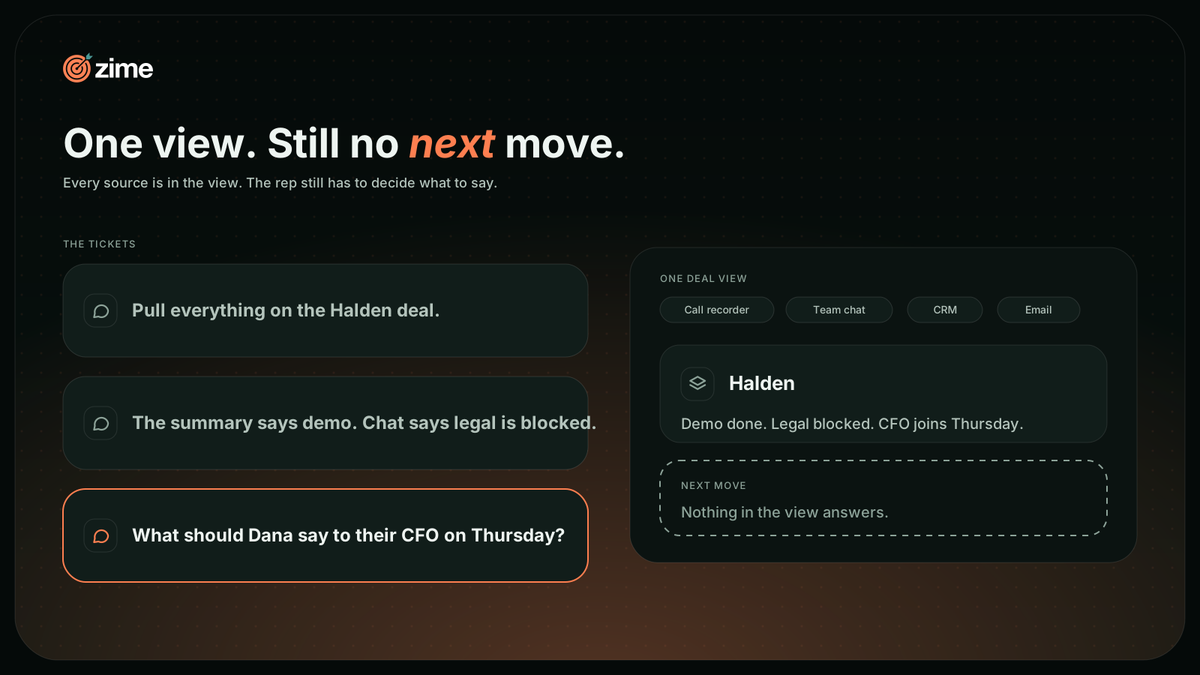
Everything is in the view. Nothing in it says which move to run.
Typed by reps, or said by buyers? That is the first question about any view. G2's enterprise review data found the average share of users who fully adopted an AI agent fell from 68% in 2024 to 55% in 2026.
Then the other tickets arrive. "The summary says demo next. Chat says legal is blocked." "Pull the same view for six more deals." And this one: "What should Dana say to their CFO on Thursday?"
Your agent gives insights, and an insight says what happened. It does not win the deal.
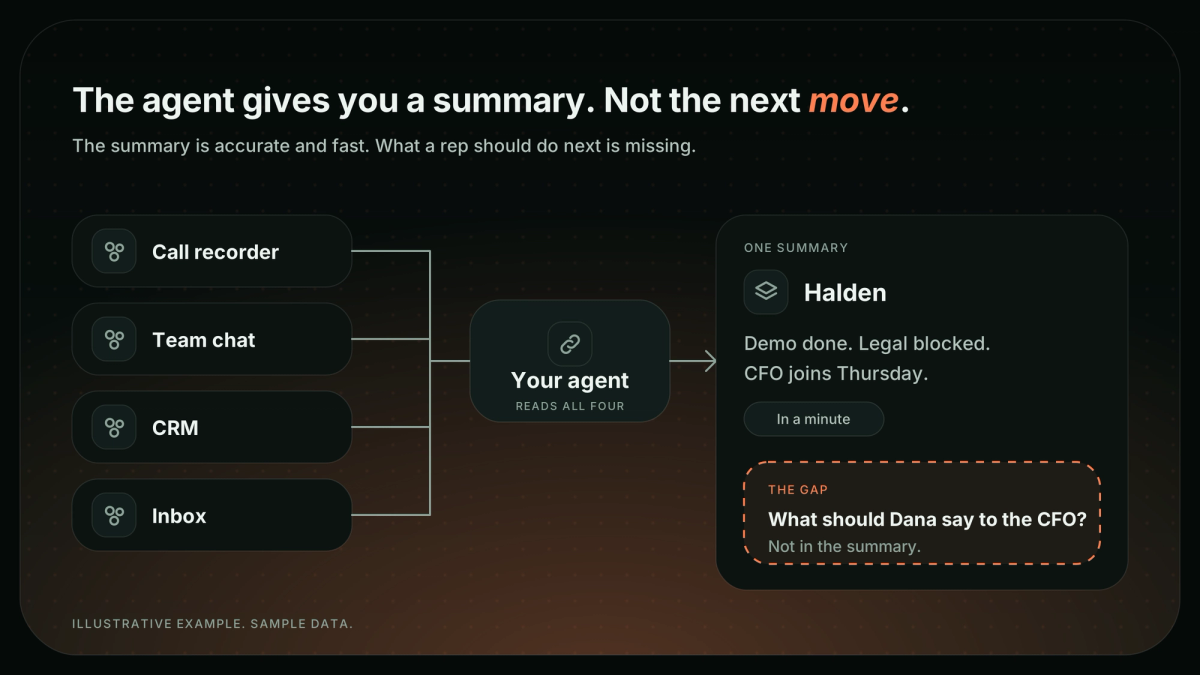
Run the Thursday test on one open deal. Ask your agent what Dana should say to the CFO. Ask your best rep the same. Pass means the same move. Fail means the agent recites what happened. The table below runs the test on five illustrative deals, and only two match.
| Deal (sample) | What the view says | What your best rep would say | Same move? |
|---|---|---|---|
| Halden | Demo done, legal blocked, CFO joins Thursday | Ask the CFO which approval is blocking legal, then name the owner | No |
| Brightwell | Security review passed, pricing sent | Confirm the buyer's budget owner before the revised price goes out | No |
| Marlow | Champion left, new sponsor not met | Ask the old champion for an intro to the new sponsor this week | Yes |
| Tidewater | Competitor named on the last call | Show total cost before price, as the CRO asked this quarter | Yes |
| Orchard | Renewal in 60 days, usage down | Book the executive review before the renewal call | No |
The Halden row carries the point. The view is accurate. It still does not say what Dana should say.
Adding a source or tuning the prompt makes the summary more accurate. The tell that it did not help is that the third ticket keeps arriving.
The third layer the agent can read
So far the agent does two things. It reads the four sources, and it turns them into a summary. A third layer is missing, and the agent can read it too. It is the move your best reps would run on this deal.
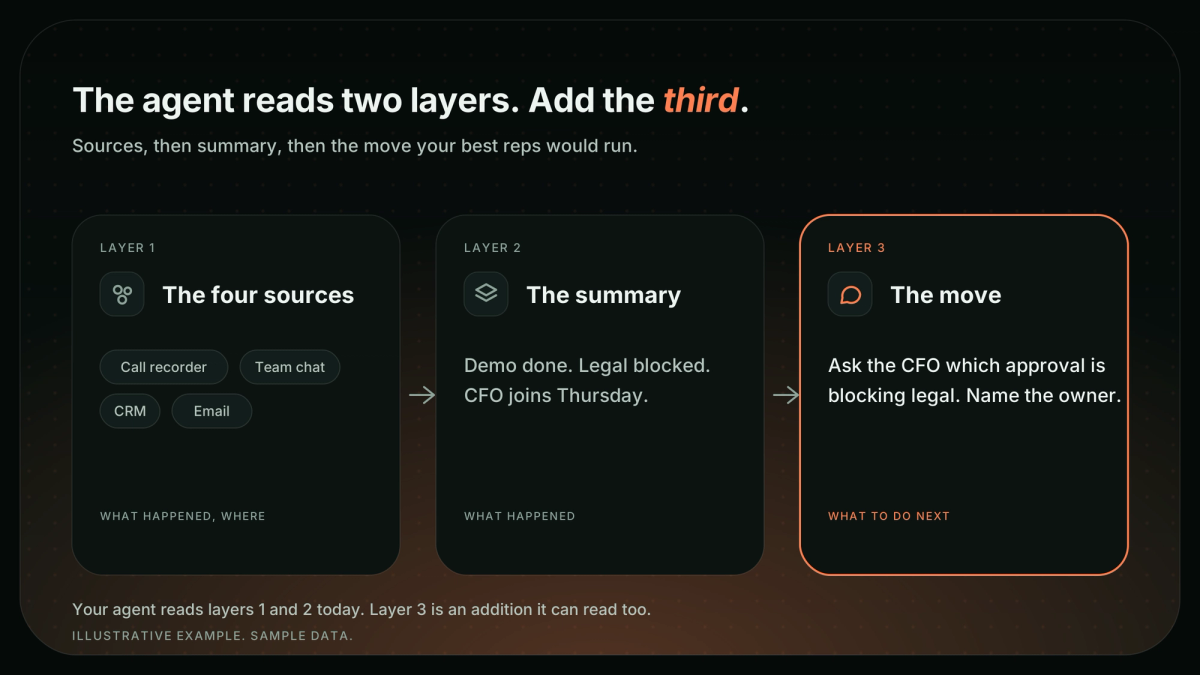
You can test that without buying anything. Pick one motion, say the second call with a finance lead. Write down the sentence your CRO used for it this quarter. Interview two of your best reps and write the three moves they describe. Put them in one prep note for a few reps for two weeks, and give it to a random half first so the other half is your comparison. Then count the calls where the move ran.
That works for one motion. It stops scaling when each new product, competitor and role needs its own interviews.
Zime does that work for every motion at once. Zime's Behavior Graph is the model that holds how your best reps decide, what your CRO decided this quarter and your past deals. It is elicited from your best people through FDE-run interviews and RLHF, including what never shows up in a transcript. FDE-run interviews means Zime's forward-deployed engineers interview your best reps. RLHF means scoring and correcting the moves until they would run them.
The graph produces a Behavior: the specific move for this deal, with the winning deal behind it. That winning deal is the receipt. Zime runs on Claude and connects to your agent over MCP, so the agent reads the Behavior as its third layer. GTM engineers keep the harness. The Behavior reaches the rep in the prep note she already reads before a call.
The CRM stays the record, recorders capture calls, and deal workspaces unify the sources. Work AI answers across tools, and your own agent keeps working. All of them can recommend a next step. The difference is where it comes from.
The table below marks what each approach does, with a cross only where it does not. One row separates them: a move taken from your best reps' tribal knowledge and your CRO's authorized strategy.
| What it does | CRM as the record | Recorder with CRM sync | Deal workspace | Your agent over connectors | Your agent plus Zime |
|---|---|---|---|---|---|
| Pulls calls, chat, CRM and email into one deal story | Partial | Partial | ✓ | ✓ | ✓ |
| Answers a deal question with its sources | Partial | ✓ | ✓ | ✓ | ✓ |
| Hands the rep a move from your best reps' tribal knowledge and your CRO's authorized strategy | ✗ | ✗ | ✗ | Partial | ✓ |
| Shows which rep ran the move, on a named call and minute | ✗ | Partial | Partial | Partial | ✓ |
| Keeps what you already built | ✓ | ✓ | Partial | ✓ | ✓ |
That row carries the argument. Your agent can carry a move you wrote by hand. Only one approach holds what your best people know.
Bureau sells an identity decisioning platform to banks and fintechs. Its product guidance sat across Jira, Confluence and spreadsheets.
"Every member of the sales teams saves 1 hour daily by automating meeting notes, CRM updates and streamlining deal reviews."
Preekshit Gupta, VP APAC & MEA, Bureau
Notes and updates are the part of the view nobody should type.
Honestly, you may not need this. With a handful of reps, one product, one motion and someone to hand-write the moves, Claude with custom prompts can be enough.
What the same Monday looks like
Same Monday. Ellen asks for everything on Halden, and your agent pulls it as before. On Wednesday, Dana already has the move in her team chat: ask the CFO which approval is blocking legal, and name the owner. It carries the receipt of the deal where a colleague did exactly that and won.
On Thursday she runs it. Ellen does not sit on the call. She opens the recording at the minute the CFO names the owner. Dana walks in with the move and the winning deal behind it. You changed neither the view nor a connector.
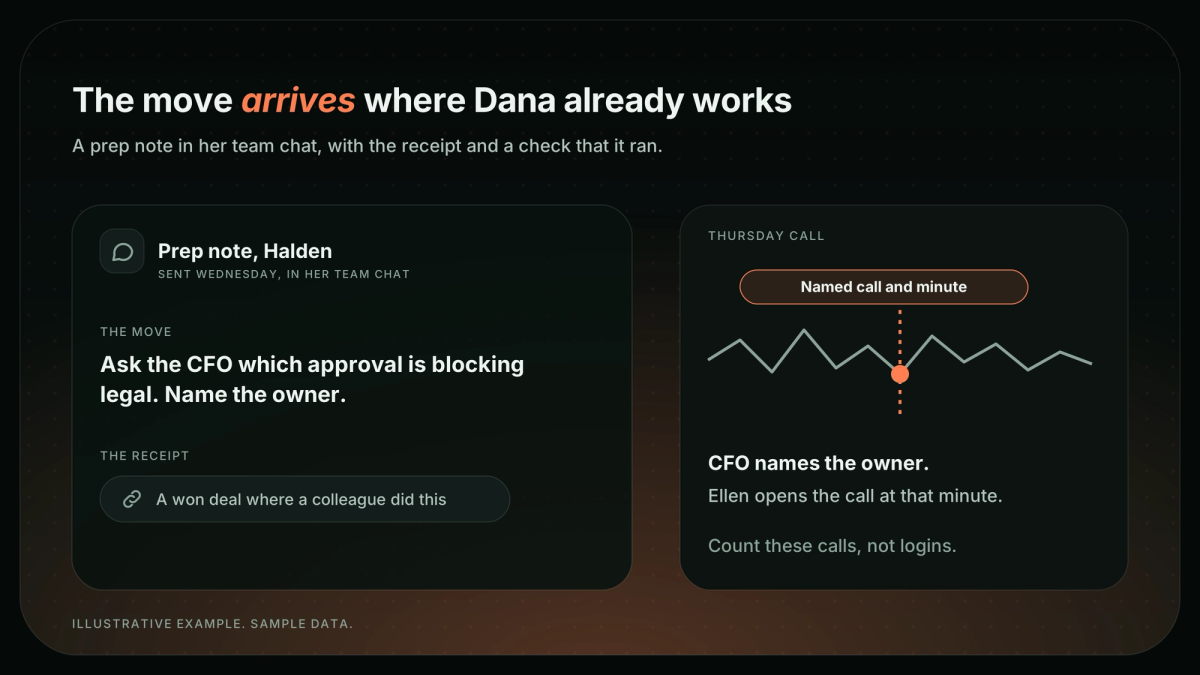
Run a third test on your own deals. Pick one move and one week. Pass means you can open each call at the minute the rep ran it. Fail means all you have is a login.
Versa counted this way. Its SEs reached 79% running the right technical discovery within three months, up from 20% at the start. That counts behaviors run on live deals. Brent Bair leads a regional sales team there.
"...the adoption rate has improved. I think it's become ingrained in our sales DNA"
Brent Bair, Regional Sales Leader, Versa Networks
The move was run, not read.
Zime's own published benchmark is separate: 80% of eligible reps running Behaviors within 90 days. Kenny Cao runs go-to-market strategy and operations at Skan AI.
"I want to understand how the team is delivering against the deck and against the new value proposition... It is more of an enablement understanding versus whether they've done it."
Kenny Cao, Senior Director, Head of Go-To-Market Strategy and Operations, Skan AI
He is asking not who understood the message but who ran it.
No customer result is published yet for replacing a stitched multi-tool deal view with this setup. What is published is the adoption count above.
So keep the view. Stagger the next change so half your reps get it first, and check each call for the move. That tally is adoption, measured as behaviors run rather than logins.
Keep your view. Add the move.
The view and the agents you built stay yours. Zime runs on Claude and adds the missing input, delivered as a move inside the tool a rep already has open. Live in 7 days on your own data. Bring one open deal and the question a rep asked about it this week, and see the move it becomes. Book a demo →
FAQ
Deal context sits across our call recorder, team chat, CRM and email. How do we get one view without another tool?
Wire the four sources into one agent and keep the CRM as the record. Then add what the view hands a rep. A summary says what happened. A move says what to say next, taken from how your best reps decide and your CRO's authorized strategy, including what never shows up in a transcript. Zime delivers it inside the tool a rep already has open.
Do we have to replace what we already wired?
No. Zime runs on Claude and connects to your agent and connectors over MCP, so the agent reads the same moves. Teams with a context graph keep theirs. Teams without one are not blocked, because Zime ships Execution Context, its own layer for entities, deal history and current strategy.
How do you match a call to the right deal, and what about noise and legal limits?
Pull twenty recent calls, read which deal each sits on, and fix mismatches before you add a source. Add chat and email one at a time, starting where deal decisions happen. Then ask any vendor how calls are assigned, how often a person fixes the match, and what limits apply to scanning chat and email.
Can one rep see another rep's confidential deal through a move?
No confidential details travel. A rep sees the move and the way another rep handled a similar situation, not the other deal.
Can we trace a recommendation to its evidence and strategy?
Yes. Each move Zime sends a rep comes with provenance, so you can follow it to the evidence and the CRO strategy behind it. The receipt names the winning deal the move came from.