Glean shows what your top sellers said. What shows reps why they won?

- Glean already surfaces how your top sellers sell. Their calls, win stories and patterns from past wins come back in seconds, with sources.
- Why they won was decided, never said. When to hold pricing, who to bring in early, when to walk away: none of it reached a call or a doc.
- Ask the winners what they'd do, and why. Their decisions and reasons set the behavior apart from what an AI suggests.
- Zime turns those decisions into behaviors every rep runs. Zime's team interviews your top reps and your CRO, and each rep gets the exact behavior before the call.
- Make running it your ask, and check it weekly. Managers see who ran each behavior on which deal. Zime's benchmark is 80% of eligible reps within 90 days.
Dana, your top AE, closed the quarter's biggest competitive deal on Friday. By Tuesday, enablement has the win story in Glean: her calls, her deck, the champion's emails and a clean summary.
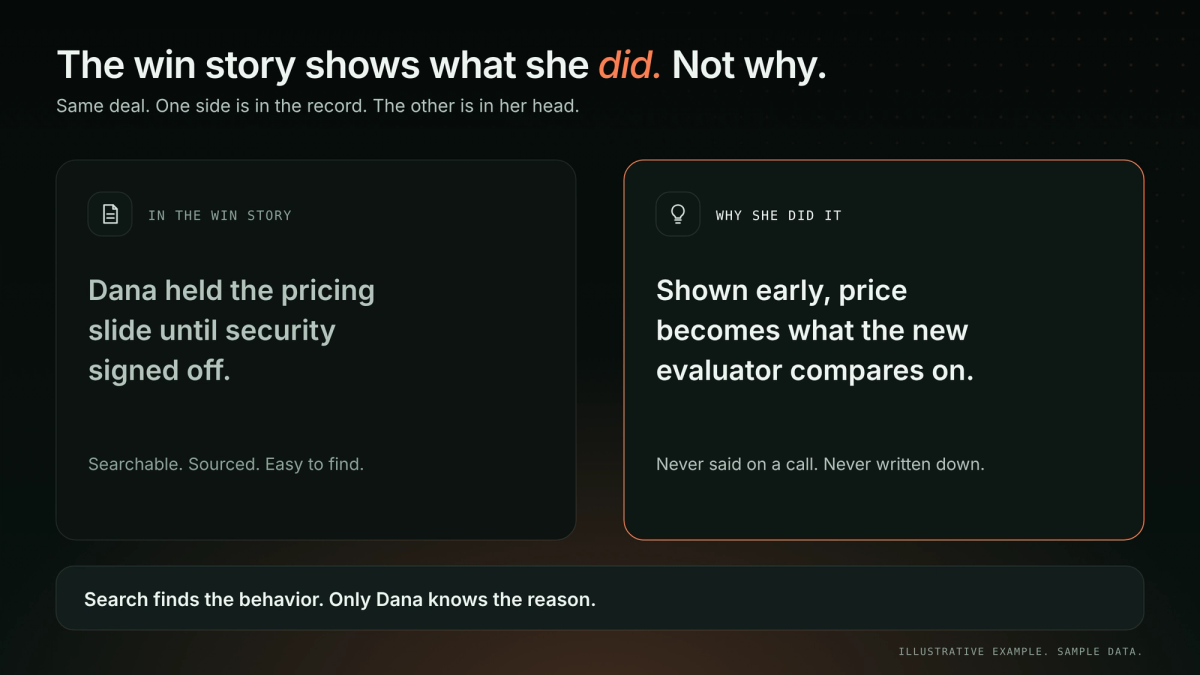
Marcus has his own evaluation call on Thursday. He reads the win story twice. He sees that Dana held the pricing slide until the buyer's security team signed off. He can't see why, or when that was the right call. So he asks you in Slack whether he should do the same.
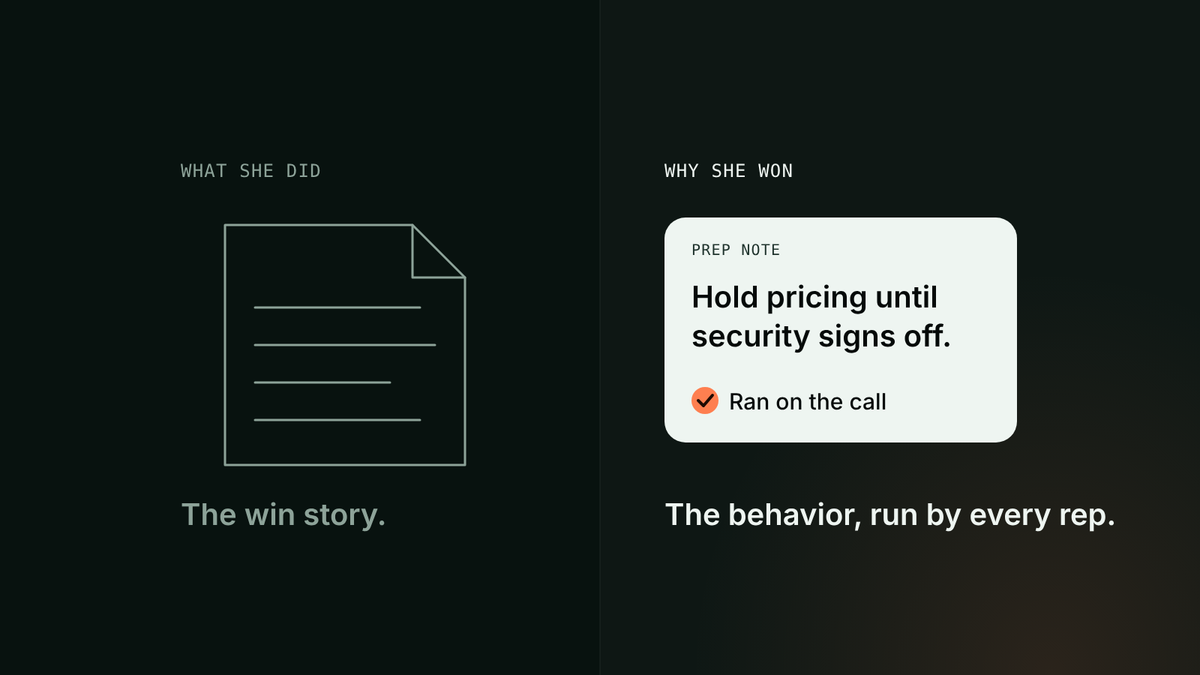
The story told him what she did but no why she won?
Ask Dana. The reason behind a winning behavior sits with the seller who made it, so the method starts there. Write each decision down as a behavior with its trigger, test it on deals you won and lost, put it in every rep's prep before the call, and check that it ran. Five steps, and the last one is the CRO's. Versa Networks ran this with Zime across its sales engineers and saw a 12% increase in technical wins.
What a win story holds, and what it leaves out
Start with what Glean does well. Its Enterprise Graph maps how documents, messages, people and activity relate. Glean Search pulls call notes and win stories by scenario, and Glean says its deal strategy agent reflects proven patterns from past wins and losses. So yes, Glean shows reps how top sellers sell. If you run it, keep it. If you're adding it, add it.
Both systems recommend a next step. The gap sits upstream, in where the answer comes from. A win story is built from what happened: what was said, sent and logged. It keeps Dana's behavior. The decision behind it never reached a call, a doc or a field. She held pricing back because, shown early, price becomes what a new evaluator compares on. She knew that from experience. She never said it out loud.
Ranjan R Reddy saw this in his own team. He is founder and CEO of Bureau, which sells identity decisioning to banks and fintechs, where volumes, budget and timelines must surface in discovery. When he read back what his reps' meetings recorded, the pitch was all there. The discovery question was not:
"I pitch this, I pitch this, I pitch that and the next step is they will test this ... I'm like no, but what is the problem? What is the use case?"
Ranjan R Reddy, Founder & CEO, Bureau
Nothing was lost. The question his best sellers would have asked never happened, so no record could hold it.
Chitresh Yadav leads 100+ sales engineers across four regions at Versa Networks, and he already uses AI in Claude for prep notes and follow-ups. On AI that learns from the data alone, he drew the line here:
"...not to the human level ... there is a context that you need to build in."
Chitresh Yadav, VP and Global Head of Sales Engineering, Versa Networks
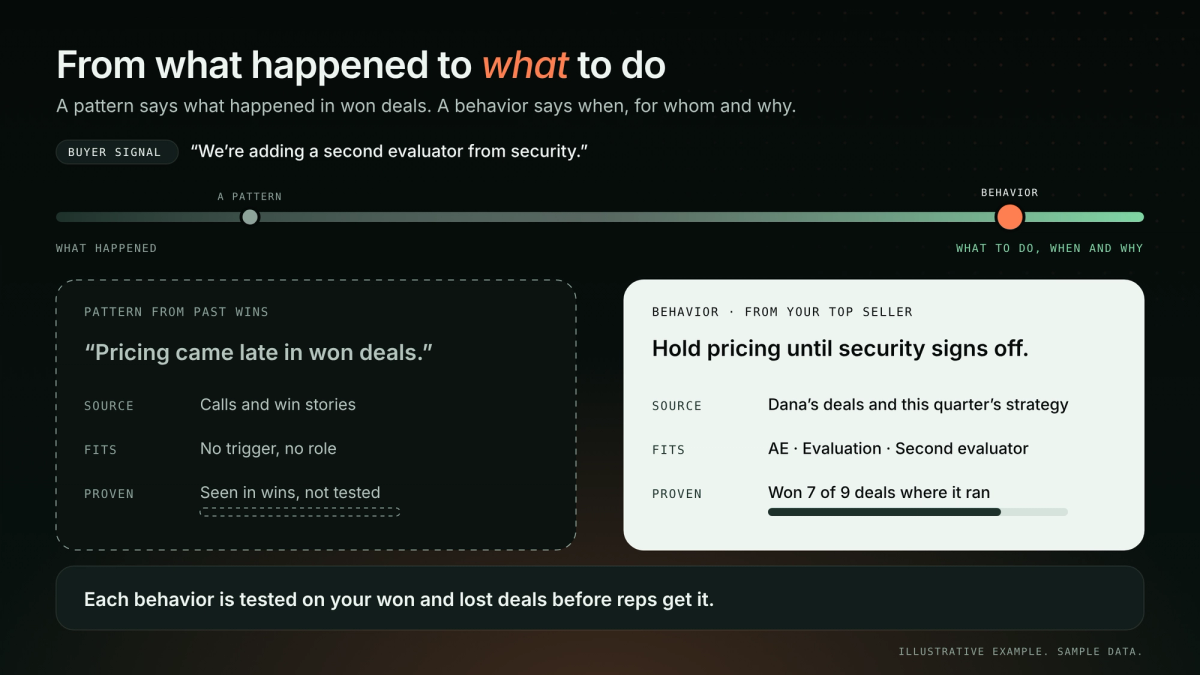
The context he means is the decision, and someone has to put it in on purpose. Your strategy runs on 1,000+ of those decisions. Nobody has written them down, tested them or kept them current. Here we call each one a behavior: what a rep does in a specific situation, with its trigger, its reason and the deals it won. How often a behavior showed up in past wins does not say when it fits, as the post on context graphs and trust explains.
The table below shows where each approach stops when the goal is every rep running how your top sellers win.
| What it takes | Enterprise search (Glean) | Conversation intelligence | Agents on your data | Zime |
|---|---|---|---|---|
| Surface top sellers' calls and win stories | ✓ | ✓ | ✓ | ✓ |
| Suggest a next step on a live deal | ✓ | ✓ | ✓ | ✓ |
| Find patterns in past wins and losses | ✓ | ✓ | ✓ | ✓ |
| Capture why top sellers made each decision | ✗ | ✗ | ✗ | ✓ |
| Tie each behavior to this quarter's CRO strategy | Partial | ✗ | Partial | ✓ |
| Test each behavior on won and lost deals | Partial | Partial | Partial | ✓ |
| Show which reps ran each behavior, deal by deal | ✗ | Partial | ✗ | ✓ |
Run Marcus's Thursday through it. The first three lines get him Dana's call, her story and a pattern that says pricing came late in wins. The last four answer his Slack question: hold pricing until security signs off once the buyer names a second evaluator, here is why, it held on deals you won, and his manager will see on Friday that he did it.
Five steps from win story to every rep's next call
None of this needs a new tool to start. Run it by hand on one situation first.
1. Choose the situations your number depends on. Begin with the strategy you set for the quarter. Pick the few moments where deals are won or lost: a displacement, a new product attached to a renewal, a second evaluator arriving late. Encoding every deal spreads the work thin and misses the ones that matter.
2. Interview the sellers who win them. Sit with three to five of them, one situation at a time. Ask what made them change course on that call. Ask what they chose not to do, and why. Ask what they check before a demo that isn't in the CRM, and when they walk away. Their deal recap gives you the story. These questions give you the reasoning.
3. Turn each answer into a behavior. Write it as one line with four parts: trigger, action, reason, role. When the buyer names a second evaluator, the AE holds pricing until security signs off, because shown early, price becomes what the new evaluator compares on. A rep in another region can run that line on Monday.
4. Test it against deals you won and lost. What a top seller tells you is a hypothesis. Martin Mackay treats it that way. He is CRO of Versa Networks, which sells SASE against ten named competitors in deals from $100K to $3M. In a win-loss session, after describing what his most effective reps do, he said:
"a lot of what I've just told you is empirical, and I'd like it to be backed up by data."
Martin Mackay, CRO, Versa Networks
If the CRO's own read needs data behind it, so does Dana's. For each behavior, count how often it ran in deals you won and in deals you lost. Keep what holds. Drop what doesn't.
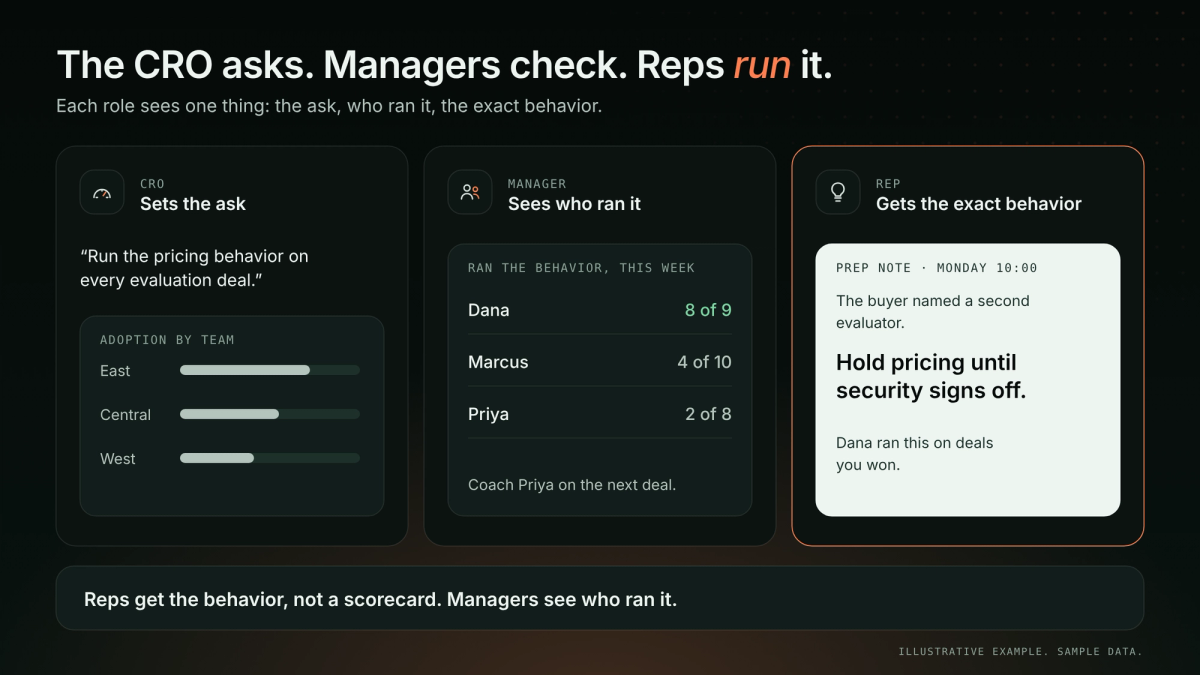
5. Make running it the CRO's ask. Get the behavior to each rep before the call, in the tools they already use. Then ask your managers every week who ran it, on which deals. Without that question, good guidance fades. G2's enterprise review data found the average share of users who fully adopted an AI agent fell from 68% in 2024 to 55% in 2026. Mickey Singh leads sales enablement at Versa, which runs 200+ reps across four regions. He names the same gap:
"...any methodology they look very attractive? But in reality, how much of them are executed in the real customer calls?"
Mickey Singh, Global Head, Sales Enablement, Versa Networks
A methodology that looks good in a deck still has to show up on calls. The weekly question from the top is what gets it there.
Will reps feel watched? They don't get a scorecard. They get the exact behavior, the rep whose behavior it is gets the credit, and managers use the list to coach.
A team of ten reps can run all five steps by hand in a month: one interviewer, ten won and ten lost deals, one spreadsheet. The hand version breaks at scale, with 1,000+ behaviors, a strategy that shifts every quarter and every call to check.
How to see who actually runs it
Proof is the hard part. In a Gartner survey of 227 chief sales officers, 31% cited difficulty proving the ROI of AI-driven tools as a top challenge for 2026. Kenny Cao leads go-to-market strategy and operations at Skan AI. After his team rolled out a new value proposition, he put the difference between knowing and doing this way:
"I want to understand how the team is delivering against the deck and against the new value proposition, right? It is more of an enablement understanding versus whether they've done it."
Kenny Cao, Senior Director, Head of Go-To-Market Strategy and Operations, Skan AI
Training can show the understanding. Only the calls show whether they've done it. So check the calls:
- Use the transcript, not a CRM field. A field shows what a rep typed.
- Count eligible deals. Deals where the behavior ran, over all deals where its trigger came up.
- Compare each rep with themselves. Their deals with the behavior against their deals without it, so a strong rep can't skew the result.
- Watch the early signal, then the result. The run rate shows within weeks. Stage movement shows next. The win rate needs a quarter.
The table below runs this check on sample numbers for one behavior: hold pricing until security signs off. Illustrative example, sample data.
| Rep | Eligible deals | Ran the behavior | Advanced within two weeks, ran | Advanced within two weeks, did not run | Read |
|---|---|---|---|---|---|
| Dana | 9 | 8 | 6 of 8 | 0 of 1 | Direction only: one deal without it |
| Marcus | 10 | 4 | 3 of 4 | 2 of 6 | The gap holds within the same rep |
| Priya | 8 | 2 | 1 of 2 | 2 of 6 | Too few runs: coach, then re-check |
| Team | 27 | 14 | 10 of 14 (71%) | 4 of 13 (31%) | Worth scaling; confirm with a staggered start |
Across the team, deals with the behavior advanced 71% of the time, against 31% without it, and the gap holds inside Marcus's own deals. So the behavior goes into every eligible rep's prep note, and Priya's manager coaches it on her next deal. For a clean read, start half your managers' teams at random and the rest three weeks later. Treat any rep with fewer than three deals on a side as direction only. The post on measuring adoption covers the count in more depth.
Nobody has published results for a team running Glean and Zime side by side, Zime included. The test above is how you would produce them.
Where Zime fits next to Glean
Zime closes the gap the record can't. It turns why your top sellers win into behaviors every rep runs, and shows who ran them. Glean keeps doing search.
- Encode. Zime's team interviews the reps who win and your CRO, including what never shows up in a transcript. Each behavior sits in the Behavior Graph, the model that holds your strategy, your best reps' decisions and your past deals. Strategy Studio tests it against your won and lost deals.
- Deliver. The behavior reaches each rep in a prep note before the call and a live prompt during it, inside Slack, Teams or Claude.
- Measure. Programmatic Adoption shows who ran which behavior on which deal, and whether the buyer moved. Zime's own benchmark is 80% of eligible reps within 90 days.
Your RevOps lead could run the first interviews, and should for ten behaviors. The work that never ends is the rest: interviewing again when strategy shifts, retesting on new deals, checking every call. Zime's team carries that every week.
The table below shows what Zime does at each step and who acts.
| Step | What Zime does | Who acts |
|---|---|---|
| Choose the situations | Turns this quarter's CRO strategy into the moments to encode | CRO |
| Interview the winners | Asks your top sellers why they made each decision | Top sellers, once per situation |
| Write the behavior | Holds trigger, action, reason and role in the Behavior Graph | Zime's team; CRO approves |
| Test it | Checks each behavior on won and lost deals | Zime; RevOps reviews |
| Make it the ask | Prep note and live prompt to reps; who ran it to managers | Reps run it; managers coach; CRO asks managers |
A quarter later
Back to Marcus, one quarter on. His Thursday prep note reads: the buyer named a second evaluator, so hold pricing until security signs off; Dana ran this on deals you won. He runs it. On Friday his manager sees that he did, and that security signed off before pricing came up. You see, team by team, the share of eligible deals that got the behavior. By week six you know which teams run it. By quarter end you know whether those deals won more often.
The behavior, run by every rep. Customers who got there measured it in their own terms. Versa's SEs across four regions ran the technical discovery their best SEs ran. Bureau's reps ran the same discovery on every first call.
The table below lists what each company's reps ran and the published result.
| Company | What reps ran | Published result | Source |
|---|---|---|---|
| Versa Networks | The technical discovery their best SEs ran | 12% increase in technical wins | https://zime.ai/success-stories/how-versa-networks-got-79-percent-of-ses-running-the-right-technical-discovery |
| Bureau | The same discovery on every first call | 30% increase in deal conversions | https://zime.ai/success-stories/how-bureau-realized-30-increase-in-deal-conversion-from-improved-discovery |
| MyAdvice | The call checklist | Checklist adoption from 66% to 87% | https://zime.ai/success-stories/how-myadvice-cut-fatal-objections-by-89-percent |
| SonicWall | A clear ask at the end of every call | 30-40% increase in reps making clear end-of-call asks | https://zime.ai/success-stories/how-sonicwall-turned-partner-deal-registration-around |
Keep Glean for the win story. Ask your top sellers for the why, test it, and make running it the ask. To see how your top sellers' decisions would reach every rep, book a demo.
FAQ
Is Glean a context graph?
Yes. Glean's Enterprise Graph connects your documents, messages, people and activity, and it does that well. Zime has its own context layer too, Execution Context. A context graph holds what happened. The decision behind a top seller's behavior has to be asked for and written down.
Does Zime replace Glean?
No. Keep Glean for search across calls, documents and CRM. Zime adds the behaviors your top sellers run, tested on your won and lost deals, and shows which reps ran them. Reps get them in Slack, Teams or Claude.
Glean already surfaces win stories. Isn't that enough?
A win story shows what a top seller did. A behavior, what to do in a specific situation with its trigger and reason, comes from asking that seller why. It is tied to this quarter's strategy and tested on won and lost deals, and you can see whether each rep ran it.
What does Zime do for CROs?
Zime is Behavioral AI for Sales Execution: your strategy, running in every rep's workflow. It turns why your top sellers win, and this quarter's strategy, into behaviors every rep runs, and shows who ran them on which deals. See Zime for CROs.