How do frontline sales managers decide which deals to inspect each week?

- Your usual list is a fair first pass. Sorting by close date, amount and stage gets most managers most of the way.
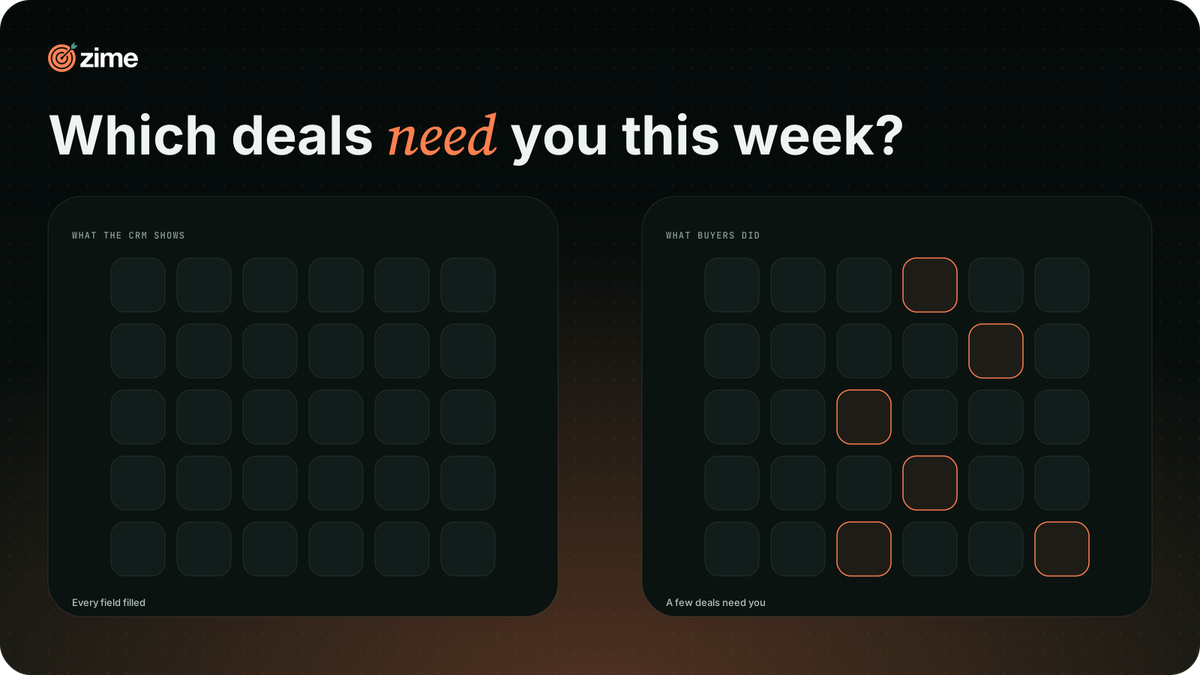
- But none of it tells you which deals need you. The stage, the close date and the status line are typed by the rep. With thirty open deals and room for six, which six deserve ten minutes?
- And what the buyer did answers better than what the rep said. Four signals earn a slot: no buyer reply in two weeks, one contact only, a next step the rep set alone, and a close date moved twice. Two together outrank one.
- That changes what you bring to the review. Bring the buyer's own words from a named call and minute instead of a status. The question moves from "how is it going?" to "what did they say?"
- So check next week that the step ran. Ask whether the buyer confirmed the step you agreed, and track the share that did. Zime scores each deal against your CRO's stage standard and shows the call behind the score.
Marcus Webb manages five reps and thirty open deals. Thursday's review has room for six, and his VP, Dana Cole, wants the commit by Friday. On Wednesday night he sorts the board by close date, then by amount, then by stage. The three lists disagree.
Priya Shah's biggest deal sits on all three, marked on track in her own words. Every field on that board was typed by a rep. The stage is the rep's call. The close date is the rep's guess. Only the last-activity stamp comes from the system, and it counts touches, not what the buyer said.
Marcus is not short on data. He is short on a reason. Why these six, and not the other twenty-four? Which of his thirty deals need him this week, and which can wait?
Why sorting does not pick the six
Sorting is a fair first pass, and every method on that board does real work. Close date puts the quarter's deals first. Amount protects the big ones. Asking reps what needs help taps what no field holds. Forecast categories, conversation-intelligence risk flags and qualification fields each add a view. Reviewing every deal works when you have few.
Each starts from something a rep typed or a system counted. That is the limit. A field records what was entered. It does not say who set the date, or who joined the last call. Forrester notes that sellers' interpretations often differ from buyers' actual reasons. That is about why deals ended. If it holds there, a rep's weekly read of a live deal deserves the same check.
Forecasts carry the same doubt. In a 2020 survey, Gartner found only 45% of sales leaders and sellers had high confidence in their organization's forecasting accuracy.
The table below shows what each way of picking can see. Start with the line on who set the next step. Only a check against what the buyer did sees it. The standard behind that check is the subject of a post on pipeline coverage.
| What it can see | Rep picks | CRM filters | Forecast category | Activity flags | Buyer evidence against your stage standard |
|---|---|---|---|---|---|
| Covers every open deal | ✗ | ✓ | Partial | ✓ | ✓ |
| Works without the rep's summary | ✗ | Partial | Partial | ✓ | ✓ |
| Shows who set the next step | Partial | ✗ | ✗ | Partial | ✓ |
| Shows who joined the calls | Partial | Partial | ✗ | Partial | ✓ |
| Shows a buyer behind the close date | ✗ | ✗ | Partial | Partial | ✓ |
| Gives you the buyer's words | ✗ | ✗ | ✗ | Partial | ✓ |
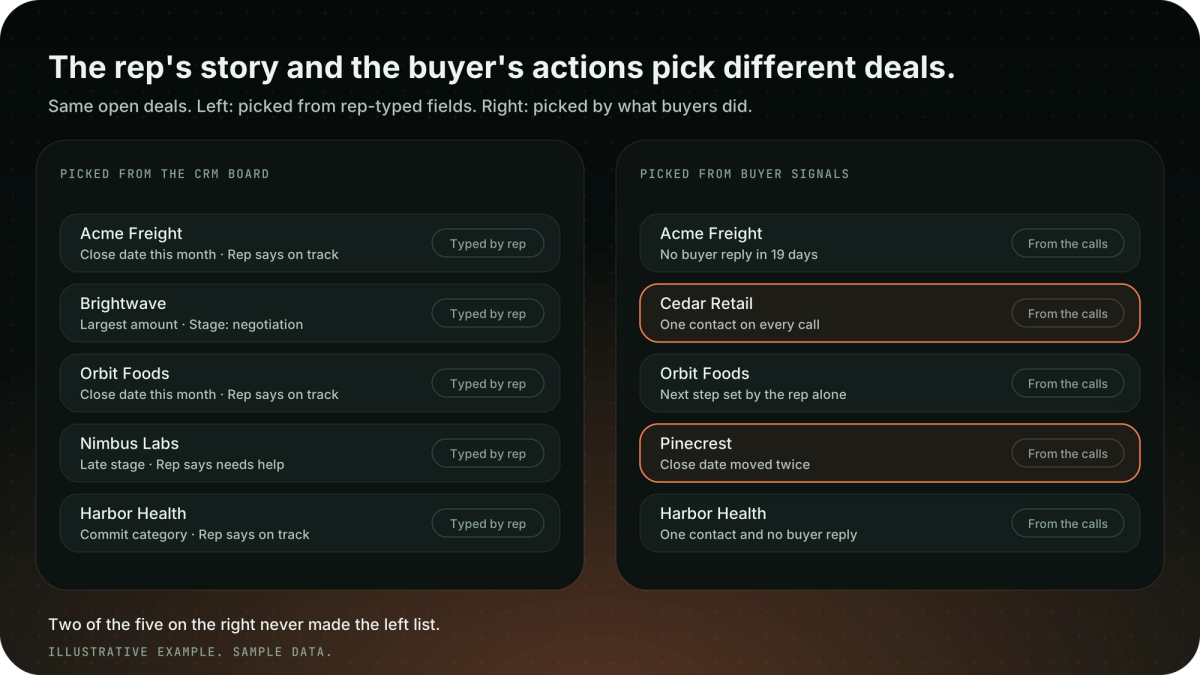
So the first rule is short. Pick by what the buyer did.
Four signals that earn a slot
Two signals together outrank one. Tune these thresholds to your cycle.
No buyer reply comes first. Count the days since a buyer, not the rep, last wrote or spoke. A rep's follow-up resets the activity stamp. It says nothing about a reply. Start with two weeks.
Next is one contact. If every call and email involves one person, the deal has one point of failure.
Third is a next step the rep set alone. A step the buyer named, with a date, is a commitment. A step the rep proposed and the buyer left unanswered is a hope.
Last is a close date moved twice. One slip is normal. Two is the moment to ask who on the buyer's side owns the date.
A quiet deal may only be a slow buyer. So one signal is a question. Two are a slot. The table below gives a test for each signal.
| Signal | What you run | Pass | Flag |
|---|---|---|---|
| No buyer reply | Find the date a buyer last wrote or spoke | A buyer replied inside your window (start with two weeks) | Only the rep wrote inside the window |
| One contact | Count buyer contacts on calls and emails this month | Two or more buyer contacts took part | One buyer contact only |
| Next step set alone | Open the last call at the minute the next step was agreed | The buyer named the step and a date | The rep proposed it and the buyer did not confirm |
| Close date moved twice | Compare today's close date with the date two reviews ago | The date held, or moved once with a buyer reason | Moved twice, with no buyer reason on any call |
Run two tests before Thursday. First, the backtest. Take five deals that slipped last quarter. Did two signals show three weeks before the slip? If not, tune the window. Second, the story test. Take one deal a rep called on track. If the buyer's last reply is outside your window, or the rep set the next step alone, the story and the buyer disagree. That deal gets a slot.
Chitresh Yadav runs sales engineering at Versa Networks, with more than 100 SEs across four regions. His deals run from $100K to $3M. The agents his team built gave visibility without adoption. On the dashboard he sees:
"When I go to my org level, I'm drowning because it shows everything."
Chitresh Yadav, VP and Global Head of Sales Engineering, Versa Networks
A board that shows everything gives no way to choose. Four signals cut it to a list he can explain.
Chad Erickson is VP of Sales & Strategy at MyAdvice, which sells marketing services to medical, dental and legal practices. Some of his deals, the story says, died quietly from moments nobody could spot. On what Zime's analysis of his calls surfaced:
"Incredibly encouraging to me is that the Zime technology picked up on it… a needle in a haystack… it recognized there's something weird going on here."
Chad Erickson, VP of Sales & Strategy, MyAdvice
The signal sat in the calls, where no CRM field holds it.
Bring what the buyer said
A slot is ten minutes. Spend them on the buyer's words. For each of the six, bring four things. The signals that earned the slot. The call and minute where the buyer last set a step. The buyer's own sentence. One question for the rep. The question changes too. "How is it going?" invites a story. "At minute fourteen, the buyer said finance signs off first. Who is talking to finance?" invites a plan.
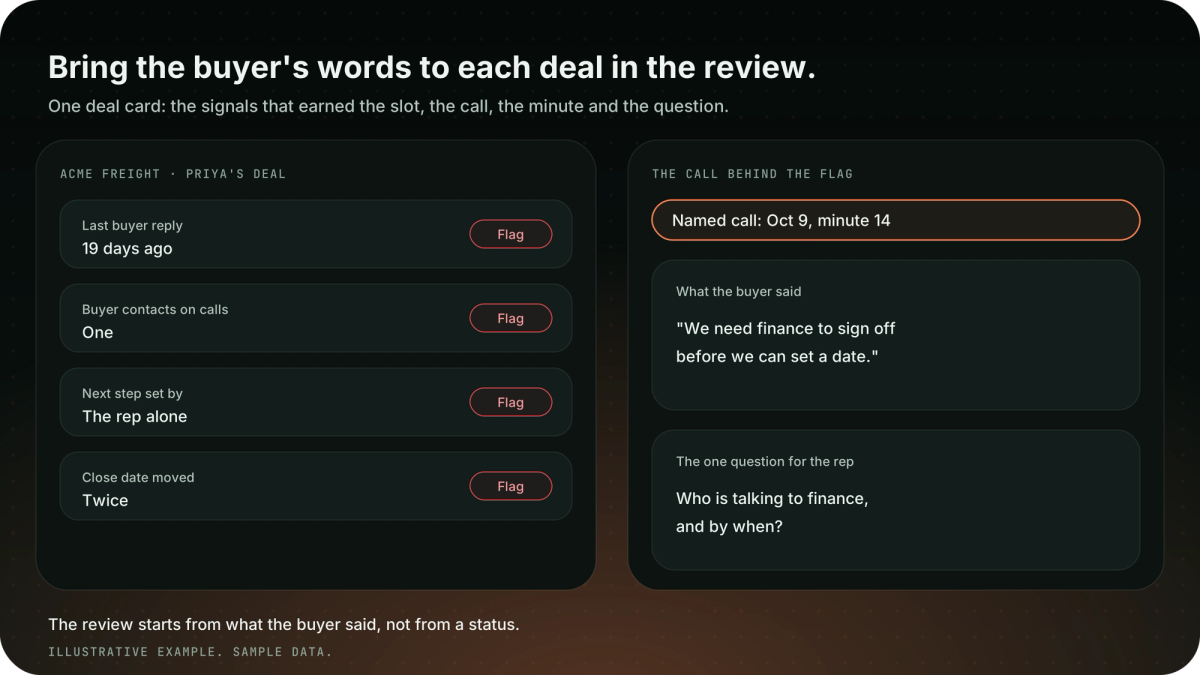
That card is the whole review for frontline managers. If it shows a rep drifting from your standard, read how to coach a rep who follows the process.
Kapil Bhagat is AVP, Sales Strategy at Bureau, an identity-decisioning platform with deals across several products and stakeholders. On what changed once a dashboard called out where reps skipped the standard:
"So this monitoring led to execution ... Having a dashboard where non adherence is called out improves execution."
Kapil Bhagat, AVP, Sales Strategy, Bureau Inc.
The gap reached the manager's screen.
No hour to spare? By hand, four checks across thirty deals is that hour. Preekshit Gupta, VP APAC & MEA at Bureau, manages sellers across international markets. He lists deal reviews among the time his teams get back.
"Every member of the sales teams saves 1 hour daily by automating meeting notes, CRM updates and streamlining deal reviews."
Preekshit Gupta, VP APAC & MEA, Bureau Inc.
Separately, Versa reports a 50% reduction in pipeline-review and coaching time. Those are two results, measured differently.
Zime has not published a head-to-head of ways to pick deals for review. It has published results like these. Zime's pipeline review scores each deal against your CRO's own criteria and shows the call behind the score. It flags a deal that shows risk, and says why.
Check the step ran
A review that changes nothing is a meeting. The check is one question next Thursday. For each of last week's six, did the buyer confirm the step you agreed? Open the named call and minute. If the buyer said yes, the step ran. If only the rep said it, it has not run yet.
Track the share. Zime calls this programmatic adoption: counting steps reps ran in live deals, not logins. If the share is low, look at the step before the rep.
Brent Bair is a Regional Sales Leader at Versa Networks, where 79% of SEs were running the right technical discovery within three months, up from 20% at the start. That counts behaviors run on live deals. On his team:
"As I look at my team, the adoption rate has improved. I think it's become ingrained in our sales DNA now that this is incredibly valuable as we're progressing through deals."
Brent Bair, Regional Sales Leader, Versa Networks
That is the measure Marcus runs on six deals each week. At MyAdvice, a different measure, checklist adoption rose from 66% to 87% between September and October.
Replay Marcus's Wednesday. He lists the deals with two signals. Seven qualify. He takes six. Priya's biggest deal is one of them. The buyer's last reply was nineteen days ago, and the next step is hers alone. Marcus opens the call at the minute that step was set. He brings the buyer's sentence to Thursday. Priya sees the same evidence he does. They agree on one step, with a date the buyer can confirm. Dana gets Friday's commit with a reason beside each deal. The next Thursday, Marcus opens the call again. The buyer confirmed the step. Priya's deal stays in the commit. Dana knows why.
Same board. Different six.
See which deals need you this week. Keep your CRM, your recordings and your forecast call. Zime adds your stage standard, from your best reps and your CRO, checked on every open deal. Live in 7 days on your own data. Bring last week's open deals and see which six the buyers picked. Book a demo →
FAQ
How do frontline sales managers decide which deals to inspect each week?
Start from buyer signals: no buyer reply in two weeks, one contact only, a next step the rep set alone, a close date moved twice. Two together earn a slot. Sorting is a fair first pass, but a rep typed those fields. Bring the buyer's words from a named call and minute, then check next week that the step happened.
Will flags just add noise?
Ask any vendor what share of flagged deals managers acted on, and how a flag is judged right or wrong. Zime has not published a figure for that. In your own team, run the backtest: check whether two signals showed before last quarter's slipped deals.
Won't reps feel policed?
Ask any vendor whether the rep sees the same evidence the manager sees. Whatever you use, send the rep the call and minute before Thursday.
My CRM already has next-step and last-activity fields. Is that enough?
Keep them. A field records what was typed, and the last-activity stamp counts touches. Neither shows who set the next step or who joined the call. Zime's pipeline review reads the calls and scores each deal against your CRO's criteria.
What is the quickest way to start?
Take last week's open deals and check the four signals by hand. Compare that list with the six you picked. Where they differ, open the call. Frontline managers can run the same check on every deal with Zime.