How do I get an LLM to give sales advice specific to our company instead of generic answers?
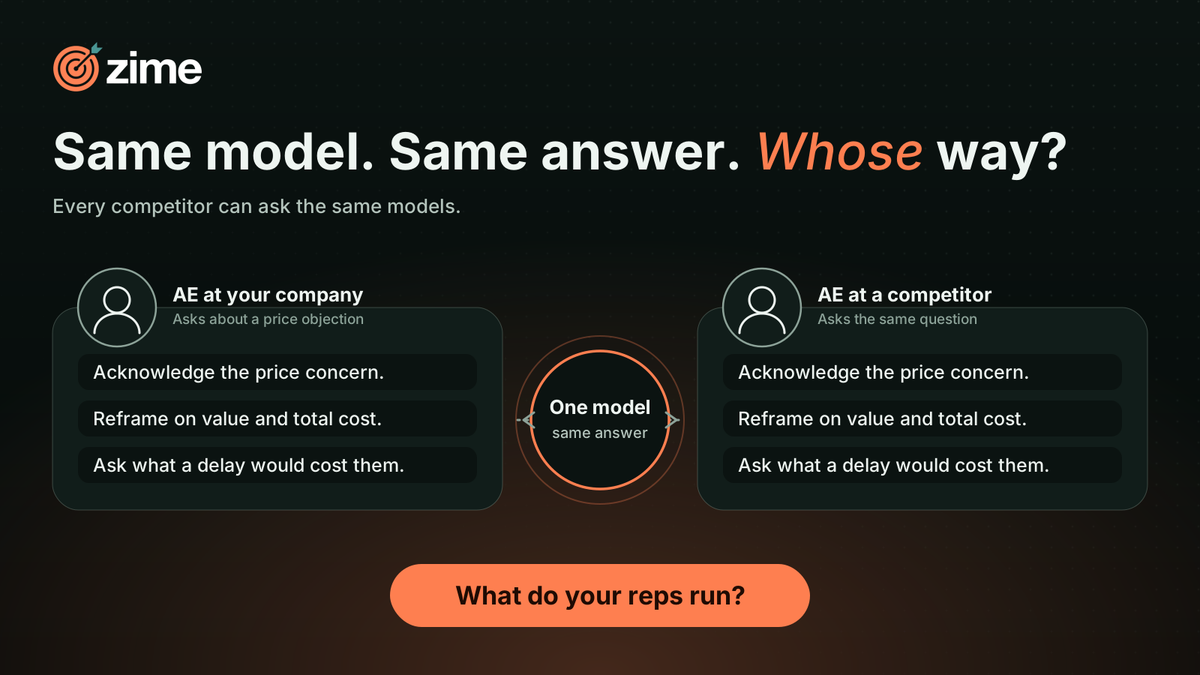

- Your AI gives real answers. Ask it about Thursday's pricing objection and it replies in seconds. General models and call-analysis tools do their jobs, and both recommend what to do.
- But the hard part is whether your reps sell your way. Competitors reach the same models. Swap a competitor's name into that answer and reread it. If it still reads right, it is not your way.
- And more data will not close that on its own. A model tuned to your calls learns what was said on them. What wins a complex deal is often never said on a call. And an answer on a screen does not show a rep ran it.
- That is what Zime's Behavior Graph adds. It holds how your best reps decide, and your strategy this quarter. Both are elicited from your best people, including what never shows up in a transcript. It turns both into the behavior a rep runs on this deal, and follows your strategy as it changes.
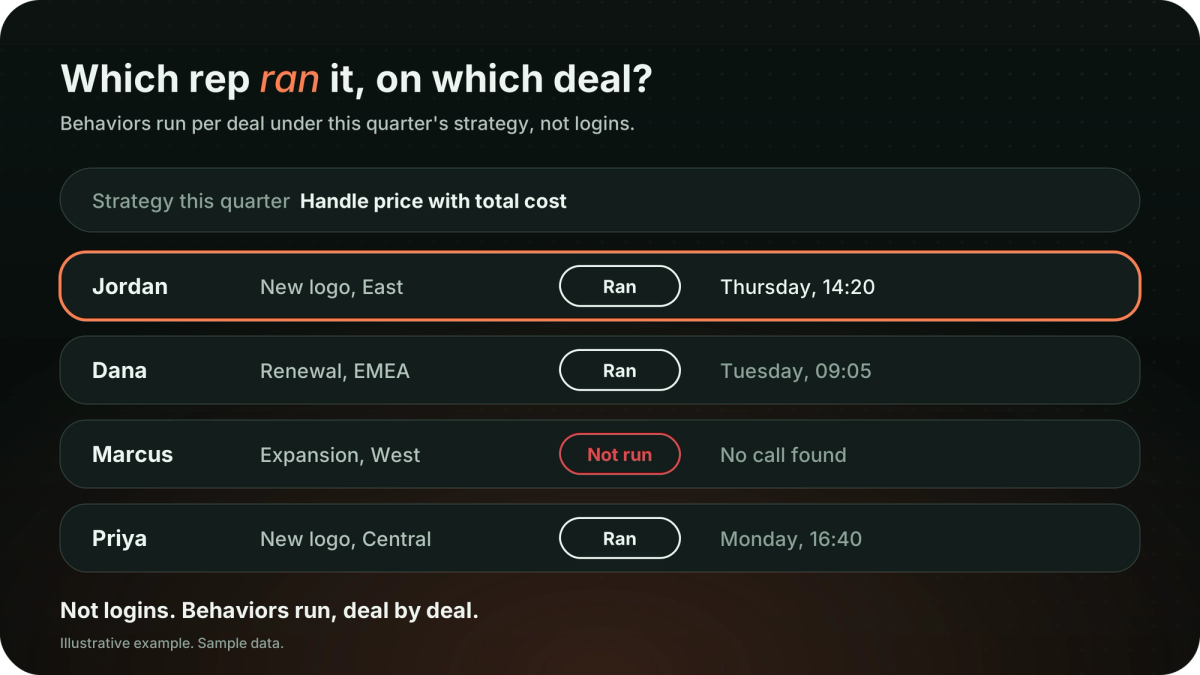
- So you check that your way ran, and keep what you built. You see which rep ran which behavior on which deal, not logins. Zime runs on Claude. Zime's own benchmark is 80% of eligible reps within 90 days, resulting in 20% uplift in deals won.
You are a CRO, and it is Monday's forecast review. The dashboard says every rep has the AI, and the usage chart is green.
Then you play back Thursday's lost deal. The buyer calls the price too high. Jordan, your AE, answers exactly as the AI told him to.
It is a good answer. It is also one any AE in your category could have given.
The AI is meant to give advice that is yours. So how would you know your reps sell a way a competitor's reps could not?
Four fixes, same generic answer
Fix one: a model on your data
It reads your calls and CRM and gets the facts right, and it draws on the same models your competitor does. At Versa Networks, Chitresh Yadav's team already used Claude for follow-ups and prep notes.
"That is where maybe AI can reach to some level, but not to the human level, right? Because there is a context that you need to build in."
Chitresh Yadav, VP and Global Head of Sales Engineering, Versa Networks
Every competitor can reach that level too.
Fix two: prompts and skills
Your team writes them. They add your voice and freeze what the writer knew that week.
Fix three: a model tuned to your calls
It learns what was said on them.
Fix four: coaching and enablement tools
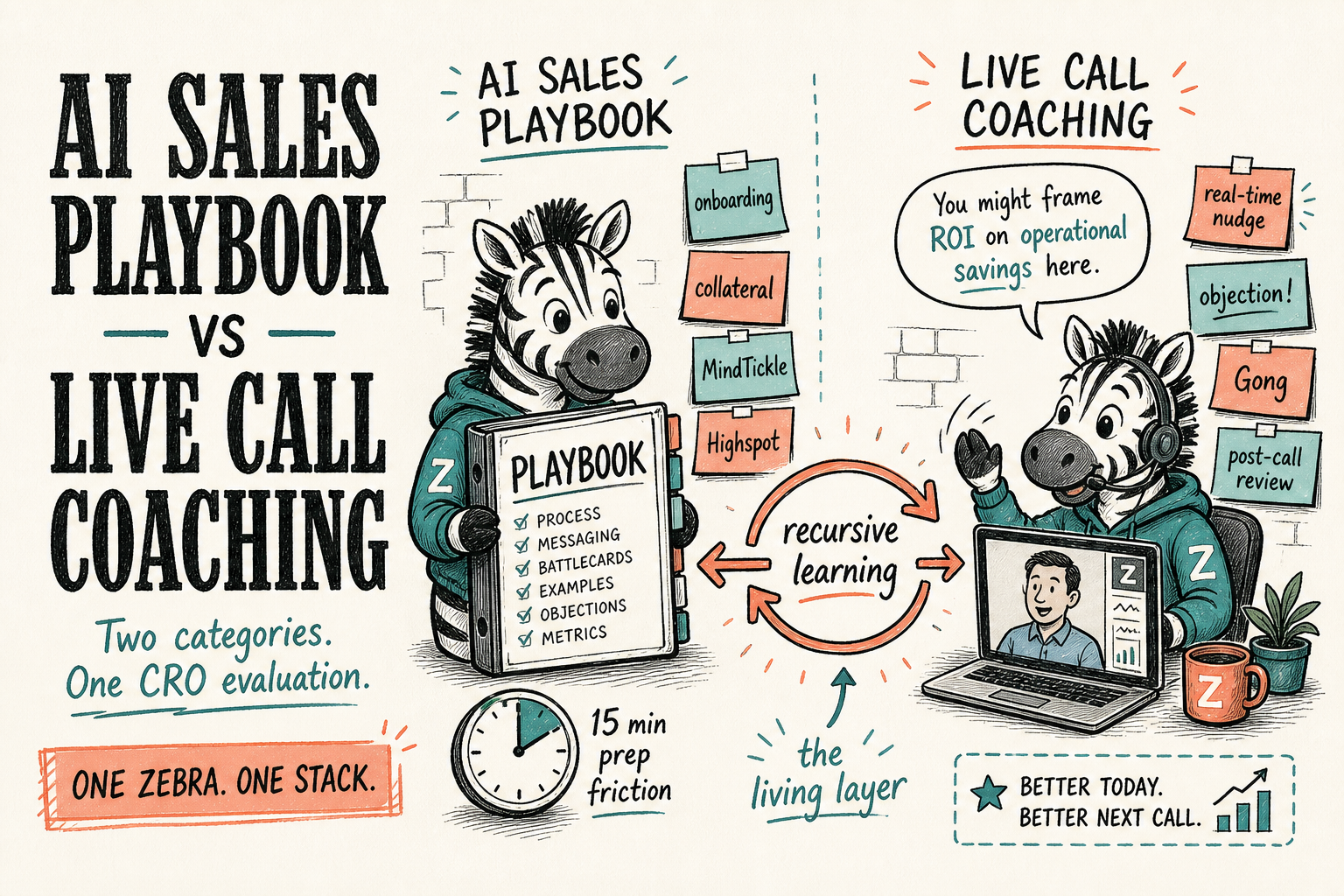
They score a rep against a method, and a score can rise while the calls sound the same (coaching versus workflow guidance goes deeper). Each recommends what to do. None is wrong to keep.
An answer that survives the move to another company is not yours.
| Test | What you do | Pass looks like | Fail looks like |
|---|---|---|---|
| Name-swap | Swap a competitor's name into one answer. | It breaks, because it names something only you do. | It still reads right. |
| Same-question | Ask a plain model, your AI and your best rep one deal question. | Your AI matches your best rep, not the plain model. | Your AI matches the plain model. |
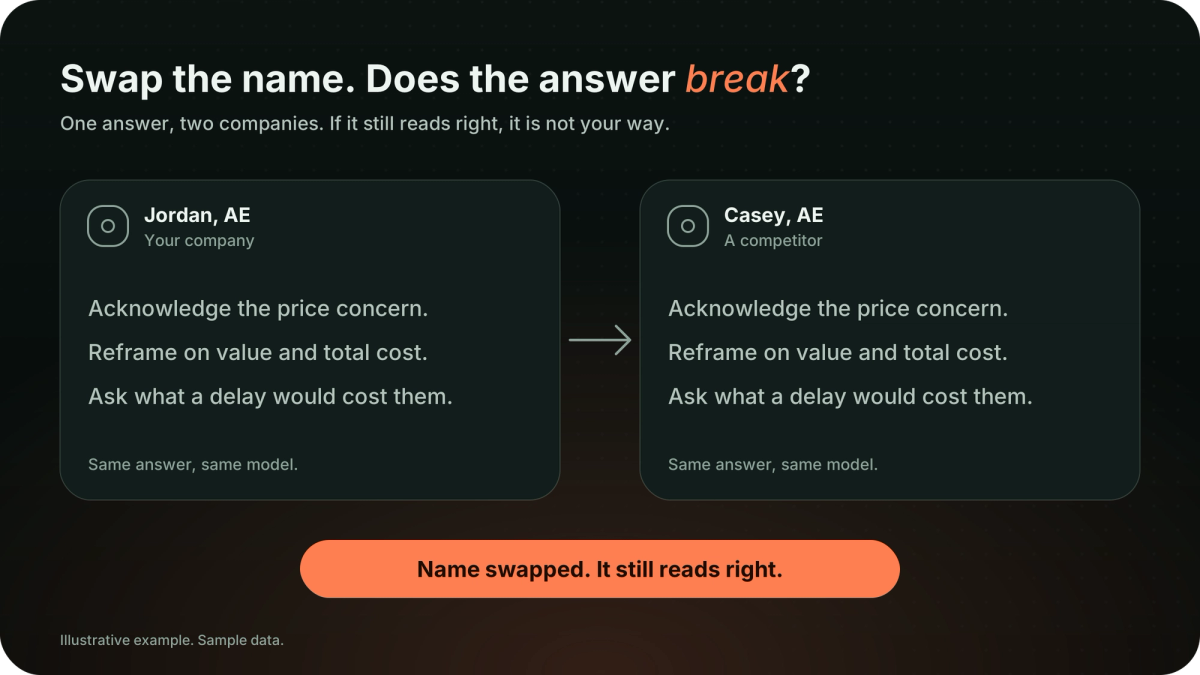
Start with the name-swap line.
The tests are small, so compare against your best rep. G2's enterprise review data found the average share of users who fully adopted an AI agent fell from 68% in 2024 to 55% in 2026.
Nobody has published how alike two companies' AI answers are, and Zime has not either.
The root cause behind every generic answer
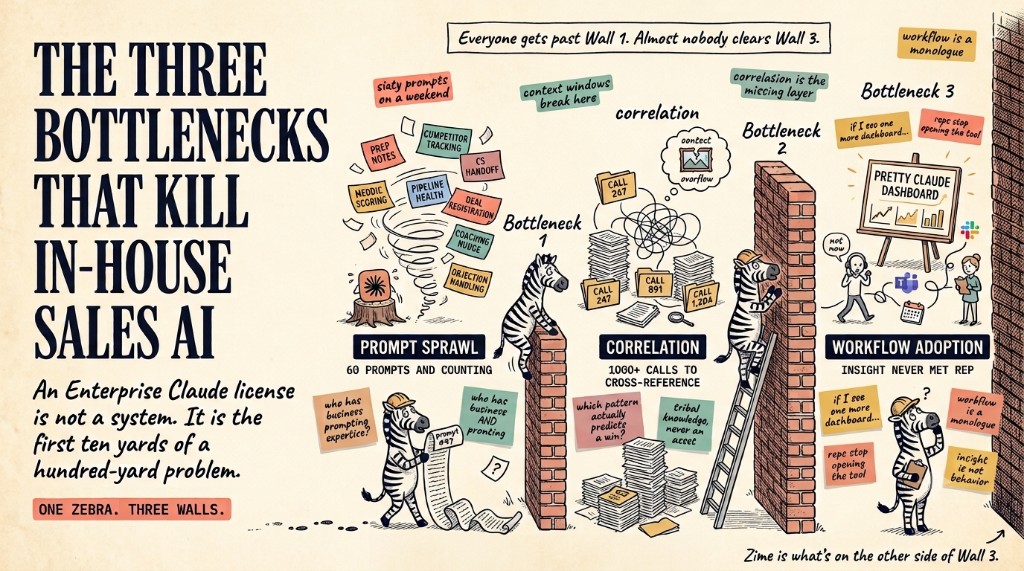
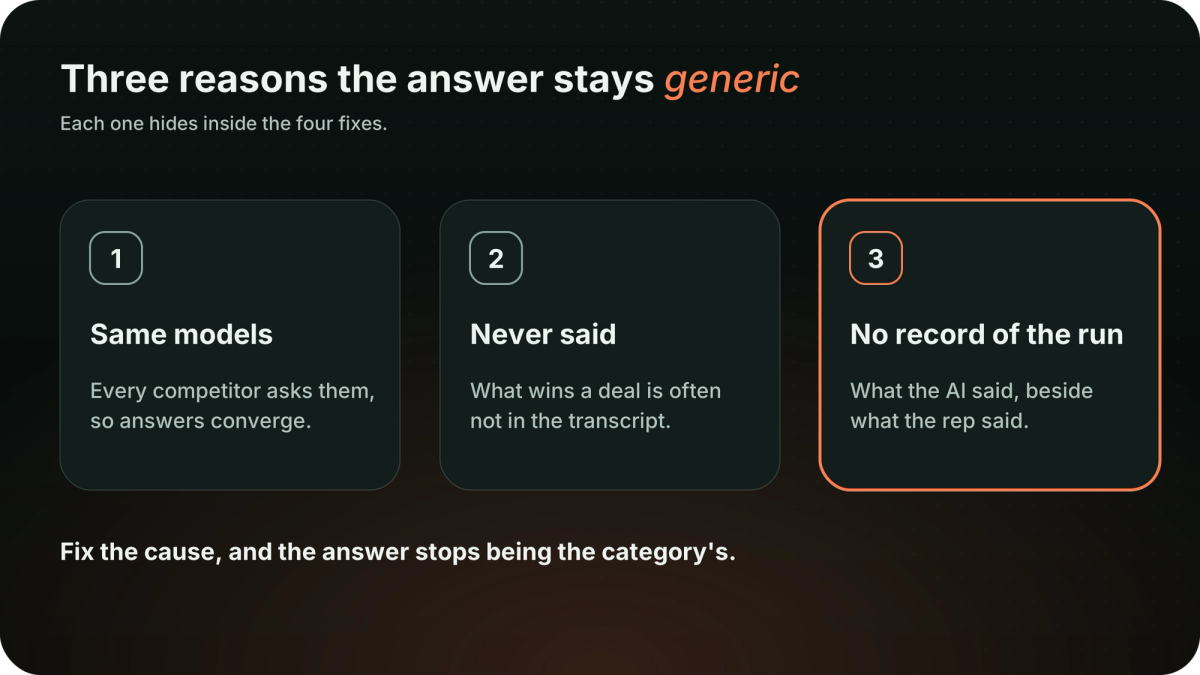
Three causes sit under all four fixes. Each has a tell.
Cause one: everyone draws on the same models. Competitors reach them too. So the same question gets the same answer. The tell is the name-swap test.
Cause two: what wins is often never said on a call. Fix three learns only what was said but not how reps decide what to say. Versa's CRO, Martin Mackay, wanted to understand wins and losses.
"...what do the most effective reps do in terms of moving a deal forward and then eventually closing it? And the second is why do we win versus lose?"
Martin Mackay, CRO, Versa Networks
His first question is about people.
Cause three: nothing sets what the AI said beside what the rep said. A screen shows an answer. It does not show the call. The ran test, below, is the tell.
The solution: a way of selling that is yours
Three things do. Your best reps taught it, including what they never wrote down. You authorized it for this quarter. And you can see it run.
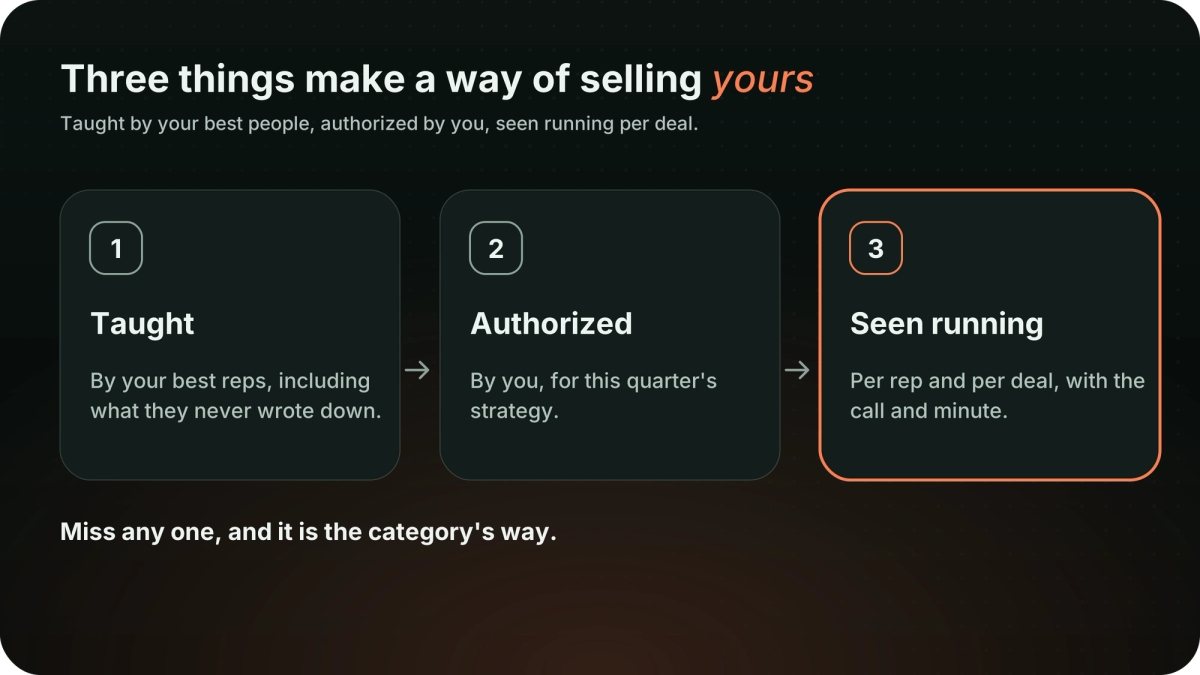
That is tribal knowledge, and it closes the gap between your strategy and what reps do.
Public models know the world. The layer on top has to learn how your company sells, from your best people and not only from your data. Behavior Graph is the name for that layer in Zime.
It holds your best reps' way of deciding and your strategy. Both are elicited from your best people through FDE-run interviews and RLHF, including what never shows up in a transcript.
Zime's forward-deployed engineers interview your best reps, then score and correct each behavior until they would run it. A behavior is the specific thing a rep says or does on this deal, with the winning deal behind it.
Every approach below recommends what to do. Only one carries what your best reps never wrote down and shows which rep ran it.
| What it does | Model with your data | Model plus prompts | Model tuned on calls | Behavior layer taught by best reps |
|---|---|---|---|---|
| Recommends what to do | ✓ | ✓ | ✓ | ✓ |
| Learns from what was said on calls | Partial | Partial | ✓ | ✓ |
| Carries what reps never wrote down | ✗ | Partial | ✗ | ✓ |
| Holds your authorized strategy | Partial | Partial | ✗ | ✓ |
| Shows which rep ran it, per deal | ✗ | ✗ | Partial | ✓ |
The line on showing which rep ran it carries the argument.
You can try this without a vendor. Pick one behavior, the price objection. Interview your two best reps, write one page, sign it, and listen to ten calls.
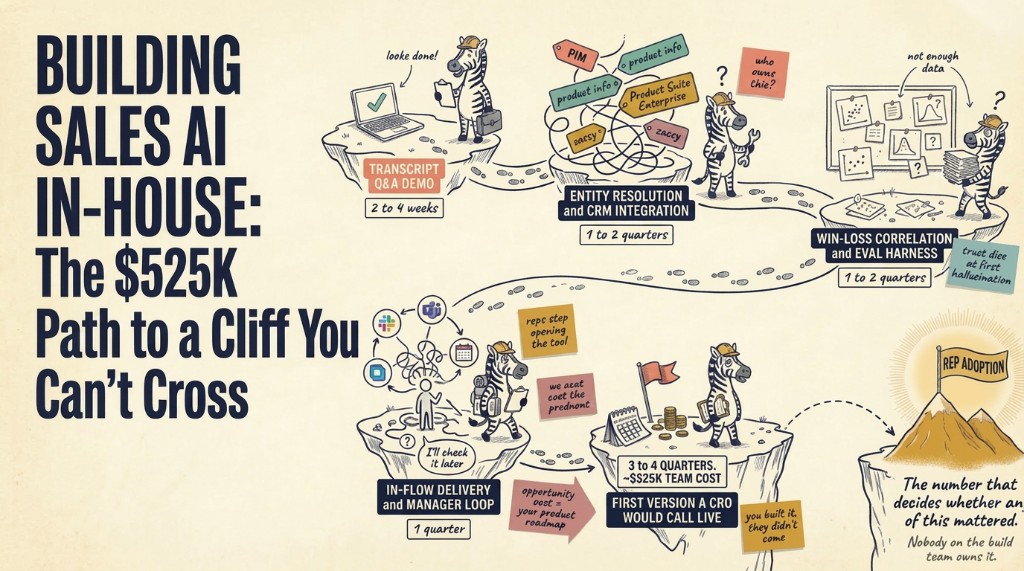
Zime estimates most organizations need 200+ evolving behaviors and 8 to 12 months to encode them by hand (build versus buy has the math). No independent study compares taught with mined behaviors.
The impact: reps run it and you can see it
Run Thursday again. Before the call, Jordan's prep note carries one behavior for this price objection against this competitor. Attached is the deal where one of your best reps ran it and won.
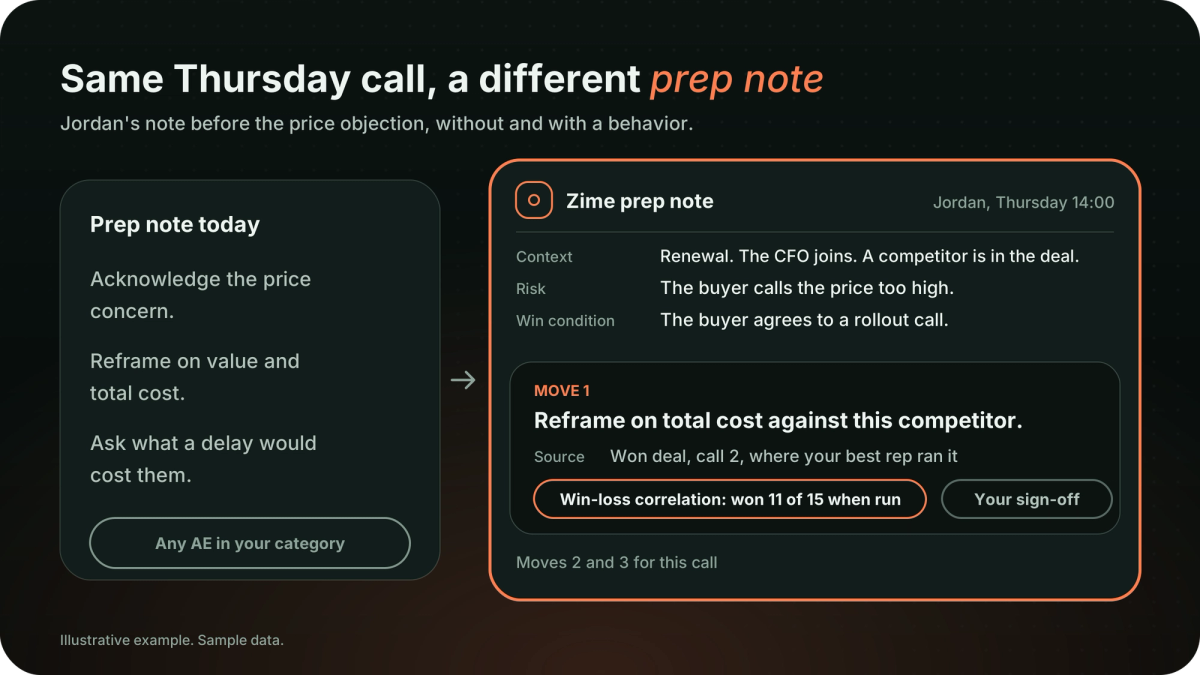
It carries your sign-off for the quarter.
He runs it. The buyer stops arguing price and asks about the rollout.
On Monday, a different report sets what the behavior said beside what Jordan said, with the minute and the strategy it served.
Versa's Brent Bair, a regional sales leader, described what changed.
"...the adoption rate has improved. I think it's become ingrained in our sales DNA..."
Brent Bair, Regional Sales Leader, Versa Networks
That is habit, not a login count.
The ran test counts. If you cannot find the call and the minute, it did not run, whatever the dashboard says. Zime calls this programmatic adoption: behaviors run, not logins.
Skan AI's Kenny Cao wanted to know how a new value proposition was landing.
"...how the team is delivering against the deck and against the new value proposition... versus whether they've done it."
Kenny Cao, Senior Director, Head of Go-To-Market Strategy and Operations, Skan AI
Bureau sells several products into the same buyers.
"So this monitoring led to execution ... Having a dashboard where non adherence is called out improves execution."
Kapil Bhagat, AVP, Sales Strategy, Bureau Inc.
Both ask for the same record: who did it, on which call.
The table below uses illustrative numbers. Each rep is compared with themselves, so habit cannot explain the gap.
| Rep | Ran it | Advanced when it ran | Advanced when it did not |
|---|---|---|---|
| Dana | 6 deals | 5 of 6 | 1 of 4 |
| Marcus | 3 deals | 2 of 3 | 2 of 5 |
| Priya | 9 deals | 7 of 9 | 1 of 3 |
| Sam | 1 deal | 1 of 1 | 1 of 3 |
Priya's line carries it: seven of the nine deals where she ran it advanced. Three of four reps advanced more often when they ran it. Sam's single deal is direction only. Where it matters, stagger the launch so a random half of your reps goes first.
At Versa, 79% of SEs were running the right technical discovery within three months, up from 20%. That counts behaviors run on live deals. Separately, HFS Research reports a 10% win-rate increase at Versa.
The picture shows that record per deal.
Make the answer your reps run yours. Keep your models, tools and dashboards. Zime adds your best reps' way of selling and your strategy, as behaviors each rep runs and you can check. Live in 7 days on your own data. Bring one price objection and your two best reps' answers, and see the behavior it becomes. Book a demo →
FAQ
How do I get an LLM to give sales advice specific to our company instead of generic answers?
Keep your model, then add what it cannot read: how your best reps sell and your strategy this quarter, elicited from your best people through FDE-run interviews and RLHF, including what never shows up in a transcript. Zime's Behavior Graph holds both and gives each rep the behavior to run, the specific thing to say or do on a deal.
When is a general model plus good prompts enough?
For a small team with one product, one motion and a deep AI operator, Claude plus custom prompts can be enough. It stops when role, product, competitor and region combinations outgrow one person's notes, and strategy changes have to reach every rep.
Do we have to replace Claude or the tools we already use?
No. Zime runs on Claude and delivers behaviors through the tools your reps already open, so nothing is ripped out. Zime also ships Execution Context, its own layer for entities and deal history, so you are not blocked if you have none.
What changes when our strategy changes mid-quarter?
Zime's forward-deployed engineers encode the new strategy in the Behavior Graph, and the behaviors reps receive, the specific things to say or do on a deal, change with it. Every recommendation traces to its source, its approver and its version, so you can see which version a rep ran.
What should we ask any vendor before we buy?
Ask for its output with your name swapped for a competitor's, who taught the behaviors, which rep ran which behavior on which deal, the cost at your volume as a written figure, and any proof that buyers notice the difference.