How do we know if our upsell playbook caused the pipeline lift, or it would have happened anyway?

- Your installed-base pipeline really did go up. The upsell playbook launched at the start of the quarter. Reps finished the training. The CRM now shows more expansion opportunities than last quarter, and the timing points at the playbook.
- But you can not see which accounts actually got the playbook. The CRM records the opportunity, not the call where a rep ran the upsell steps. So a strong market, a price change and the playbook all look the same on your dashboard. Your CFO will ask which one it was.
- And the usual checks can not tell them apart. Before-and-after hands the playbook the market's tailwind. Trained against untrained compares people, not whether the playbook ran on a call. Holding it back from half your reps would cost you the quarter you are trying to measure.
- That comparison already sits inside your quarter. Some eligible accounts got the playbook on a call before their opportunity opened, and others did not. Compare the two within each rep's own accounts, and the tailwind falls on both sides. If the gap holds, scale the playbook; if it vanishes, fix it before next quarter.
- So the playbook has to be something a call can be checked against. Zime's Behavior Graph turns it into the steps your top reps run, from their tribal knowledge, including what never shows up in a transcript, and this quarter's CRO strategy. Then it checks every call. You see behaviors run, tied to the strategy that authorized them and the deals they moved.
Week eleven. As CRO, you are building the QBR deck. Slide four has the chart: installed-base pipeline, up since the upsell playbook went live.
The playbook was good work. Your top reps helped write it. It says when to raise the second team, which usage signal to name and what case to bring.
Then your CFO reads slide four. Would those accounts have expanded anyway?
In a Gartner survey of 227 chief sales officers, 31% cited difficulty proving the ROI of AI-driven tools as a top challenge for 2026. A playbook launch faces it too.
You have the CRM, the launch date and the completion report. None of them shows which eligible accounts heard the playbook on a call. So the CFO's question hides a sharper one. Did the lift come from the accounts where your reps actually ran it?
Three accounts, one quarter
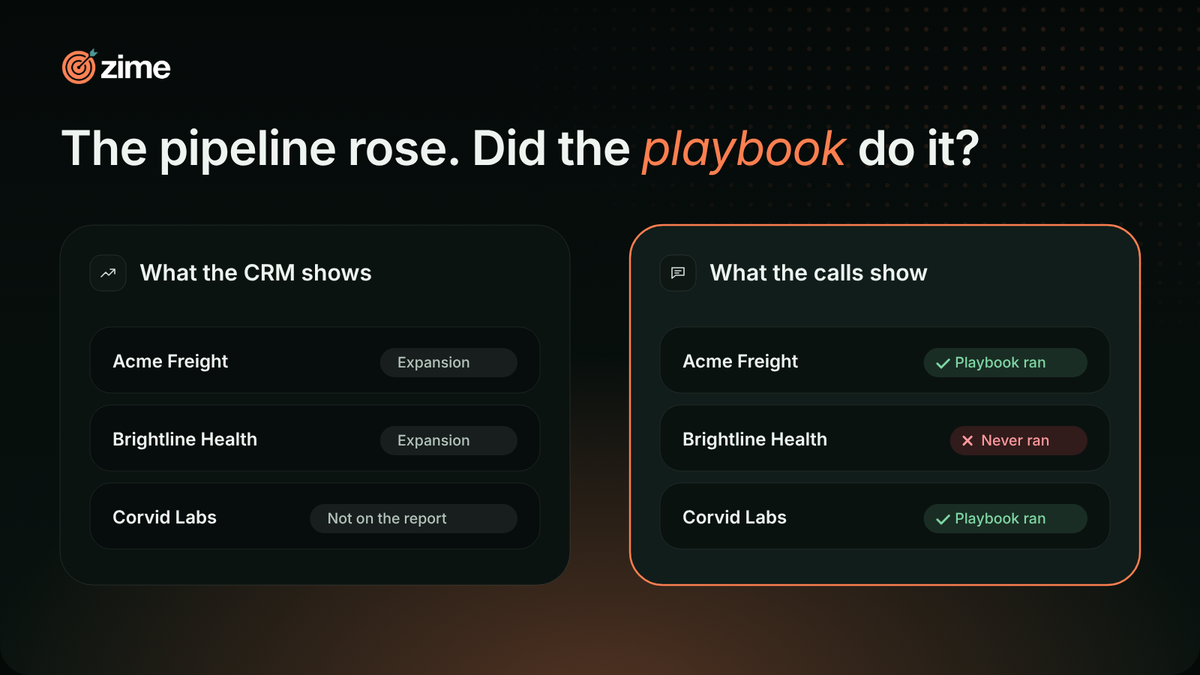
At Acme Freight, Maya ran the playbook on the quarterly review. She raised the second team and made the case. An expansion opportunity opened two weeks later.
At Brightline Health, Luis never got to it. In week six, their ops lead emailed to add seats for a new region. An opportunity opened that day.
At Corvid Labs, Tessa ran every step. The buyer agreed and said budget opens next fiscal year. No opportunity yet.
In the CRM, Acme and Brightline look identical: expansion, created after launch, owned by a certified rep. Corvid does not appear. Same row, different story. The account the playbook never touched counts toward the lift.
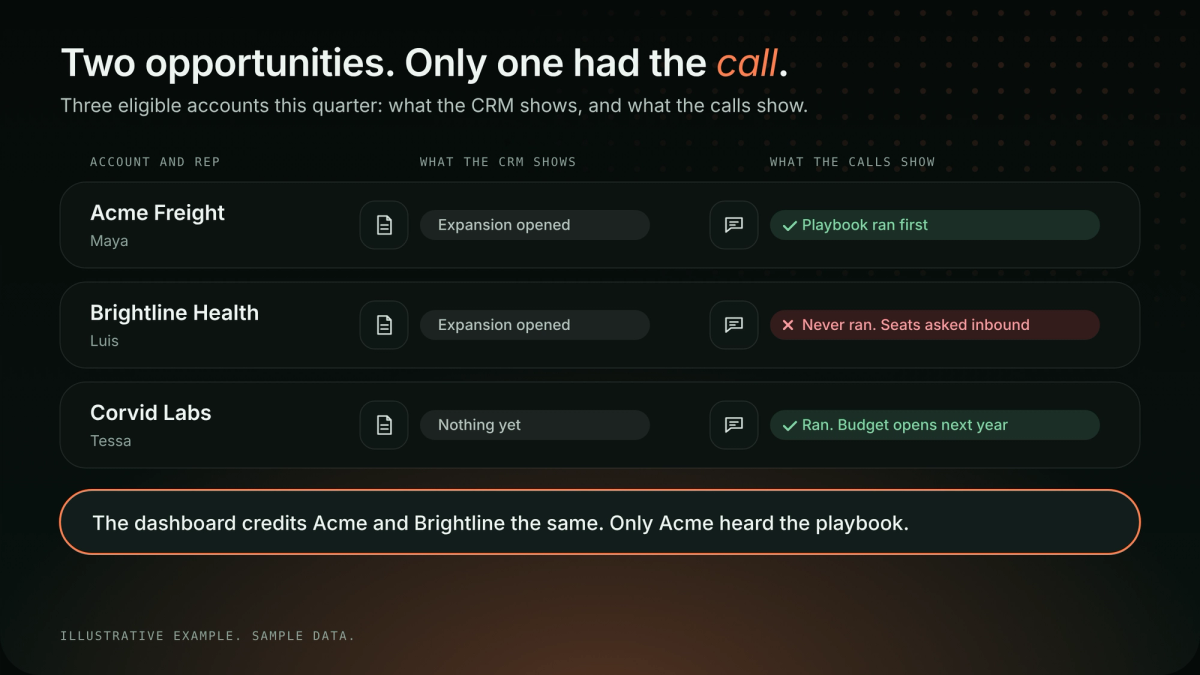
The CRM records the opportunity, not the call where a rep ran the steps. HFS Research describes the wider pattern: the plan a CRO sets does not convert into execution, so reps revert and win rates stall. It is also why healthy coverage still misses the quarter.
Kenny Cao runs go-to-market strategy and operations at Skan AI. In October, he described his goal.
"I want to understand how the team is delivering against the deck and against the new value proposition ... versus whether they've done it."
Kenny Cao, Senior Director, Head of Go-To-Market Strategy and Operations, Skan AI
How each call delivered the play decides which accounts earn credit.
Why the usual checks can't settle it
Before and after hands the playbook the market's tailwind. The tell: the same quarter last year rose too.
Trained against untrained compares people. Reps who finish first are often your strongest, and they expand accounts anyway. The tell: the gap shrinks against each rep's own last quarter.
CRM attribution credits touches. The tell: tags jump right after managers are reminded to fill them.
Keyword tracking hears "expansion" even in a renewal complaint.
A holdout group is the cleanest. Hold the playbook back from random accounts, and the difference is the playbook's. Most CROs will not trade upsell coverage for it. A staggered rollout costs less: a random half of eligible accounts gets the playbook in month one, the rest in month two.
The table below shows where each check holds and where it breaks. Only a holdout, a staggered rollout or a same-quarter ran split keeps the market and your best reps out of the answer.
| What the check does | Before and after | Trained vs untrained | CRM attribution | Holdout group | Staggered rollout | Ran vs not ran, same quarter |
|---|---|---|---|---|---|---|
| Uses records you already have | ✓ | ✓ | ✓ | ✗ | ✗ | Partial |
| Keeps the playbook with every rep | ✓ | ✓ | ✓ | ✗ | ✓ | ✓ |
| Removes the market's tailwind | ✗ | ✓ | ✗ | ✓ | ✓ | ✓ |
| Removes the best-rep effect | ✓ | ✗ | ✗ | ✓ | ✓ | ✓ |
| Removes the warm-account effect | ✗ | ✗ | ✗ | ✓ | ✓ | Partial |
| Knows which calls it ran on | ✗ | ✗ | ✗ | ✗ | ✗ | ✓ |
| Shows which step to fix | ✗ | ✗ | ✗ | ✗ | ✗ | ✓ |
Five methods are blind on which calls the playbook ran on. On the attribution report, Brightline counts as a playbook win. On a ran split, it sits with the accounts that never heard it.
Kapil Bhagat leads sales strategy at Bureau, which sells identity decisioning through multi-product discovery. In early 2024, he could not show his team who ran the discovery play.
"I did not have the data to present to go back to my team ... But if this is percentage then improvement is possible."
Kapil Bhagat, AVP, Sales Strategy, Bureau Inc.
A percentage of calls where the play ran is what every check above lacks.
Split by ran, not by trained
Some eligible accounts heard the playbook on a call before any expansion opportunity opened. Others did not. Both lived through the same market. The tailwind lands on both sides.
Compare them within each rep's book: Maya's ran accounts against her not-ran accounts. Your strongest reps drop out of the answer.
Define a run before you count, as you would for a win-loss finding. A mention is not a run. A run is the steps on the call: the second team raised, the usage signal named, a next step agreed with the buyer.
The table below lists four tests, with pass and fail for each. If timing and warm accounts pass, the same-rep gap is the playbook's share of the lift.
| Test | What to pull | Passes when | Fails when |
|---|---|---|---|
| Timing | Opportunity date and playbook call date | The call comes first | The opportunity came first |
| Same rep | Each rep's ran and not-ran accounts | Most reps open more where they ran it | Only your two strongest reps show a gap |
| Warm account | Seat requests or usage jumps before the call | The gap holds without those accounts | The gap vanishes without them |
| Bookings | Closed-won expansion at quarter end | The gap carries into closed deals | Pipeline rose, closed-won did not |
The table below is a sample read-out with illustrative numbers. Read it by rep, never pooled.
| Rep | Ran: opened | Not ran: opened | Gap holds? |
|---|---|---|---|
| Maya | 3 of 6 | 1 of 5 | Yes |
| Luis | 2 of 4 | 2 of 7 | Yes |
| Tessa | 2 of 5 | 1 of 4 | Yes |
| Jordan | 0 of 3 | 2 of 6 | No |
Three of four reps show the gap. Luis's gap still holds without Brightline, which asked first. Credit the playbook, then read Jordan's calls for the step he skipped.
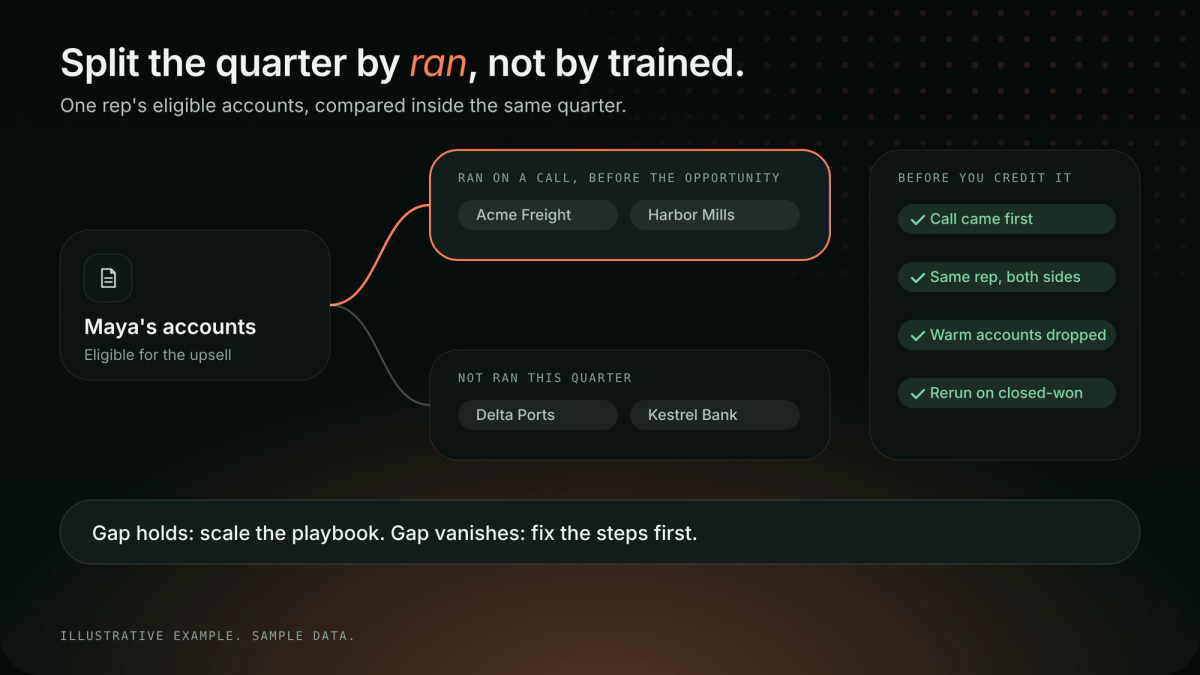
The run column changes behavior on its own. Kapil saw it at Bureau.
"So this monitoring led to execution ... Having a dashboard where non adherence is called out improves execution."
Kapil Bhagat, AVP, Sales Strategy, Bureau Inc.
Once reps see the column, next quarter's not-ran group shrinks. So next quarter, stagger the launch.
Back to the QBR, with the calls
You can fill that column yourself. Pull the last call before each opportunity and check it for the three steps. Twenty accounts take an afternoon. Every account, every quarter, does not. Martin Mackay is CRO of Versa Networks, running four regions. On a win-loss call in June 2026, he asked where the evidence would come from.
"Is it taking from Rep notes from Salesforce, or is it taken from calls?"
Martin Mackay, CRO, Versa Networks
From calls. Rep notes record what the rep remembers.
That is the column Zime for CROs fills. First it writes your playbook as steps a call can be checked against. The steps come from your top reps' tribal knowledge. It is elicited from your best people through FDE-run interviews and RLHF, including what never shows up in a transcript. FDE-run interviews are Zime's engineers interviewing those reps; RLHF is scoring each step until they would run it. The steps also carry this quarter's CRO strategy. The model that holds all of it is the Behavior Graph.
Then Zime checks every call. Programmatic Adoption shows behaviors run by rep and account, tied to the strategy that authorized them and the deals they moved.
At Versa Networks, that column showed 79% of SEs running the right technical discovery within three months, up from 20% at the start. That was discovery. We have not yet published a customer case measuring an upsell playbook's lift this way. What is published is the run column, counted on live deals.
Back at week eleven, slide four splits the eligible list. Acme Freight sits under ran, with Maya's call two weeks before the opportunity. Brightline Health sits under not ran, credited to the customer's own request. Corvid Labs sits under ran, flagged for next quarter.
Your CFO sees the same-rep gap and the call behind each account. Maya sees her account credited. Luis gets the steps before his next Brightline call. You decide whether to scale the playbook, fix one step or drop it.
The CFO asks which accounts it ran on. You open the list.
See where your playbook ran.
Keep your CRM and playbook. See which accounts heard it on a call, and what moved after. Book a demo
FAQ
How do you know if an upsell playbook caused the pipeline lift, or it would have happened anyway?
Split this quarter's eligible accounts by whether a rep ran the playbook on a call before an expansion opportunity opened. Compare within each rep's accounts, so the market and your strongest reps sit on both sides. Zime supplies that ran column: its Behavior Graph holds the playbook as your top reps' steps, including what never shows up in a transcript, and Programmatic Adoption shows behaviors run per account, tied to the deals they moved.
Can I measure it without holding the playbook back from some reps?
A holdout is cleanest if you can afford one. Without it, compare accounts where reps did not run it this quarter, or stagger the launch so a random half goes first.
How many accounts do I need before the difference means anything?
Read it rep by rep. Count the reps whose gap holds. A rep with fewer than three accounts on either side gives direction only.
What is behavior-to-outcome linkage in sales?
It is the link between a step a rep ran on a call and what the deal did next. For an upsell playbook: was the second team raised, and did an opportunity follow? Rep notes report the step; the call shows it.