How do you make your revenue team less dependent on a few hero reps?

- Your top reps are real, and your recorder already captures their calls. Your playbook, coaching and enablement are doing their jobs too.
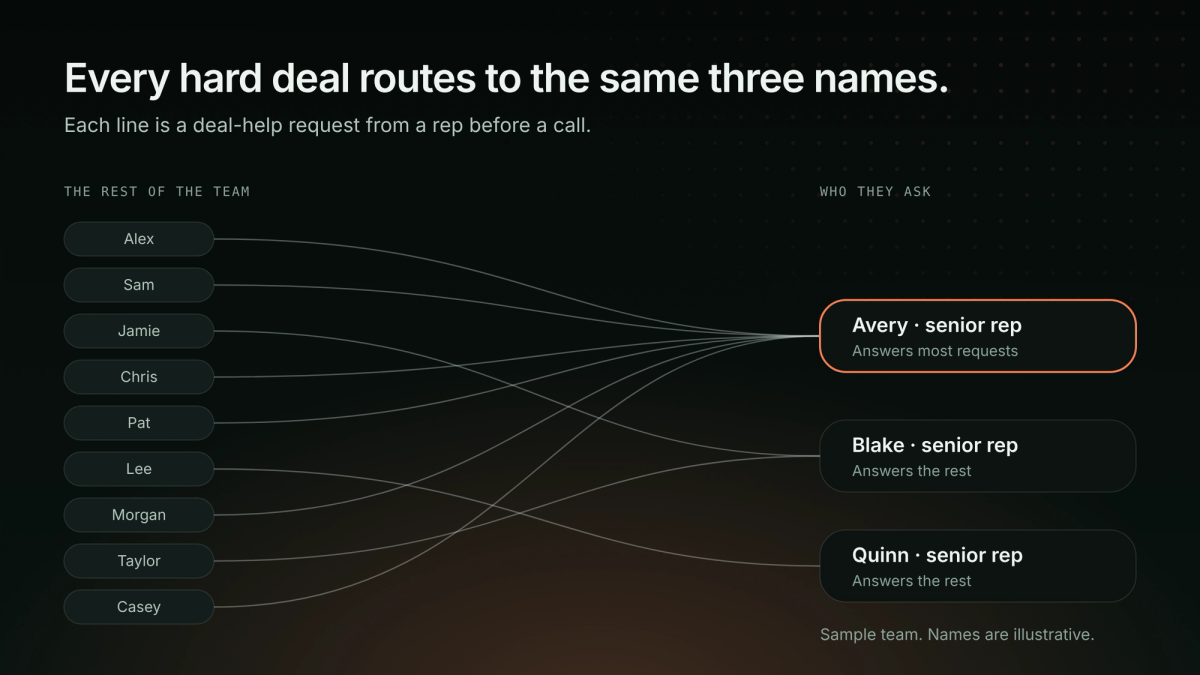
- But what they do differently was never written down. So nobody else can run it, and when a deal gets hard, reps message the same three names.
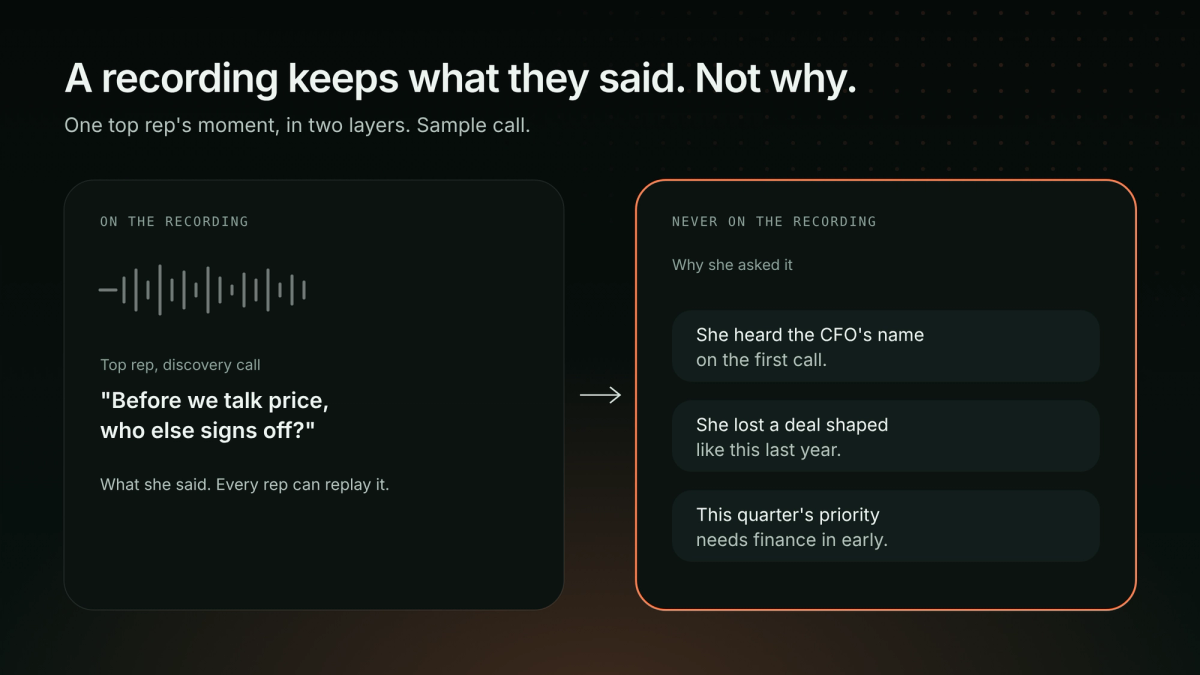
- And a recording keeps what they said, not why. Listening teaches the words, not the reasoning, so the rest of the team can't run the move in their own deals.
- That tribal knowledge is what Zime draws out and delivers. Its team interviews your top reps and you, including what never shows up in a transcript, and maps it as a Behavior Graph: which move wins where.
- So the rest of the team runs it, and you count it. Moves reach reps before and during calls, and you see who ran each. At Versa Networks, 79% of SEs ran the right technical discovery within three months, up from 20%.
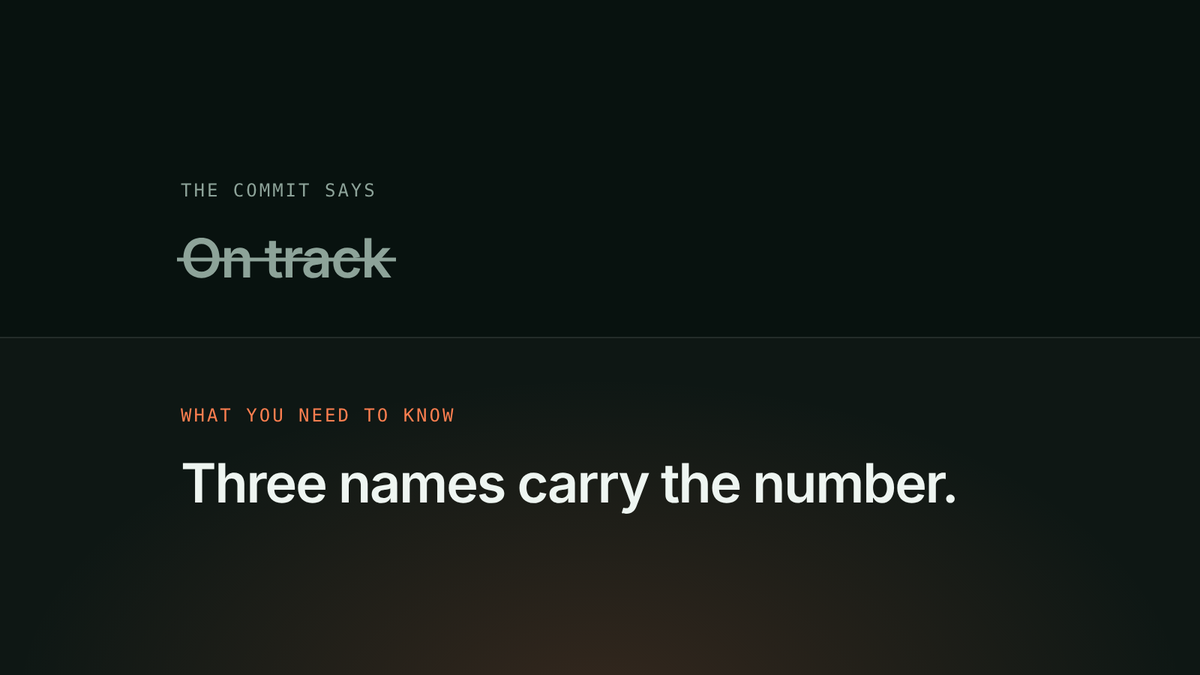
It's the Thursday commit call, week ten. The number reads on track. Then you read the names beside it. Three names carry the number.
That afternoon, the deal-help channel lights up. "On a call tomorrow against our biggest competitor. Can someone help?" The same senior rep replies, as she did yesterday.
Every call is recorded. Enablement certified the team last quarter. Your top reps are real, and they're good. But the commit and the channel say one thing: the number rests on what three people know.
So the question isn't how to hire a fourth. It's how you get the rest of the team running what only your top reps know, and how you'd know they are.
That's the problem Zime was built to solve. Zime is Behavioral AI for Sales Execution: your strategy, running in every rep's workflow. This post follows Versa Networks from a few expert sales engineers to most of its SEs running their moves. It also shows what Bureau, MyAdvice and SonicWall saw when the rest of their teams did the same. Start with how much rides on those three names.
What only your top three know
Run this first. Pull the commit and two quarters of closed-won by rep, plus 30 days of deal-help requests by the name each tags. It fails if losing two names takes the quarter below plan, or most requests tag the same three. Otherwise it passes. No published benchmark says how concentrated a team should be, so trust your own commit.
Martin Mackay is CRO at Versa Networks, with 200+ reps across four regions. Versa sells against ten named competitors, in deals from $100K to $3M that turn on technical evaluations. On a call with Zime, he named the first thing he wants to know:
"... what do the most effective reps do in terms of moving a deal forward and then eventually closing it?"
Martin Mackay, CRO, Versa Networks
His first question was about people, not process. The answer lived with the reps who make those moves.
Versa's own team had that shape. Almost every Versa deal turns on a technical evaluation, and 60% of its fatal objections were technical or product fit. Its sales engineers ran those calls without a manager on the line. At the start, only 20% of SEs ran technical discovery the way the best did, and context got lost at the handover from AE to SE.
The obvious fixes don't touch that. Another star adds a fourth name. Better comp keeps the three you have. Pod selling spreads the deals. The reasoning stays in three heads.
So why hasn't the rest of the team picked it up from the calls?
Why their calls don't teach the rest
Your call recorder already captures what each rep says on every call. What it can't hold is what the best reps do differently, and why. Your top rep asks who else signs off because of something she heard on call one. Those are specific moves at specific moments in a deal, and Zime calls them behaviors. Your strategy runs on 1,000+ behaviors. Nobody has written them down, tested them or kept them current.
So reps reach for the person. Chitresh Yadav runs Versa's 100+ SEs over four regions, on a portfolio that keeps broadening. He described what they need mid-deal:
"As our portfolio gets broader, we have more products, more technologies. SEs should know. You should have a tool available that will give them just-in-time information. I'm going for a call, I'm up against Fortinet, can you help me?"
Chitresh Yadav, VP and Global Head of Sales Engineering, Versa Networks
That last line is your deal-help channel. When the reasoning lives in a few heads, reps go find the head.
He could already see every call. What the view didn't show him was who ran the right discovery:
"This is the dashboard I typically see, and it is drowning me. When I go to my org level, I'm drowning because it shows everything."
Chitresh Yadav, VP and Global Head of Sales Engineering, Versa Networks
Seeing everything didn't change what his SEs did on the next call. The reasoning still sat with a few of them.
Training doesn't close it. Kenny Cao heads go-to-market strategy and operations at Skan AI. On a call with Zime about a new value proposition, he named the gap:
"I want to understand how the team is delivering against the deck and against the new value proposition, right? It is more of an enablement understanding versus whether they've done it."
Kenny Cao, Senior Director, Head of Go-To-Market Strategy and Operations, Skan AI
Completion records show who understood it. They can't show who ran it. Each common fix has its tell:
- Playbook and training. Reps still tag the top rep before the call.
- Call libraries. Views rise, and the same three names still answer.
- A team channel or wiki. Answers arrive only when a star is free.
- Coaching the middle. Each manager coaches a different version.
Test the transfer yourself, before any vendor. Ask your top rep, for 30 minutes, when she makes one move and why. Write it as trigger and move, give it to three mid-tier reps, and check 10 calls each where the trigger came up. It passes if the move runs on most and nobody tags the star first. It fails if it runs only the week someone coached it. Stagger the start, and the late half is your comparison.
The table below runs that test on illustrative sample numbers: six reps, two staggered groups, five trigger calls per fortnight each.
| Rep | Got the move | Move run, weeks 1-2 | Move run, weeks 3-4 | Tagged the star first |
|---|---|---|---|---|
| Dana | Week 1 | 4 of 5 | 4 of 5 | No |
| Marcus | Week 1 | 3 of 5 | 4 of 5 | No |
| Elena | Week 1 | 4 of 5 | 5 of 5 | No |
| Jordan | Week 3 | 1 of 5 | 4 of 5 | Once, in week 2 |
| Kim | Week 3 | 0 of 5 | 3 of 5 | No |
| Tom | Week 3 | 1 of 5 | 4 of 5 | No |
| Verdict | Early group 11 of 15, late group 2 of 15 | Late group catches up, 11 of 15 | Pass |
In weeks one and two, reps with the move ran it on 11 of 15 trigger calls; reps without it, on two. Then the late group caught up. That's a transfer.
By hand, it works for one move and stalls at the hundredth. The Signal profiled a CRO who runs his revenue org from Claude Code. Eight months in, the judgment is still hand-built: a Sales Bible from 409 calls of his single best rep. That's one rep, while your strategy moves every quarter. The in-house math is in Should you build GTM agents in-house on Claude, or buy a platform?.
Versa ran the same math. Chitresh estimated an in-house build at 12 to 24 months and about a million dollars, with the tribal knowledge encoded into hundreds of skills. He chose Zime instead.
How Zime gets the rest of the team running it
Zime for CROs solves this: it draws out what your top reps know, puts it into every rep's deal, and shows you who ran it.
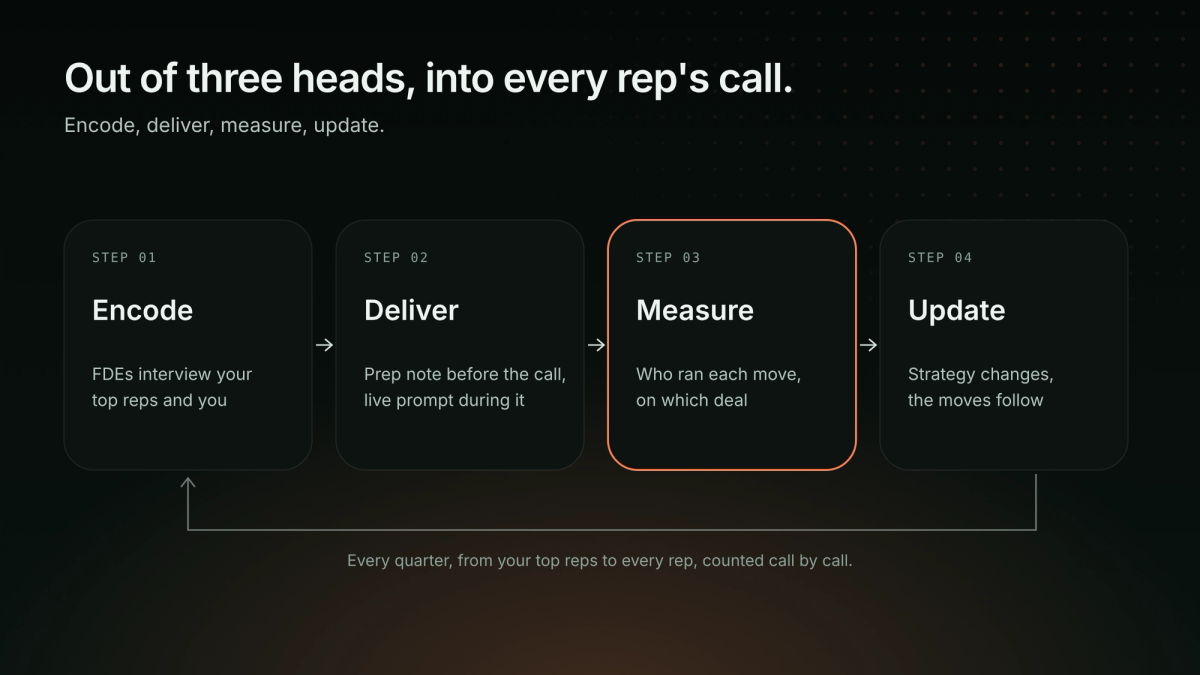
- Encode. Zime's forward-deployed engineers (FDEs) interview your top reps and you. What they capture is elicited from your best people through FDE-run interviews and RLHF, including what never shows up in a transcript. RLHF means scoring and correcting each move until your top reps would run it. It goes into the Behavior Graph, the model that holds this tribal knowledge, your CRO strategy and your past deals, and produces the behaviors.
- Deliver. Each rep gets the move in the prep note before the call. During it, Live Coach sends a live prompt on screen.
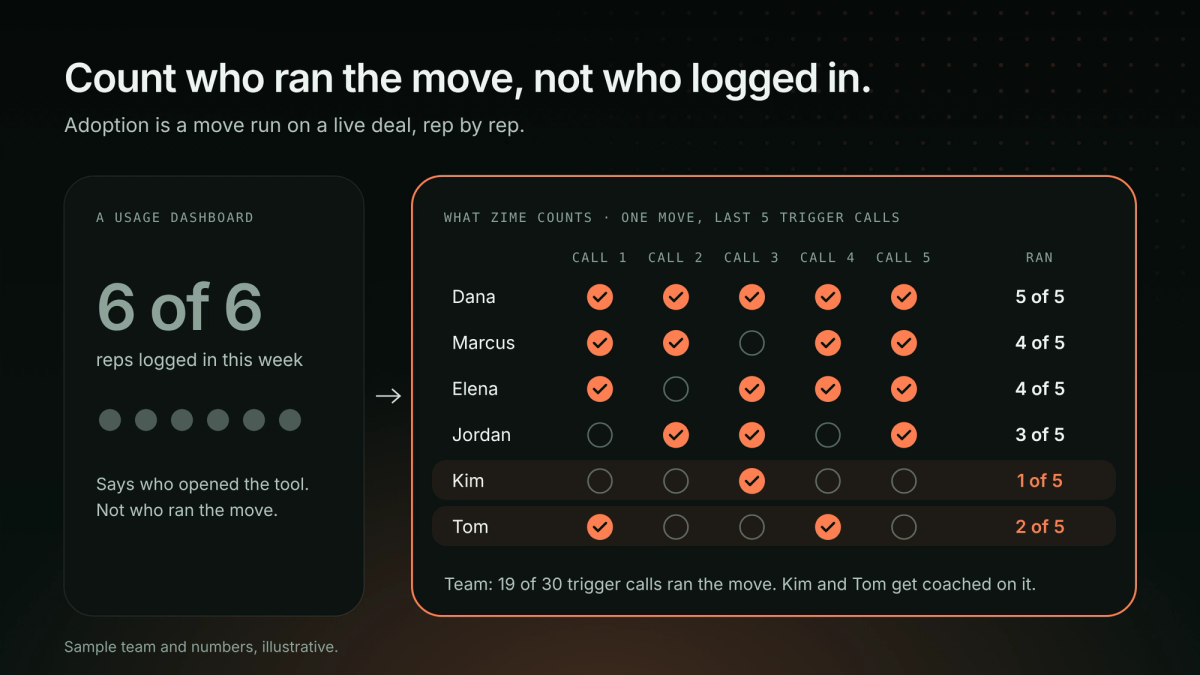
- Measure. Programmatic Adoption counts behaviors run on live deals, not logins: which rep ran which move, on which deal.
- Update. When your CRO strategy changes, FDEs encode it and the moves follow.
The moves are your top reps' and your priorities, never a generic best practice. Your recorder, CRM and playbook stay.
At Versa, this is how it ran. Zime's FDEs interviewed Chitresh and Versa's enablement and revenue leaders on what a good technical evaluation looks like. That became a stage-by-stage discovery and POC playbook: the current stack, the requirements, the budget and the pilot test cases, agreed upfront. Checklists fire from the Salesforce opportunity stage. Prep notes add guidance for the competitor in play. After each call, each SE gets a score on whether they ran it. Zime delivered it in one month.
Of the four steps, measurement is where the dependency comes down. Encoding puts the move in writing. Delivery puts it in front of the rep. Neither tells you whether the rep ran it with a buyer. A usage dashboard counts who opened the tool. Programmatic Adoption counts something else: on each call where the moment came up, did the rep run the move? It counts rep by rep and deal by deal, tied to the CRO strategy that set the move.
That count answers three questions you get asked. Which reps still lean on a star: the move doesn't show up on their calls. Where to coach: the manager sees the exact call where it was skipped, not a monthly average. And whether the strategy was wrong or never ran: a move that ran and still lost is a strategy question, while a move that never ran is an adoption question.
Versa measured it this way. The per-call score showed which SEs ran the stage's discovery steps, and which skipped them. That is how Versa knew, within three months, that 79% of SEs were running the right technical discovery, up from 20%. The count is what turned a few experts' habit into a team number.
Built an in-house agent on a frontier model? Keep it. Both systems recommend a move. The difference is upstream: one reasons from what's in your data, the other from your top reps and your strategy.
The table below compares the usual approaches; the rows that decide it are whether an approach captures why, and whether it shows who ran it.
| Capability | Hire more stars | Playbook and training | Call libraries | Team channel or wiki | Coach the middle | In-house agent on a frontier model | Zime |
|---|---|---|---|---|---|---|---|
| Keeps what top reps said on calls | ✗ | Partial | ✓ | Partial | Partial | ✓ | ✓ |
| Captures why they made the move | ✗ | Partial | ✗ | Partial | Partial | Partial | ✓ |
| Recommends a move in the live deal | ✗ | Partial | ✗ | Partial | Partial | ✓ | ✓ |
| Reaches every rep without a star | ✗ | ✓ | ✓ | ✗ | Partial | ✓ | ✓ |
| Shows who ran it, on which deal | ✗ | ✗ | ✗ | ✗ | Partial | Partial | ✓ |
| Changes when your strategy changes | ✗ | Partial | ✗ | Partial | Partial | Partial | ✓ |
Every approach does part of the job; the in-house agent recommends too. Only one captures the reasoning and shows, call by call, who ran it.
Now replay that week with Zime in place. A mid-tier rep has tomorrow's call against your biggest competitor. Her prep note carries your top rep's move, with the deal it came from. The buyer raises price early, and a live prompt reminds her. She runs it. Nobody posts in the channel. On Friday, you see who ran it, on which deals.
The table below maps the questions behind hero-rep dependency to what Zime shows and who acts on it.
| Your question | What Zime shows | Who acts |
|---|---|---|
| Whose deals carry the number? | Commit by rep, beside the moves each ran | You and RevOps |
| What do my top reps do that others don't? | Their moves, drawn out in FDE interviews | Top reps confirm, FDEs encode |
| Did the rest of the team run it? | Which rep ran each move, on which deal | Frontline managers |
| Where does a rep still reach for a star? | The move skipped when the deal turned | That rep's manager |
| What happens when strategy changes? | The updated move in the next prep note | You set it, FDEs encode it |
What changes when the middle runs it
At Versa, within three months, 79% of SEs were running the right technical discovery, up from 20% at the start. That figure counts moves run on live deals. Logins and courses aren't in it. The team saw 12% more technical wins and 24% less leakage in the committed pipeline. HFS Research cited Versa's 10% increase in win rates. Martin Mackay judged it by deals, not usage:
"Zime helped our sales team qualify deals more accurately and move them through the pipeline."
Martin Mackay, CRO, Versa Networks
Martin had asked what his most effective reps do. Within three months, most of his SEs were doing it. Brent Bair, a regional sales leader at Versa, saw the change on his team:
"As I look at my team, the adoption rate has improved. I think it's become ingrained in our sales DNA now that this is incredibly valuable as we're progressing through deals."
Brent Bair, Regional Sales Leader, Versa Networks
That's what less dependent looks like: the move became part of how his team works a deal.
Bureau runs multi-product, multi-threaded deals. Kapil Bhagat, AVP of sales strategy, saw what moved execution:
"So this monitoring led to execution ... Having a dashboard where non adherence is called out improves execution."
Kapil Bhagat, AVP, Sales Strategy, Bureau
Seeing who skipped the move changed what reps did. Ask any vendor, Zime included: does the rep see the same evidence the manager sees?
Bureau's results came from the same shift on discovery: a 30% increase in deal conversions and average deal size up 30%. MyAdvice, which sells a growth platform to medical, dental and legal practices, put its conversion checklist on every call. Checklist adoption rose from 66% to 87% across the team, not only among top performers. Chad Erickson, VP of Sales & Strategy, said what that meant as volume grew:
"When the volume increases, we see Zime as a critical part of the equation to allow them to be more efficient."
Chad Erickson, VP of Sales & Strategy, MyAdvice
The checklist ran across the team, not just with the few who knew it by heart. At SonicWall, the move was a clear ask at the end of every call.
The table below shows what changed at four Zime customers when the rest of the team ran a move that had lived with a few.
| Customer | The move the rest of the team took on | What changed |
|---|---|---|
| Versa Networks | Technical discovery by every SE | 79% of SEs running the right technical discovery within three months, up from 20%; 12% more technical wins; 24% less leakage in the committed pipeline; 10% increase in win rates (cited by HFS Research) |
| Bureau | Discovery on early calls | 30% increase in deal conversions; average deal size up 30%; 10% ARR improvement |
| MyAdvice | The conversion checklist on every call | Checklist adoption from 66% to 87%; fatal objections from 38% to 4%; win rate from 15% to 17% |
| SonicWall | A clear ask at the end of every call | 30-40% increase in reps making clear end-of-call asks |
Each company had a different move. In each, the move stopped depending on a few people and started running on the rest of the team's calls.
HFS Research reached the same answer from outside: learn from won deals, turn that into scoreable behaviors, ship them where reps work. Its payoff: "a day-one starter can sell like a five-year veteran."
For the board, the measure is reps running the moves; Zime's adoption figure is 80% of eligible reps within 90 days. Next quarter, rerun the concentration test. If losing two names no longer sinks the plan, the dependency is falling, and the staggered start says the moves did it. For the same idea across roles, read How do you keep rep behavior consistent across complex deals?.
Take the number off three names. Keep your recorder, CRM and playbook. Zime, trusted by 100+ revenue teams, adds what your top reps know, in every rep's deal, counted call by call. Live in 7 days on your own data. Bring one move your top rep makes, and see who runs it. Book a demo →
FAQ
How do you make your revenue team less dependent on a few hero reps?
Get the rest of the team running what your top reps do differently. Draw out the reasoning behind each move in interviews, including what never shows up in a transcript. Deliver it into every rep's deal, and count who ran it.
What does Zime do for CROs?
Zime is Behavioral AI for Sales Execution. It turns your top reps' tribal knowledge and your CRO strategy into behaviors, specific moves for specific deal moments, delivered before and during calls. You see which reps ran each move.
What results have Zime customers seen when the rest of the team runs the move?
At Versa Networks, 79% of SEs ran the right technical discovery within three months, up from 20%, with 12% more technical wins. Bureau saw a 30% increase in deal conversions. At MyAdvice, fatal objections fell from 38% to 4%.
Isn't this just coaching the middle of the team?
Coaching is part of it, but it needs a written standard. Without one, each manager coaches their own habits. Zime gives every manager your top reps' moves, and shows which reps ran them on live deals.
My top reps won't give away their edge, and I can't pull them off quota.
Zime's forward-deployed engineers run the interviews, so top reps answer questions instead of writing documents. How much of their time it takes is worth asking any vendor, Zime included, before you start.