How do you test whether a champion is real when MEDDPICC fields come from rep opinion?

- Test a champion by what the buyer did, not what the rep typed. Ask for one action with a date, then check what happened.
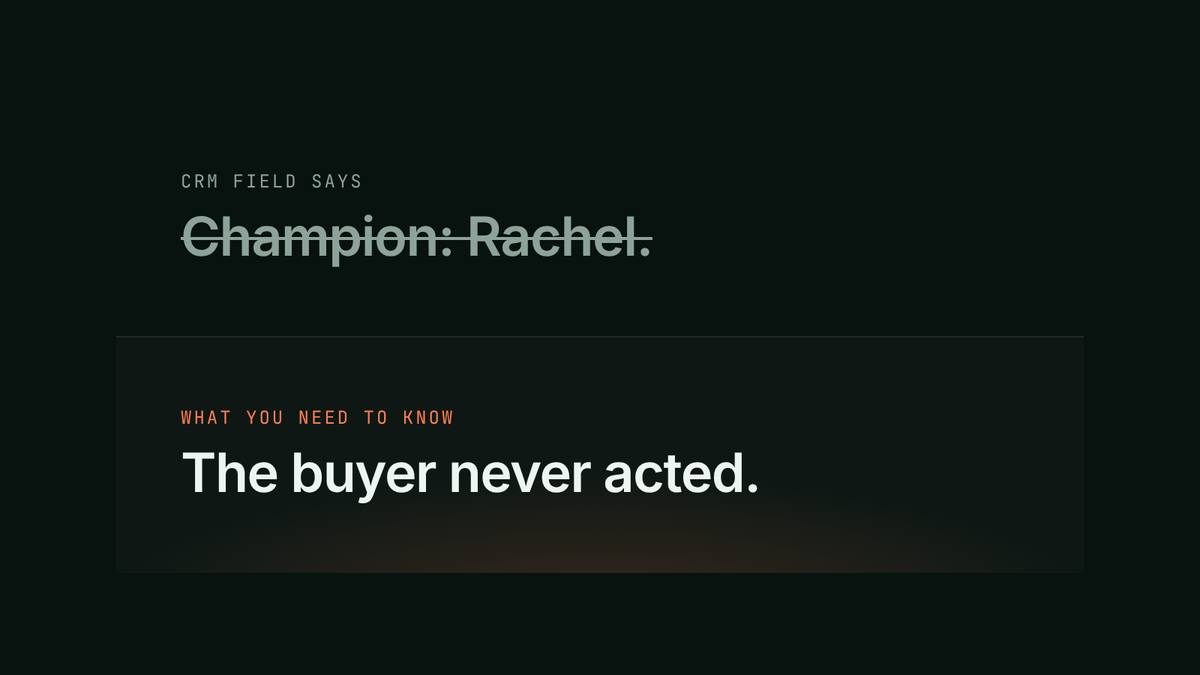
- The Champion field holds the rep's belief, not the buyer's actions. From the field alone, you cannot tell whether the champion did anything.
- Confirm a champion only when selling inside plus one more sign show up. Access to power, influence or a personal win, seen as actions on a call or in the deal's emails and invites.
- The test only works if every rep runs it. Count who made the ask, rep by rep, and let reps bring the evidence to defend their own commit.
- Zime runs this test on every deal, from your own won deals. It hands each rep the ask before the call and shows which reps ran it.
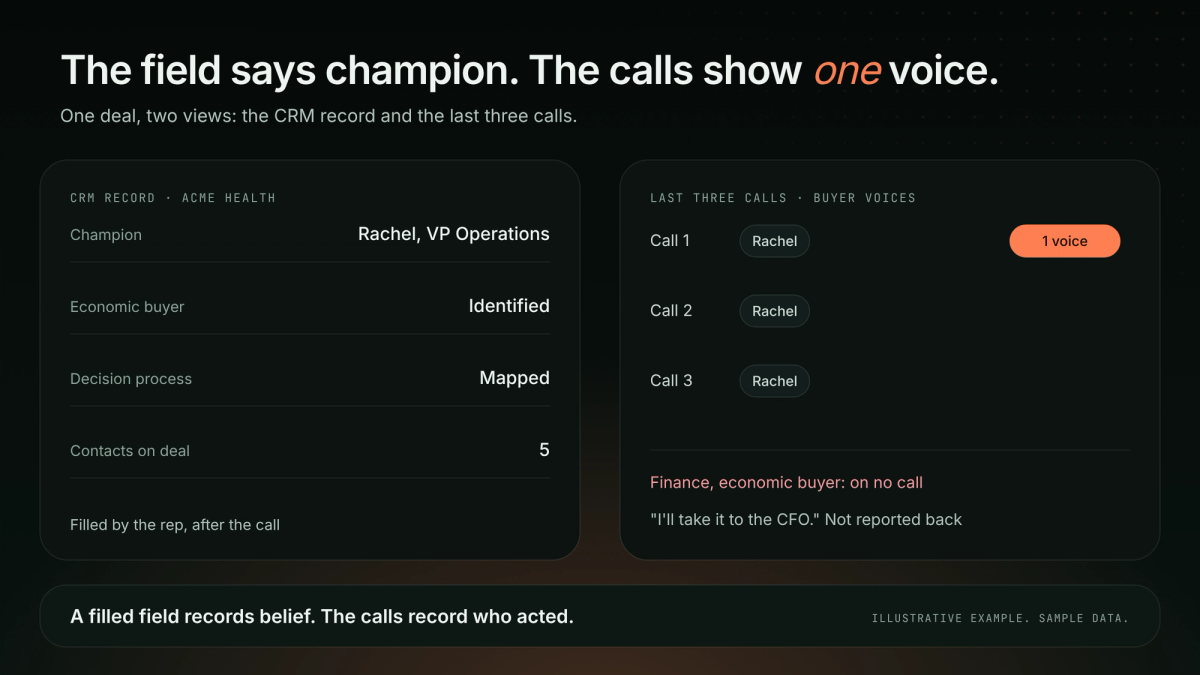
Monday, 8:30, the commit call. Jordan has Acme Health in commit. Every MEDDPICC field is filled. Champion: Rachel, VP of Operations. "She loves us," Jordan says. "She's taking it to the CFO this week."
Last quarter, two deals with filled Champion fields went quiet in the final month. Nobody could say whether the champion ever sold for you.
So: is Rachel a champion, or a friendly contact?
Here is how to find out. A champion is real when the buyer's own actions show it, on the call or off it. Write down what champions did in your won deals. Ask this champion for one of those actions, with a date. Check what happened. Grade the field only when selling inside plus one more sign show up. Then count which reps ran the test.
Why a filled Champion field proves so little
MEDDPICC, or MEDDICC, earns its place in complex deals. Keep it. The weak spot is where the answers come from. A rep fills the Champion field after a call, from memory and from hope. The field records what the rep believes. It cannot record what the buyer did. In the CRM, a friendly contact looks the same as a champion who walked your proposal into the CFO's office.
Forrester put the general problem plainly: "Sellers' interpretations often differ from buyers' actual reasons." Forrester meant win-loss; every Champion field has the same gap.
Martin Mackay runs sales at Versa Networks, where SASE deals pass through a technical evaluation and a POC across four regions. In a win-loss review, he asked where a deal signal came from.
"Is it taking from Rep notes from Salesforce, or is it taken from calls?"
Martin Mackay, CRO, Versa Networks
Ask it of every Champion field on your commit list.
A deal with a coach and no champion rarely loses cleanly. It drifts. Challenger says its research found that 40 to 60 percent of lost deals ended in no decision.
Multi-threading helps, but a contact count has the same flaw. Five CRM names show who the rep met. They do not show who acted.
The root cause: nobody wrote down what a real champion does in your deals. So each rep grades by gut.
The champion test, step by step
The fix is a test the rep runs with the buyer.
1. Write down what champions did in your won deals. In your last ten won deals, note what each champion did: brought someone senior, shared how the decision gets made, or came back with what their boss said. Ask your two best reps which actions told them the deal was real, since some of it never shows up in a transcript. That list is your standard.
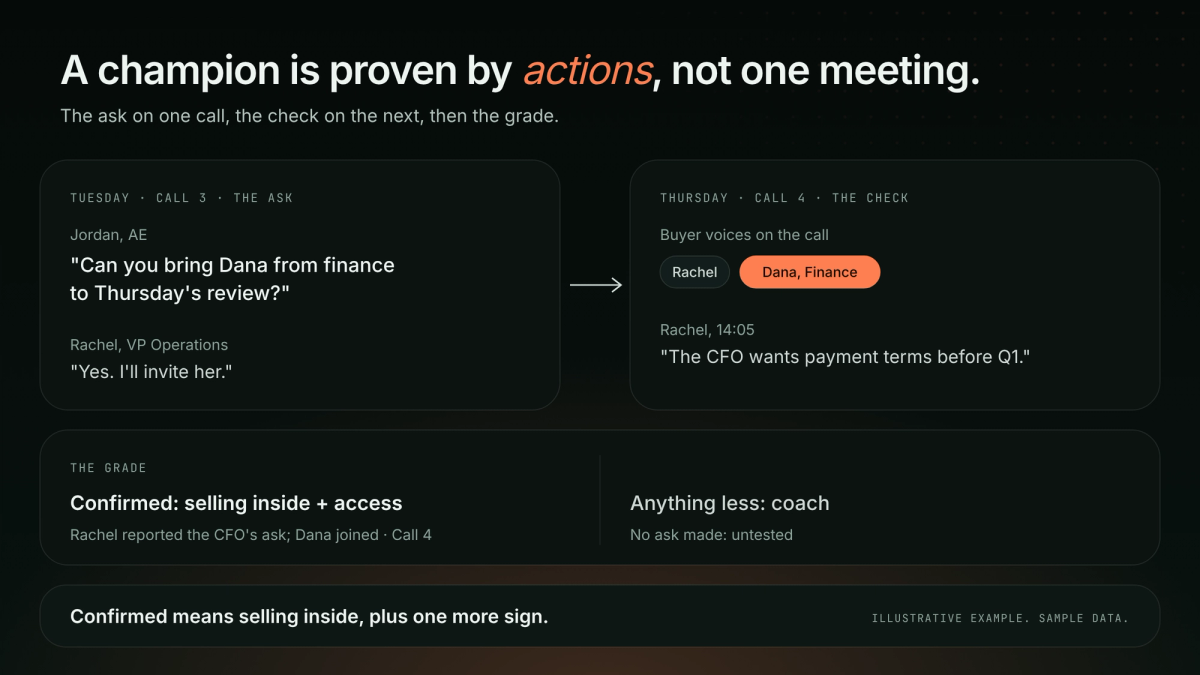
2. Ask the champion for one action, with a date. "Can you bring Dana from finance to Thursday's review?" A real champion says yes, or offers another route. A coach goes vague, or asks you not to go around them.
3. Check what happened, on the call and off it. Did Dana join? Did Rachel report what the CFO said? Off the call, look for actions you can date: the invite she sent herself, the proposal she forwarded, the partner she looped in. If a buyer will not be recorded, the email thread and the calendar are your evidence.
4. Grade against the full champion standard. One action proves access, not a champion. The table below is a scorecard you can copy: a champion is confirmed when selling inside plus one more criterion show up as actions.
| Criterion | Action that proves it | Where you see it |
|---|---|---|
| Access to power | Gets the economic buyer or finance into a meeting | Call attendees, or an invite she sent |
| Influence | Shares or changes a decision criterion | Her words on a call, or a document she sends |
| Personal win | Says what she gets if this lands | Her own words on a call |
| Selling inside | Reports back what her boss said, before you hear it from the boss | The next call, then the boss's own words |
Mark each champion confirmed (selling inside plus one more), coach (anything less) or untested (no ask made), with the call, email or invite that decided it.
Here is what that looked like in one of Zime's own won deals. At Skan AI, the main contact, Thiago Correa, was planning a team rollout on a December call. Talking about his leader, Aman Rangrass, he said:
"I'm gonna talk to him."
Thiago Correa, Skan AI
In February, Aman joined a call with his team.
"I like this. ... Do it now."
Aman Rangrass, Skan AI
Thiago did the selling inside. Aman brought his team. Skan signed the same day.
5. Count which reps ran the test, and run it with them, not on them. For each rep, count the late-stage deals where the ask was made in the last 30 days. Let the rep grade first and bring the evidence to the commit call. They get a commit nobody can argue with, and permission to cut a dead deal early.
Run it on ten deals this week
You can try this without a new tool. Pick ten late-stage deals. Search the last three transcripts and the email thread of each for the champion's name, and grade against the scorecard. By hand, it does not scale.
The table below runs the test on one team's ten late-stage deals, with illustrative sample numbers. All ten Champion fields were filled, and the evidence confirmed three champions.
| Check | Deals | What it tells you |
|---|---|---|
| Champion field filled | 10 of 10 | What the reps believe |
| Ask made | 6 of 10 | Where the test ran |
| Selling inside plus one more | 3 of 10 | Confirmed champions |
| Less than that | 3 of 10 | Coaches, still to work |
| Ask never made | 4 of 10 | Untested, test this week |
The verdict sits in the confirmed-champions line: a commit of ten becomes three you can defend. A rep with fewer than three late-stage deals is direction only. To learn whether the test moves win rates, stagger it: half your reps start this month, the rest next month, then compare.
Before you trust the scorecard, back-test it. Grade your last ten won and ten lost deals the same way. If confirmed champions do not show up more often in the wins, change the rule.
Kenny Cao, who runs go-to-market strategy and operations at Skan AI, named why step five gets skipped.
"It is more of an enablement understanding versus whether they've done it."
Kenny Cao, Senior Director, Head of Go-To-Market Strategy and Operations, Skan AI
Knowing the test is not running it. Bureau sells identity decisioning to banks and fintechs, in multi-threaded deals. Kapil Bhagat, who runs its sales strategy, saw what changed once skipped steps became visible.
"So this monitoring led to execution ... Having a dashboard where non adherence is called out improves execution."
Kapil Bhagat, AVP, Sales Strategy, Bureau Inc.
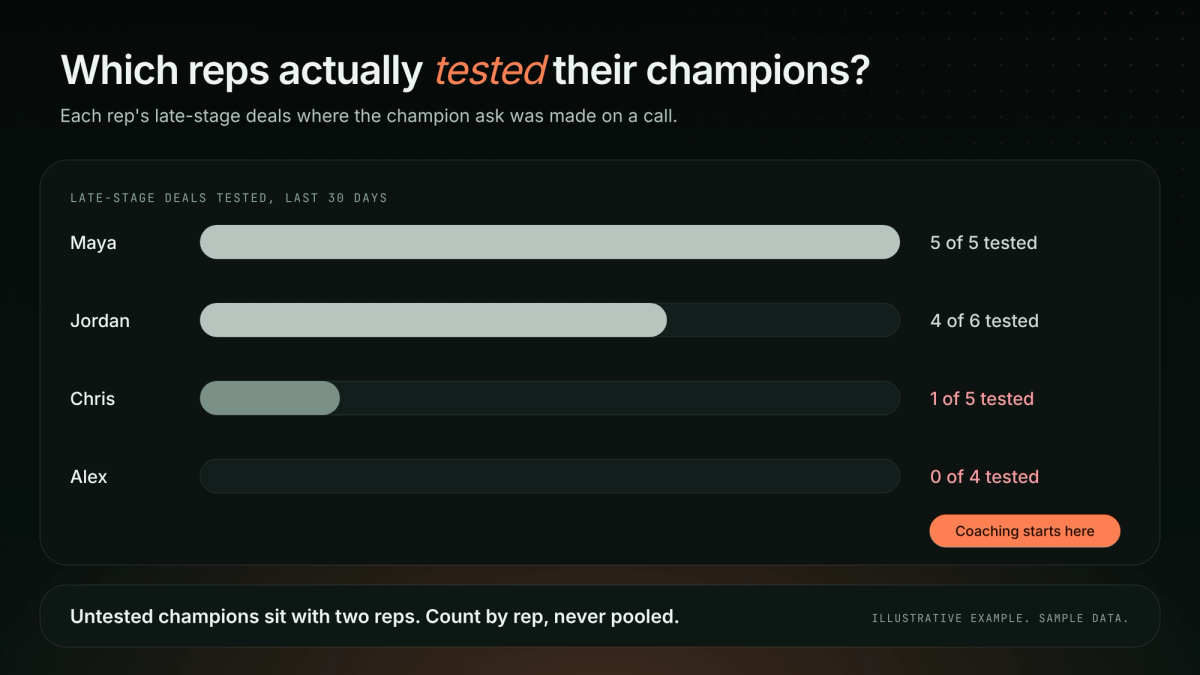
How Zime runs the champion test on every deal
Zime solves this by handing every rep the champion test before the call, then showing whether it ran. Call-analysis tools read buyers too, and some score champions. Keep them. Both read the call. The difference is where the standard comes from, and whether the rep gets the ask in time to use it.
- Encode. Zime's Behavior Graph is a model of how your company wins: what champions did in your won deals, plus your CRO's rule for when one counts. Zime's team builds it by interviewing your best reps and scoring the moves until those reps would run them, including what never shows up in a transcript. It is live in 7 days.
- Deliver. Before the call, the prep note hands the rep the champion ask for this deal, with the won deal it came from.
- Measure. After the call, Pipeline Review shows the evidence in the buyer's words, and CRM update suggests a value for the Champion field from the call. The rep decides. Zime counts which reps ran the ask, on which deal.
- Update. When your CRO changes what counts as a champion, every rep's ask changes with it.
Run Monday again. Before his Tuesday call, Jordan's prep note gave him the ask: bring finance to Thursday's review. Rachel did. Dana from finance joined, and Rachel added that the CFO wants payment terms before the new quarter. Selling inside, plus access to power. On Monday, Jordan grades Rachel confirmed himself, with that call beside it. Your strategy runs in every rep's workflow, and you kept what you bought. For the whole pipeline, see why coverage looks healthy while the quarter misses.
What changed when deals ran on evidence
Before Zime, Versa's CRO described his pipeline this way.
"...the rest of it is various degrees of fiction."
Martin Mackay, CRO, Versa Networks
Within three months, 79% of Versa's SEs were running the right technical discovery, up from 20% at the start. The committed pipeline showed 24% less leakage.
The table below lists published results from teams that ran deals on call evidence. Each line measures something different.
| Company | What it measured | Published result | Source |
|---|---|---|---|
| Versa Networks | SEs running the right technical discovery | 79% within three months, up from 20% | Versa story |
| Versa Networks | Committed pipeline | 24% less leakage | Versa story |
| Bureau | Deal conversions | 30% increase | Bureau story |
| SonicWall | Reps making clear end-of-call asks | 30-40% increase | SonicWall story |
The SonicWall line, clear end-of-call asks, sits closest to the champion ask. None is a champion-only measure, and Zime has not published how often a filled Champion field hides a coach. For your wider process, read how to measure whether reps are adopting your sales process.
See which champions on your commit list are real.
Keep MEDDPICC, your CRM and your recordings. Zime makes the champion test a move every rep runs. Bring ten late-stage deals and see each champion graded from the evidence.
FAQ
How do I test whether a champion is real when MEDDPICC fields are filled in from rep opinion?
Test the buyer, not the field. The rep asks the champion for one action with a date, then checks the calls, emails and invites for what happened. Confirm a champion only when selling inside plus one more criterion show up as actions. Zime runs this on every deal from a model of your own won deals, built by interviewing your best reps, including what never shows up in a transcript.
What if the buyer will not be recorded?
Use what you can date: invites the champion sent, documents she forwarded, the partner she looped in. Zime complies with the required data norms, and reps decide whether Zime joins each call. The grade still needs selling inside plus one more.
Will my reps feel policed?
Not if the rep grades first. The evidence becomes their defence on the commit call, and a reason to drop a dead deal early.
What does Zime do for CROs?
It hands every rep your champion standard before the call, then shows which champions are confirmed and which reps ran the test.