How do you track health across 50 live POCs when every stakeholder gives a different update?

- Your tracker is doing its job. Every POC has a record, an owner, dates and a weekly status. Keep all of it.
- But the hard part is adoption: getting every SE to run the same checks. Say one SE gets the success criteria agreed in writing before kickoff. Another starts on a verbal yes. Fifty POCs then run on fifty private standards, and five people report five states.
- And a longer status form will not close that. A field records what someone typed. It cannot show whether the buyer agreed the criteria or confirmed the next step on a call. Until the SEs run one standard, you become the system, chasing them for updates.
- Reps adopt specific moves, not strategy. Zime's Behavior Graph is a model that turns your CRO strategy and your top SEs' tribal knowledge into the exact move for each POC stage. It is taught by your best SEs, including what never shows up in a transcript.
- You keep your tracker, and you can see the standard ran. The moves SEs run on live calls are tied to the CRO strategy that authorized them and the deals they moved. The five updates then have one record to check against. Fifty POCs do not mean fifty status meetings.
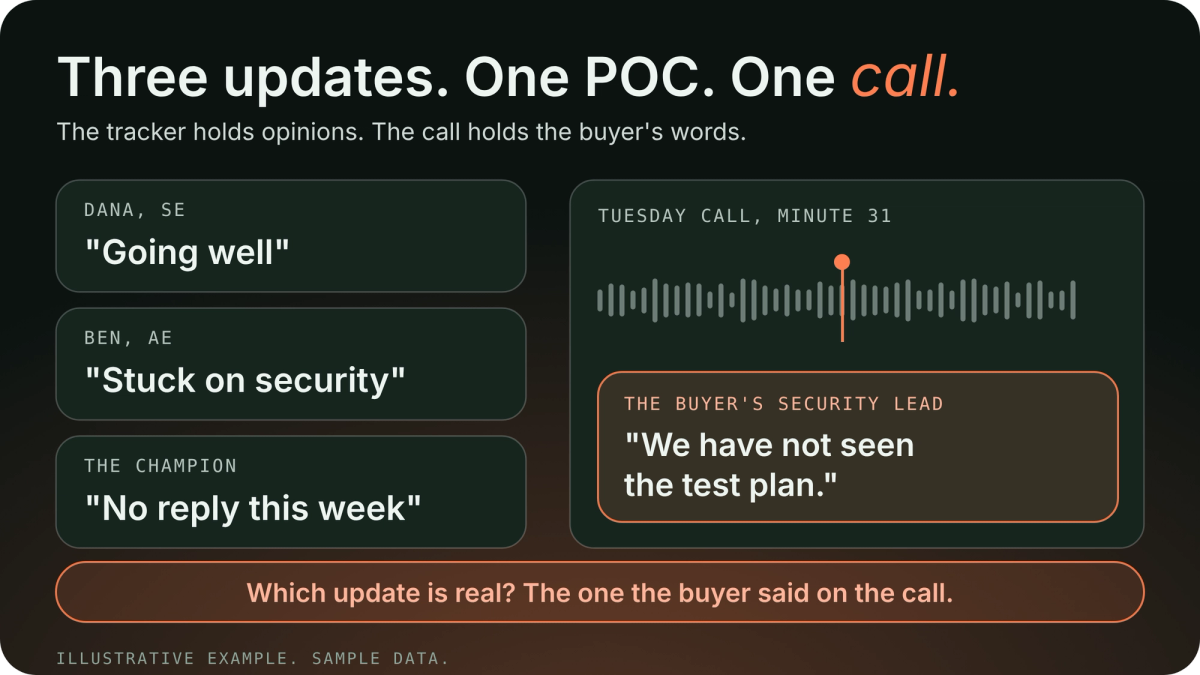
You lead sales engineering. It is Friday, 4 pm, and the VP asks where the POCs stand. Your tracker has a row for each one: owner, dates, weekly status. Keep all of it. It tells you who owns what. It cannot tell you what is true. Dana says her POC is going well. Ben, the AE, says it is stuck. The champion has not replied in days. Three honest answers, one question. How would you know which of these POCs is healthy without asking anyone?
Which POC is real when updates disagree?
Each answer is true from where that person sits. Dana ran the last demo and thinks it landed. Ben has chased procurement and knows security is still open. The champion is quiet because her boss pulled her onto something else. None of them is the buyer speaking.
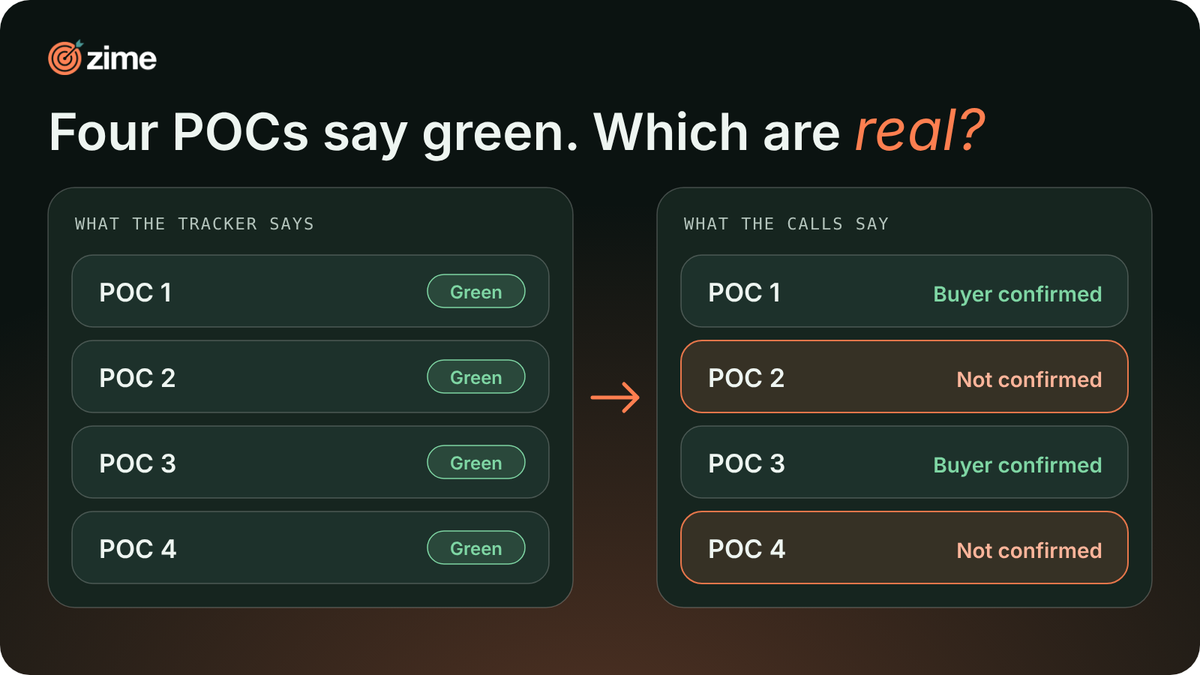
The buyer did speak, on Tuesday's call, at minute 31. Her security lead said they had not seen the test plan. Nobody put that in the status field. Nobody replays every call. Forrester notes that "sellers' interpretations often differ from buyers' actual reasons." That is about lost deals. The same gap opens in a live POC. A green status can hide a deal that is not real yet.
When the answer lives in people's heads, you become the system. You ask, you wait, you compare, you pick whom to believe. If the three keep disagreeing, look at what each was asked to check.
Nobody wrote the POC standard down
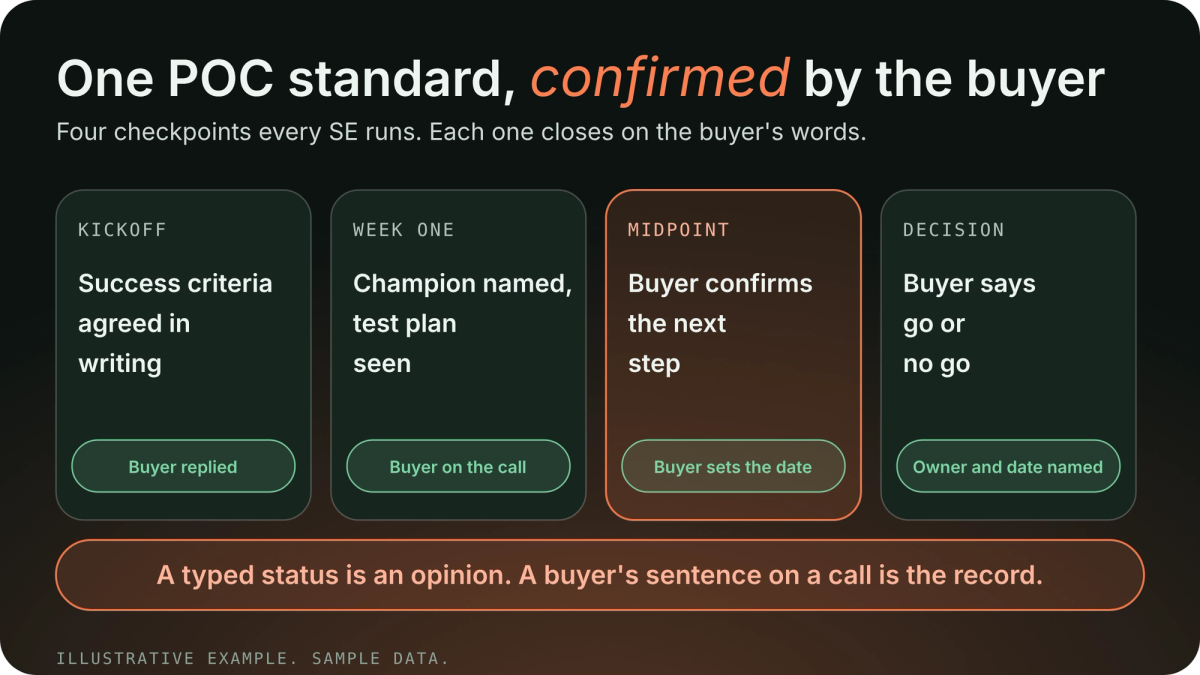
Say Dana gets success criteria agreed in writing before kickoff. Raj starts on a verbal yes. Nothing tells either one what every POC must have. So the tracker can only log what each chose to type.
Strategy does not get adopted. Behaviors do. A Behavior is the specific move for one stage of a POC, like getting the criteria agreed in writing, with a win behind it. Your best SEs run these moves without thinking. That is why nobody wrote them down.
Chitresh Yadav leads sales engineering at Versa Networks. Almost every Versa deal turns on a technical evaluation. His org is 100+ SEs across four regions, and his dashboards showed him everything.
"When I go to my org level, I'm drowning because it shows everything."
Chitresh Yadav, VP and Global Head of Sales Engineering, Versa Networks
More rows is visibility. It does not show which POCs ran the same checks.
Martin Mackay is Versa's CRO. On a win-loss call with Zime, he asked where the patterns came from. Typed notes and calls can disagree, so he asked which one it was.
"Is it taking from Rep notes from Salesforce, or is it taken from calls?"
Martin Mackay, CRO, Versa Networks
A status typed by a rep and a sentence said by a buyer are different sources. A leader needs to know which one a status rests on.
Pick your five oldest live POCs. Run three tests this week.
- Criteria. Name what the buyer agreed, and the date. Pass: written, dated, answered by the buyer. Fail: only the SE's note exists. The tell: "we aligned on a call."
- Confirmation. Find the call and minute where the buyer confirmed the last next step. Pass: the buyer says the date or the owner. Fail: only the rep says it. The tell: "she seemed keen."
- Match. Mark three updates on one POC against the call. Pass: two match. Fail: none do. The tell: a green status beside a silent champion.
The table below runs the three tests on five illustrative POCs, and two of them pass all three.
| POC | Tracker says | Criteria agreed and dated | Buyer-confirmed step (call, minute) | Updates matching the call | Verdict |
|---|---|---|---|---|---|
| Retailer | Green | Yes, 3 Nov | Yes, call 12, minute 18 | 3 of 3 | Real |
| Fintech bank | Green | Yes, 29 Oct | No, only the SE says it | 1 of 3 | Not confirmed |
| Logistics (Acme Freight) | Green | No | Yes, call 9, minute 41 | 2 of 3 | Watch: no criteria |
| Insurer | Green | No | No | 0 of 3 | Not real |
| SaaS vendor | Green | Yes, 5 Nov | Yes, call 4, minute 7 | 2 of 3 | Real |
The fintech bank carries the argument: its tracker reads green, and only the SE says the step is confirmed.
Do it by hand first. Open the last two calls of each POC. Mark the minute the buyer sets the next step. That is roughly an afternoon for five POCs. It does not repeat every week for fifty.
Give every SE one standard to run
You already own tools that cover part of this, and they do real work. Dashboards give one view. POC trackers and presales platforms hold criteria and status. Recorded-call review shows what was said. A Claude agent over your calls and CRM can summarize any POC on request. Each of them can suggest a next step. The difference is where the standard comes from, and whether anyone checks that it ran.
The table below compares five approaches, and only one line separates them: which SEs ran the same checks.
| What it shows | Dashboard | POC tracker or presales platform | Recorded-call review | Your Claude agent on calls and CRM | Zime on top of your tracker |
|---|---|---|---|---|---|
| One record per POC with owner and dates | ✓ | ✓ | Partial | Partial | ✓ |
| Written success criteria | Partial | ✓ | ✗ | Partial | ✓ |
| What the buyer said on a call | ✗ | Partial | ✓ | ✓ | ✓ |
| The next step confirmed by the buyer | ✗ | Partial | Partial | Partial | ✓ |
| Which SEs ran the same checks | ✗ | Partial | Partial | Partial | ✓ |
HFS Research describes the same gap: a CRO's plan does not convert into execution, so reps revert.
Zime's Behavior Graph builds that standard. Think of it as a model that holds three things: your CRO strategy, your past deals, and what your top SEs know.
Zime gets that knowledge from people, not only from data. Its forward-deployed engineers interview your best SEs (FDE-run interviews). Then Zime scores and corrects each move until those SEs would run it (RLHF). That includes what never shows up in a transcript.
You start from a library of 1,200+ GTM behaviors, so you edit a standard instead of inventing one. The Enterprise Sales Harness delivers each move where SEs work, such as the prep note before a call. You keep your tracker and your Claude build.
Versa shows why this has to scale. Its SE calls run without managers. John Volkering ran the European SE team there.
"My team doesn't like their managers to be on their calls and get micromanaged."
John Volkering, Director of Systems Engineering, Versa Networks
Nobody can sit in on fifty POCs. The standard has to travel with the SE. Versa then measured 79% of SEs running the right technical discovery within three months, up from 20% at the start. That counts a behavior run on live deals. It is not a POC result.
Kapil Bhagat is AVP of Sales Strategy at Bureau, a fraud and identity platform with multi-product deals. He was weighing how a team gets from a process to execution.
"Having a dashboard where non adherence is called out improves execution."
Kapil Bhagat, AVP, Sales Strategy, Bureau
Calling out who skipped a step turns monitoring into execution.
Now replay Friday with the standard. Dana gets a prep note before Tuesday's call with one check to run: confirm the test plan with the buyer. The buyer's security lead says she has seen it. Ben reads the buyer's own sentence, so he stops guessing about security. The champion gets a short plan she can confirm in writing. Raj gets the same prep note, so his POC faces the same checks. You open one list that shows which POCs ran the standard and which did not. Whatever the buyer answers lands on that list with a call and a minute beside it. Each of them trusts it because it carries the buyer's words and a win behind it.
What you can see by next Friday
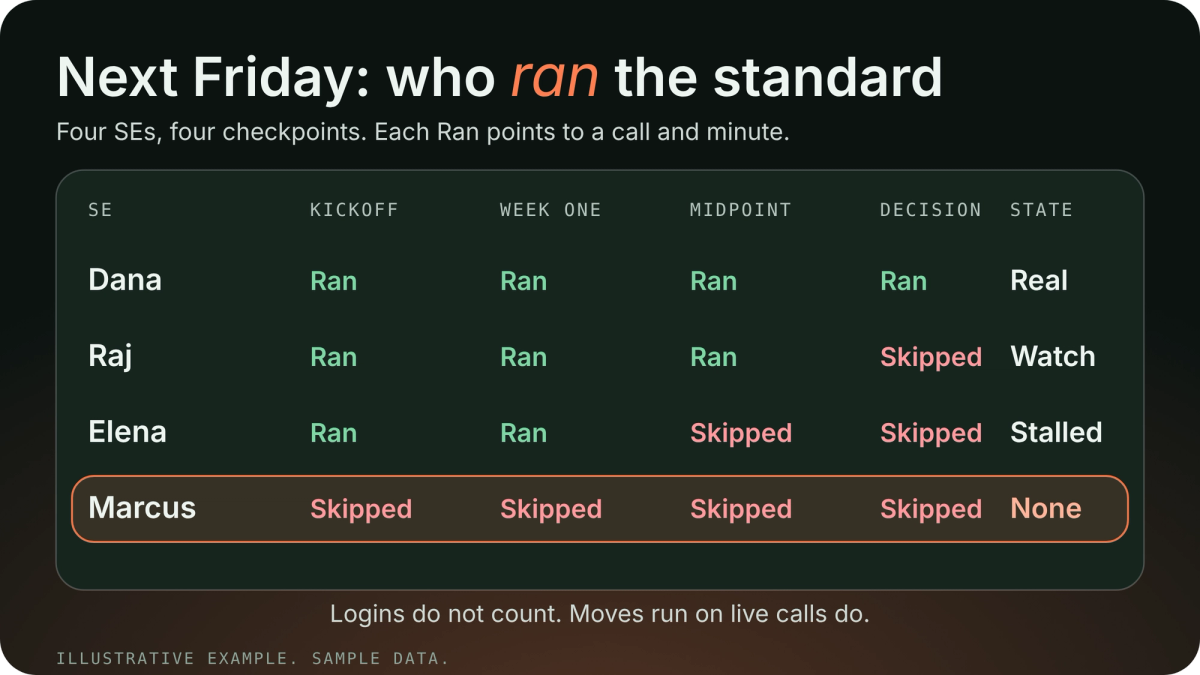
Next Friday you read one count: how many SEs ran the standard on live calls, tied to the CRO strategy that authorized it and the deals it moved. That is programmatic adoption. Logins do not count. Each Ran points to a call and minute, so you can check it yourself.
Kenny Cao leads go-to-market strategy and operations at Skan AI. His team had just rolled out a new value proposition, and he wanted to know whether reps delivered it.
"It is more of an enablement understanding versus whether they've done it."
Kenny Cao, Senior Director, Head of Go-To-Market Strategy and Operations, Skan AI
Knowing the standard and running it are two different facts.
To know the standard helped, start it on a random half of new POCs first. Give the rest the standard inside the quarter. Read the result SE by SE. Fewer than three POCs on either side is direction only.
Zime has no published figure for POC health or POC win rate. What is published is Versa's SE adoption, above. If one SE owns every POC and you sit on every call, a tracker and a Friday review are enough.
Keep your tracker. See which POCs ran the standard.
The tracker and the Claude build you have stay yours. Zime adds the standard your best SEs run, from your CRO strategy and their tribal knowledge, and counts which SEs ran it on live calls. Live in 7 days on your own data. Bring five of your oldest live POCs, and see which ran it. Book a demo
FAQ
How do you track health across 50 live POCs when every stakeholder gives a different update?
Judge each POC by what the buyer confirmed on a call, not by what people typed. Give every SE one POC standard to run, such as written success criteria and a buyer-confirmed next step. Zime's Behavior Graph, a model taught by your best SEs including what never shows up in a transcript, builds that standard and counts who ran it.
Do we have to replace our POC tracker?
No. The tracker keeps the owner, dates and status. The standard adds the buyer's confirmed steps beside them. Zime runs on Claude, so an agent you built stays too, and nothing in your stack gets ripped out.
Can our own Claude agent over calls and CRM do this?
It can summarize any POC and search any call, and that is useful. What it lacks is a standard to check against: the moves your best SEs run, approved by your CRO. Without one, nobody can tell whether the SEs ran the same checks.
Will my SEs feel watched?
Show each SE the same marked calls you see, before any review, so the check is shared evidence. Whether a tool does that is a fair question for any vendor: does the SE see the same evidence the leader sees?
How many POCs before a pattern is real?
Read it SE by SE, never pooled. Treat an SE with fewer than three POCs on either side as direction only. For a clean test, start the standard on a random half of new POCs first.