How does your sales AI earn your reps' trust?

- You built the agent, and it works. It reads your calls and CRM, answers in seconds and demos well. Building first was a reasonable move, and you can keep improving it.
- But reps still won't act on it in front of a buyer. One visible miss on a live deal costs a rep more than the agent ever saved them. Until they know which answers hold, they ask a colleague instead, so a home-grown sales AI gets low adoption.
- That trust can't be declared. It is earned over time, from evidence. Most eval suites test the system: did the model drift, did the prompt break. A sales answer needs a different check: does it match this quarter's CRO strategy, and did buyers respond, deals move and deals close when reps ran it?
- So grade every move against outcomes, and keep an approver until it earns autonomy. Score each recommended move on three signals: the buyer's response on the call, the deal's next stage, and won value. Zime does this with behaviors, the specific moves your best reps and your CRO's strategy say win, each tested against won and lost deals.
- You know it worked when reps run the move on live deals and those deals move. Count behaviors run in live deals, not logins. That is the adoption number your CRO will ask for.
Your agent went live last month. The demo landed. In the usage log, reps are asking it real questions: "The incumbent is cheaper. What do I say?" The agent answers in four seconds. Offer a discount.
Then you check the rep's next move. She did not take the answer to the buyer. She sent a Slack message to the team's best AE and asked the same question. He told her to hold the price and lead with the white-glove onboarding your CRO made this quarter's priority. She ran that instead.
The agent was not broken. Its answer was plausible. Plausible is not the same as trusted, and that gap is where home-grown sales AI loses its reps.
On November 17, Zime's CEO Sanchit Garg moderated a closed-door session in Palo Alto with people who build and govern agents for a living: an engineer building run-time safety for agents, a founder shipping agents for a medical publisher, a compliance engineer and a university director who works on AI safety. For an hour, the room kept reaching the same answer about trust.
One visible miss resets adoption
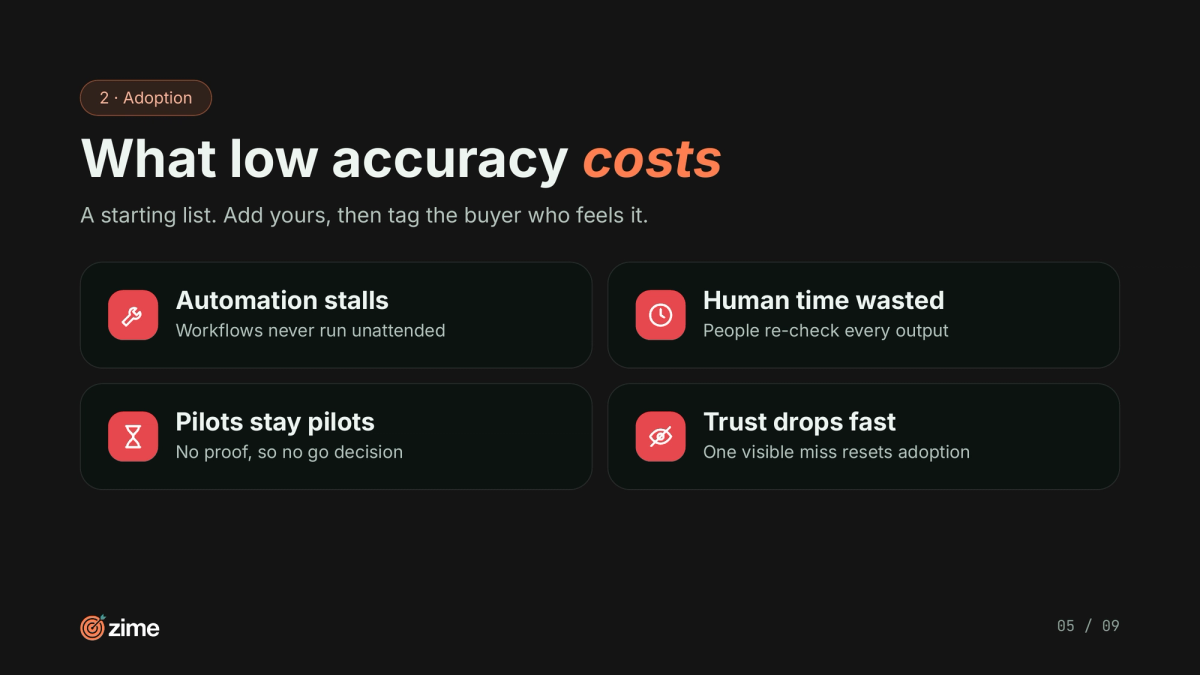
The slide above opened the adoption part of the session. Its last card is the one that matters for sales: trust drops fast, because one visible miss resets adoption. A rep who repeats a wrong answer to a buyer does not file a bug. She stops asking.
The room agreed that trust cannot be switched on. A university director who works on AI safety partnerships put it this way: "trustworthiness is earned over time. You can't really measure trustworthiness." Another participant added that one good result proves little: "it's continuous evidence... it's not a spot evidence." Later he put it simply: "the trust has to be earned and it has to be preserved."
Revenue teams say the same thing about their own tools. Kenny Cao is Senior Director and Head of Go-To-Market Strategy and Operations at Skan AI. On a recent call he was deciding whether AI-written CRM updates should go straight into the CRM or wait for a rep to confirm them. For now, he wanted the rep to confirm:
"I just don't know the quality of the input yet... I don't have the conviction to say yes, I can 100% rely on AI to actually do that."
Kenny Cao, Senior Director, Head of Go-To-Market Strategy and Operations, Skan AI
That is not a vote against AI. It is a GTM leader keeping a human approver in place until the output has a record. Your reps make the same call every time they read your agent's answer before a meeting.
The pattern shows up in outside data too. G2's enterprise review data found the average share of users who fully adopted an AI agent fell from 68% in 2024 to 55% in 2026. A rep cannot check an answer in front of a buyer, so the bar for trust is higher.
Why a correct-sounding answer still isn't trusted
Most teams already run evals. They test the system: a regression suite, an LLM grader, a check that the new model answers like the old one. In the room, one participant defined evals as having exactly two jobs: train the model, or test the system. Both matter. Neither tells a rep whether this answer is right for this deal.
In sales, there is no approver and no written answer. Sanchit described it from what Zime sees across enterprise customers: "A CRO will never come and say, hey. Let me look at your thing and approve it." Nobody in enablement or the field has the time to grade every answer either. And the standard moves. Products, competitors, pricing and positioning shift every quarter. "In my case, this changes every month," he said. The medical founder summed up the difference: in sales, every answer is a judgment call.
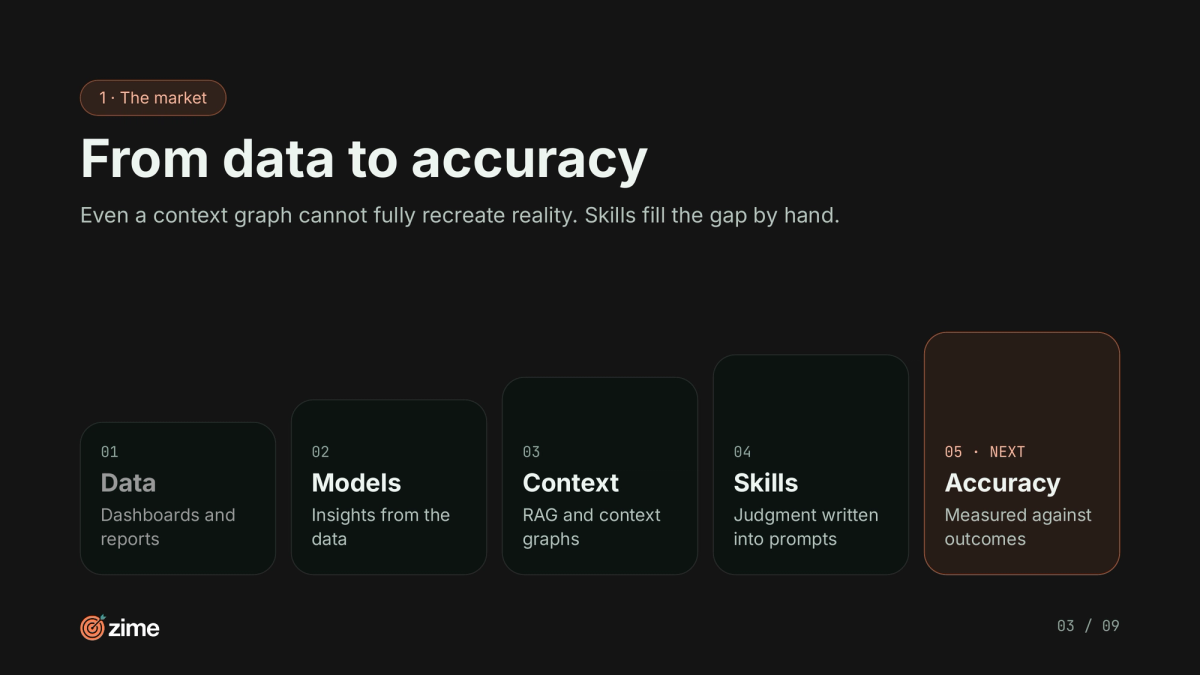
The slide above shows the ladder most stacks have climbed: dashboards, insights, RAG and context graphs, then know-how written into prompts and skills. Each step made answers more specific. None measures whether an answer wins, which is the step the slide marks next.
That is the root cause. Whether an answer is right lives in two places your data does not hold: what your CRO decided this quarter, and how your best reps actually win. Sanchit's line in the room was blunt: "the data never captured the story." A context graph can find every call where a buyer said "the incumbent is cheaper." It cannot tell which reply your CRO wants this quarter. Nor which one your best reps use and win with.
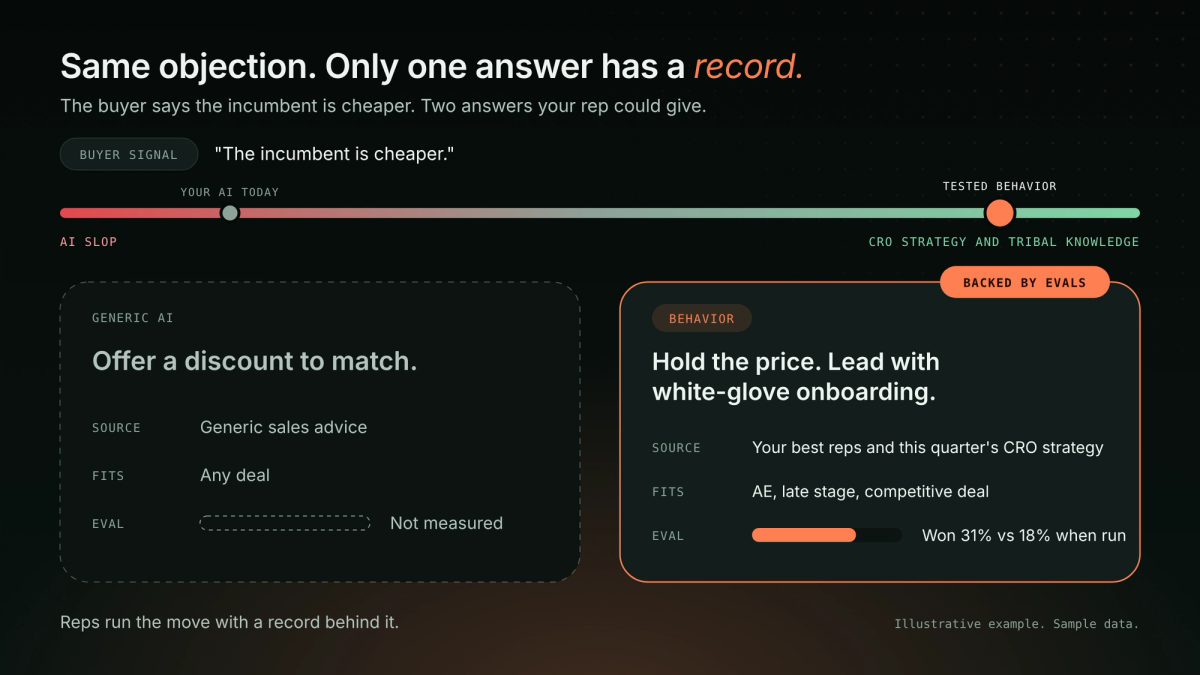
The picture above is the discount question from the opening, scored. The generic answer fits any deal and nobody has measured it. The behavior on the right comes from your CRO's strategy and your best reps, and it carries a record of how deals went when reps ran it.
Customers name the same gap. Chitresh Yadav is VP and Global Head of Sales Engineering at Versa Networks. He runs an AI-native team of more than 100 sales engineers across four regions. His team already used AI for follow-ups and prep notes. He still describes its limit: AI can reach some level, "...not to the human level... there is a context that you need to build in." The missing context is not more transcripts. It is tribal knowledge: what your best reps know that no transcript recorded.
Earn trust the way the room described it
Nobody in the room had a trust score to sell. What they described was a method. Set an expectation, meet it, and keep meeting it while someone outside the system checks. Here is that method applied to a sales agent.
Grade the move against outcomes, not against a reference answer. A recommended move can be scored on three signals, in the order they arrive. First, the buyer's response on the call: did they agree a next step, or say they would get back to you in a week? Second, the deal's stage: did it move from discovery to evaluation, or stall? Third, won value: was it won, and for how much? Sanchit described the same three signals as how Zime grades its own behaviors. "For me, the human in the loop is the customer itself," he said.
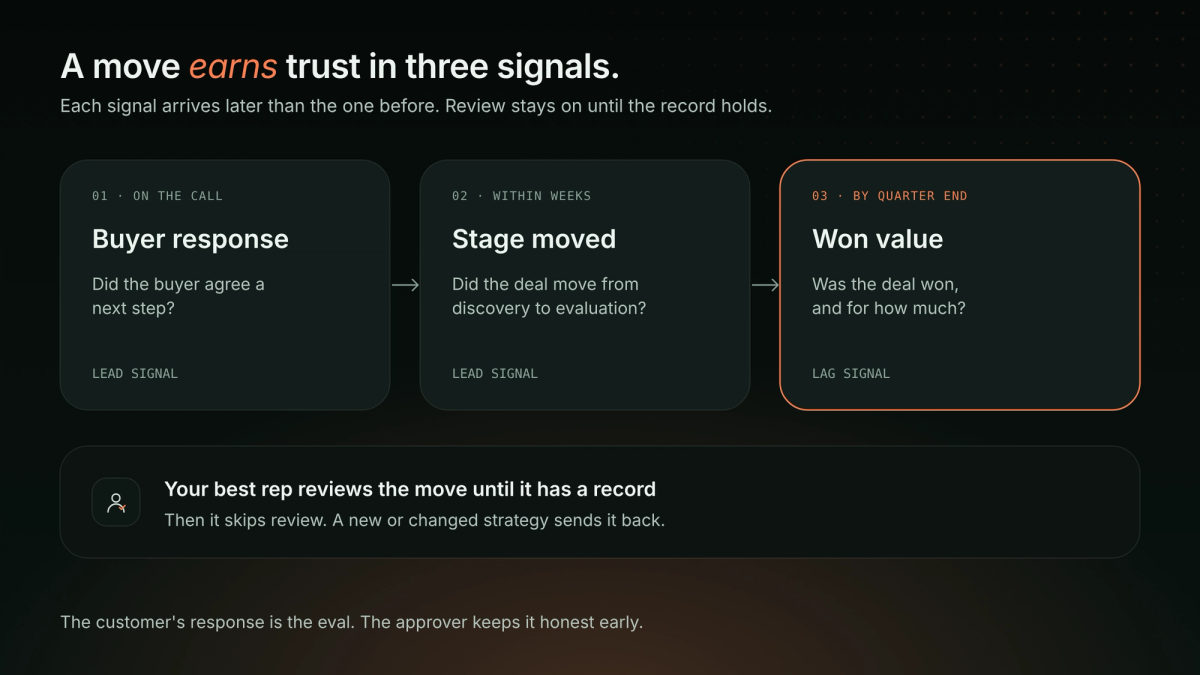
As the picture above shows, the three signals arrive at different speeds, so a move earns trust in steps. The buyer's response shows up on the next call. Stage movement takes weeks. Won value takes a quarter.
Keep an approver outside the system until the move earns autonomy. The compliance engineer in the room runs one agent per control, and a person reviews only when the agent is not confident.
Tayo Ogunseyinde, Versa Networks
In sales, a move earns the right to skip review by being right, again and again. A move your best reps confirm and buyers respond to graduates. A new move stays in review.
Separate the never-outcomes from the gradients. The engineer building run-time safety drew this line. Some outcomes must never happen, such as a discount your deal desk would not approve. Those belong to guardrails. Everything else is a gradient you measure.
Re-run the evals when the strategy changes. A move that won last quarter can lose this one. Tie each move to the strategy that authorized it, and re-score it when that strategy changes.
Generic eval suites catch regressions, and human review catches some misses on the days someone has time. Neither grades a move against the buyer's response, the stage or the win.
The table below runs that check on illustrative sample numbers for one objection, "the incumbent is cheaper," over one quarter.
| Move the rep ran | Calls where it ran | Buyer agreed a next step | Deal advanced a stage | Deal won |
|---|---|---|---|---|
| Offer a discount to match | 40 | 45% | 30% | 18% |
| Hold the price, lead with white-glove onboarding | 36 | 64% | 47% | 31% |
On these sample numbers, holding the price wins on all three signals. That is the move to send reps, and the record to show them. Keep one caution from the room: a participant pointed out that sometimes every answer was right and the buyer was dealing with something else. Read a gap like this rep by rep, and treat a rep with only a few calls on either side as a direction to watch.
You can run this by hand before you buy anything. Pick one objection your reps hit every week. Pull last quarter's calls where it came up, note what the rep said, and check the next step, the stage and the outcome for each. One objection is a manageable project for one analyst. It stops scaling when the list grows to every objection, product, competitor, region and role, and when the strategy changes again next quarter.
Two tests you can run on your own agent this week:
- The grading test. Ask your agent the five questions reps ask most. Have your best rep and your CRO grade each answer: would I say this to a buyer this quarter? Pass: both say yes to at least four. Fail: they disagree with each other, which means the standard was never written down.
- The record test. Pick one move your agent recommends often. Compare deals where reps ran it with deals where they did not. Pass: you can see a difference in next steps or stage movement. Fail: you cannot tell which deals it ran on.
This is the work Zime does underneath your build. Your agents and skills stay; Zime runs on Claude. Zime adds behaviors: the specific moves your best reps and your CRO's strategy say win, by role, stage and situation. They come from the Behavior Graph, which encodes your best people's judgment, elicited through FDE-run interviews and RLHF, including what never shows up in a transcript. In plain words, Zime's engineers interview your CRO and top reps and turn what they know into moves your agent can call. Strategy Studio tests each move against won and lost deals, and the Zime Enterprise Sales Harness traces every recommendation to its source, its approver and its version. Zime's library starts from 1,200+ GTM behaviors.
What changes when reps trust the answer
When the move carries a record, the rep's question changes from "is this right?" to "when do I use it?" Evan Fromberg is SVP of North American Sales at Versa Networks. Versa sells against ten named competitors. His reaction, in the Versa coaching story, was about exactly that: "I was surprised to see the accuracy based on the context of the deal." Accuracy tied to the deal in front of the rep is what earns the next use.
Then adoption follows. At Versa almost every deal turns on a technical evaluation, and 79% of SEs were running the right technical discovery within three months, up from 20% at the start. That count is behaviors run on live deals, not logins. Read the Versa story. Brent Bair, a Regional Sales Leader at Versa, described it from the field:
"As I look at my team, the adoption rate has improved. I think it's become ingrained in our sales DNA now that this is incredibly valuable as we're progressing through deals."
Brent Bair, Regional Sales Leader, Versa Networks
"Ingrained" is what trust looks like once it has been earned. Nobody is checking the answer anymore, because it has been right enough times.
Each role gets something it can trust. The rep gets a move with its record beside it, so she can say it to a buyer without asking a colleague first. The CRO sees whether his strategy is being run. Kapil Bhagat is AVP of Sales Strategy at Bureau, which sells identity decisioning across several products. He saw it on his own team: "Having a dashboard where non adherence is called out improves execution." The builder gets the number leadership asks for: Programmatic Adoption counts behaviors run in live deals and the deals they moved.
The room ended on buyers. A participant who sells AI products said customers ask for one thing: "They literally asked for ROI. That's it." Your reps will not adopt an agent because it scored well. They adopt it once its answers have been right on live deals often enough that they stop checking. Earn trust on live deals, not demos. To see that on your own deals, book a demo.
More from Zime's roundtables: what GTM leaders said about getting AI used in live deals. For the conditions a rep checks before running a recommendation, read why a context graph or RAG doesn't make agent recommendations trustworthy.
FAQ
How does a sales AI earn reps' trust?
By being right on live deals, again and again, against a standard reps believe. Grade each recommended move on the buyer's response, the deal's next stage and won value, keep an approver until the move has a record, and show the rep that record. Zime does this with behaviors drawn from your CRO's strategy and your best reps.
Can't I use an LLM as the judge?
For checking format and regressions, yes. Anthropic's engineering team recommends that LLM graders be closely calibrated with human experts. In sales, those experts are your CRO and best reps, and the final grader is the buyer.
How long does it take for reps to trust a sales agent?
No fixed number of days: trust builds as answers prove right on live calls. Ask any vendor how many runs a move needs before it skips review.
We don't have enough closed deals per segment. What then?
Read the comparison rep by rep, and treat a rep with fewer than three deals on either side as direction only. Where it matters, stagger the launch.