How to stop a sales agent from spreading an unapproved discount or messaging workaround

- Field permissions and approval queues do their job. A discount above the policy limit waits for approval. That is real engineering. Keep it.
- But they govern what the agent writes, not what it advises. A winning field move is not always an approved one. An agent that learns from calls cannot tell the two apart, because the approval was never in the call. So ask who approved each move.
- And the more reps trust the agent, the faster a workaround travels. If it learns from a top rep's winning calls, the next rep gets the same move on the next call. If that move was a discount or a talk track nobody approved, it becomes the team's standard. Adoption cuts both ways.
- That is why each move carries its approval status. Zime's Behavior Graph is the model of how your best reps decide, what your CRO authorized this quarter, and your past deals. Zime builds it from interviews with your best people, including what never shows up in a transcript. Each move traces to the strategy that authorized it.
- So add the check. Keep your harness, because Zime runs on Claude and nothing you built gets ripped out. Start with a test you can run alone: for each move your agent recommends, find who approved it. Proof is a count of moves reps ran, tied to the strategy that authorized them and the deals they moved.
The deal desk lead pings you on a Tuesday morning. Say the policy limit is eight percent, and three reps quoted twelve this week.
Her tickets come in quotes. "Why did it tell the rep to take that much off?" "Where did this talk track come from?" "Who approved it?"
You built the agent, and it works. It reads calls, CRM records and the playbook, then recommends the next move to a rep in the tools they already use. Field permissions fence the records. Anything quoted past the limit stops at an approval queue. Months of engineering sit behind that, and every piece of it holds. Keep all of it.
Say the logs look clean. The agent never wrote a field. It told a rep what to say, and the rep said it. Your logs cannot answer the third ticket: who approved that move?
Follow one discount through your agent
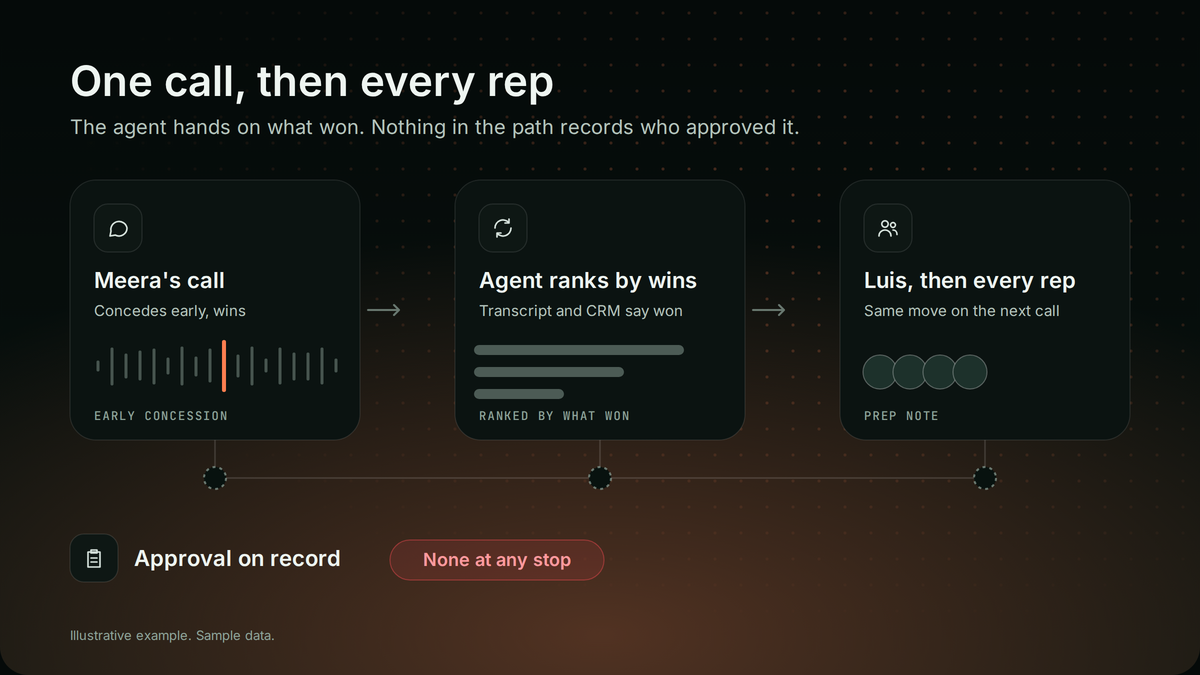
Meera, a top rep, wins a hard renewal on a first call by conceding early. The transcript lands in the data your agent learns from, beside the CRM record that says won.
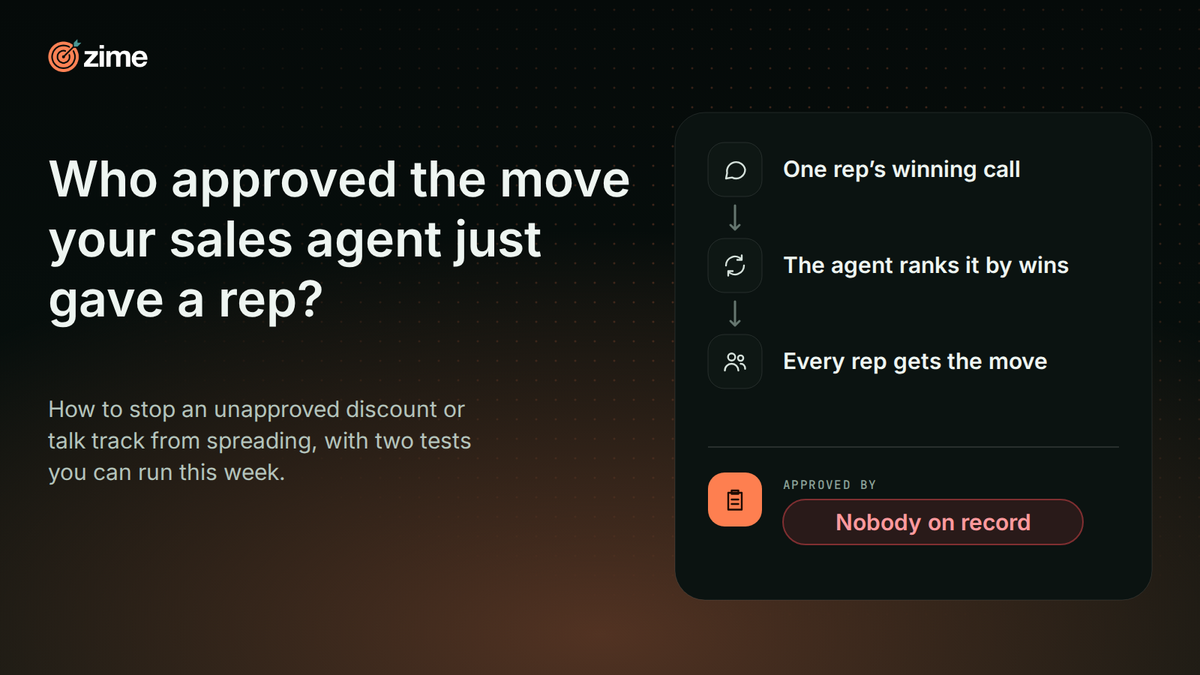
The agent ranks moves by what correlated with wins, and her concession ranks well. Two days later, Luis has a similar renewal. His prep note leads with her move. He runs it. Nobody pushes it. The agent's credibility does that work.
A talk track travels the same way. Say a rep tells buyers the new add-on already works with the old platform. The picture shows the path: one call, then every rep, with no approval at any stop.
The Signal profiled a CRO at Hatch who wrote a Sales Bible from 409 calls of his single best rep. But a call records what a rep did. Approval lives in a pricing policy, a battle card or a CRO's decision, and sometimes nowhere.
Why the usual fixes stop short
So your guardrails never saw the move. Field permissions suit a field. An approval workflow suits a quote. A prompt rule stops a phrase you thought of. A language library keeps quoted text clean, and a keyword monitor catches a banned word.
Each has a tell. If the quote appears and the agent never wrote a field, permissions were never the gate. If a new talk track slips past a rule, the rule only knows what you wrote. If the move returns from the second and third rep, dropping the top rep's calls did nothing.
Manager review has a tell too. Versa sells against ten named competitors, with deals from $100K to $3M, and its SE calls run without managers. John Volkering, Director of Systems Engineering, ran the European SE team.
"My team doesn't like their managers to be on their calls and get micromanaged."
John Volkering, Director of Systems Engineering, Versa Networks
A gate that needs a manager in the room is a gate reps route around.
The table below sorts six approaches by job. On advised moves, the others cover it in part, and only a record of approval covers it in full.
| Job | Field permissions | Approval workflow | Prompt rules | Approved-language library | Manager call review | Approval record per move |
|---|---|---|---|---|---|---|
| Keep the agent out of a record | ✓ | Partial | Partial | ✗ | ✗ | ✗ |
| Hold a quote above the limit | ✗ | ✓ | Partial | ✗ | Partial | Partial |
| Stop a banned phrase | ✗ | ✗ | Partial | ✓ | Partial | Partial |
| Stop an unapproved move being advised | ✗ | ✗ | Partial | Partial | Partial | ✓ |
| Show who approved a move | ✗ | Partial | ✗ | Partial | ✗ | ✓ |
| Let leadership promote a good move | ✗ | ✗ | ✗ | Partial | Partial | ✓ |
Walk Luis's call through it. No field is written and no quote exists, so only a manager who was not on the call could ask who approved the move.
Two tests show where you stand. A fail on either means the move is a candidate, not a standard. The table below sets out both tests.
| Test | What you do | Pass | Fail |
|---|---|---|---|
| Trace test | List the last twenty moves your agent recommended. Name an approver and where it is written. | Every move has both | Any move has neither: it is only a candidate |
| One-rep test | Remove one top rep's calls from the data. Ask the same twenty questions again. | Advice on strategy-backed moves holds | Advice changes: it rests on one rep |
Start with the trace test. A move with no approver on record is the whole problem, written down.
Put the approval status on the move
A candidate is not a standard. Give every move a status before it reaches a rep: seen on calls, candidate for review, or approved with a named approver. Only approved moves ship. A candidate waits in a short queue for whoever owns the decision, usually the CRO or the deal desk.
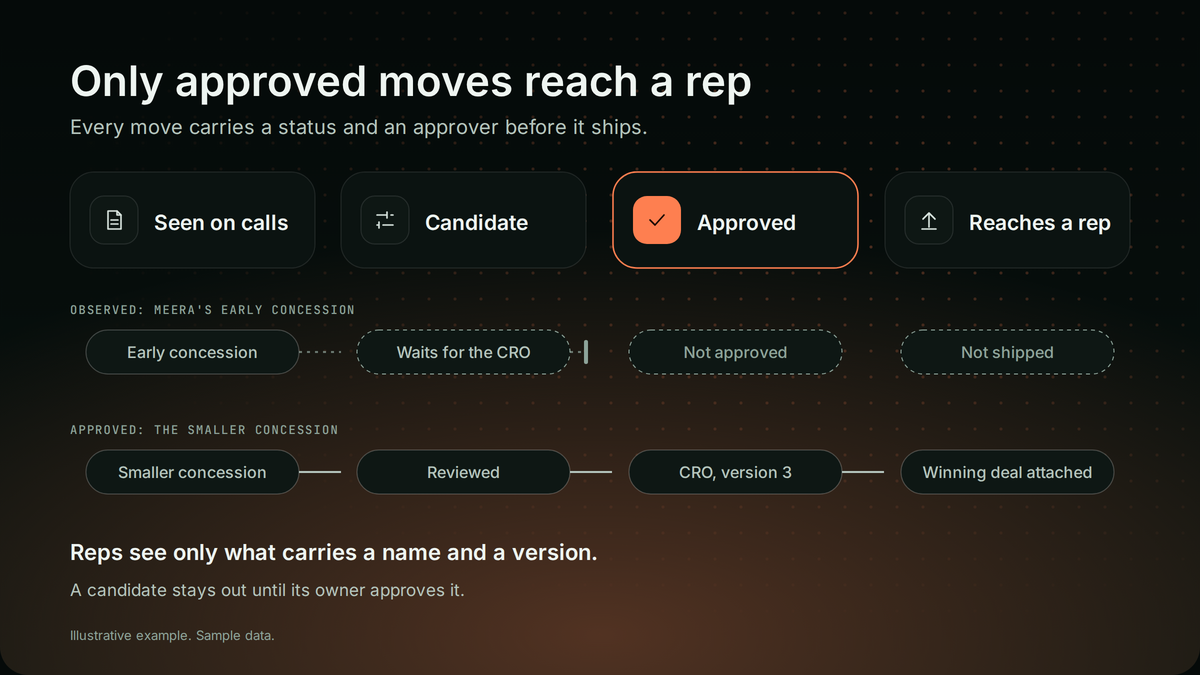
Status has to move with strategy too. When the CRO changes the priority next quarter, last quarter's approval is not enough, so each approval needs a version. HFS Research names the wider gap: a CRO's plan does not convert to execution, so reps revert.
Zime builds this into one model. It holds how your best reps decide, what your CRO authorized this quarter, and your past deals. Zime calls it the Behavior Graph. Its judgment is elicited from your best people through FDE-run interviews and RLHF, including what never shows up in a transcript. In plain words, Zime's forward-deployed engineers interview your best reps, then score and correct moves until those reps would run them. The model produces Behaviors: the specific move for this deal, with the winning deal behind it.
Every Behavior traces to the strategy your CRO authorized, and the Zime Enterprise Sales Harness tests, approves, versions and rolls back skills from one hub, with central policy setting who may approve them.
Chitresh Yadav, VP and Global Head of Sales Engineering at Versa, runs this test by ear. When a competitor comes up, he is thinking
"…whether my rebuttal to those were inline to our battle card."
Chitresh Yadav, VP and Global Head of Sales Engineering, Versa Networks
The approved line is his test. A status on the move gives every rep that test.
You can build this layer yourself, and it is not harder engineering than what you shipped. The input does not exist, because nobody wrote down which moves leadership approved. Collecting it is a different job. And strategy resets every quarter. Zime estimates 8 to 12 months and 200+ .md files to encode that judgment by hand. Yadav's own scoping at Versa ran 12 to 24 months and about $1M of GTM engineering. Both are estimates. Neither is a measured result.
Zime has not published a customer case of an agent spreading an unapproved move, and this post claims none. With one product, one motion and a deal desk that reads every quote, a hand-kept list can hold. It stops when role, product, competitor and region outgrow one person's list.
Replay the same week
Meera wins the same renewal with the same early concession. This time her move enters as a candidate, with the call attached, and waits for the CRO. Luis's prep note carries the approved move instead, with the winning deal behind it. He runs it and can see why it is safe. No rep has to guess. The deal desk lead's ticket never opens, because each quote traces to an approver. The CRO decides on Meera's move once, with her call in hand. If they promote it, every rep gets it with the CRO's name on it. You get one answer for the deal desk lead: the move, its approver, its version.
The same pattern covers messaging. Bureau once kept product updates, pricing and objection guidance across Jira, Confluence and spreadsheets. Its founder put the result in one line.
"We improved our ARR by 10% with Zime seamlessly getting our product releases to our sales team in the form of just-in-time Actions."
Ranjan R Reddy, Founder & CEO, Bureau Inc.
Approved messaging that reaches the rep inside the deal leaves no gap for a talk track to fill.
Add one line to your dashboard: moves run, by authorizing strategy and by deal. Reps running it is the first sign. Deals moving is the second. Neither alone proves the move was right.
Keep your harness. Add the check.
The agents you built stay yours. Zime adds the layer underneath: judgment elicited from your best reps, your CRO's authorized strategy, and Behaviors that reach a rep tied to the strategy that authorized them. Live in 7 days on your own data, which is enough to prove one Behavior before you scale it. Bring one discount rule and one talk track from this quarter, and see the Behavior each becomes. Book a demo →
FAQ
How do I stop our sales agent from spreading a field workaround leadership hasn't approved?
Attach an approval status to every move before it reaches a rep. Permissions and approval queues guard what an agent writes, not what it advises, and an agent that learns from calls cannot tell a winning move from an authorized one. Hold each learned move as a candidate until its owner approves it. Zime's Behavior Graph, a model of how your best reps decide, what your CRO authorized this quarter and your past deals, ties each move to the strategy your CRO authorized.
Isn't a field permission or an approval workflow enough?
A permission limits which fields an agent may write, and a workflow holds a quote already written. A discount said on a call, or a talk track advised to the next rep, touches neither. The check has to sit on the advice itself.
What if the workaround is the better move?
Then promote it. Send it to whoever owns the decision, usually the CRO or the deal desk, with the winning call attached. Approved, it becomes the standard with a name and a version. Declined, it stops spreading.
Do I replace my CRM and conversation intelligence?
No, keep both. Both recommend a course of action, and the difference is where it comes from: patterns in past calls, or your reps' judgment and your CRO's authorized strategy. Zime runs on Claude and connects to your agents over MCP.
What should I ask any vendor about reviewing learned moves?
Ask four things. How long does a candidate wait for a decision, and what does the rep see meanwhile? Who can approve, and where is the approver recorded? Can you show a move the system declined to ship? What happens to an approval when strategy changes?