I have every call recorded. How do I get the right move for my next call?
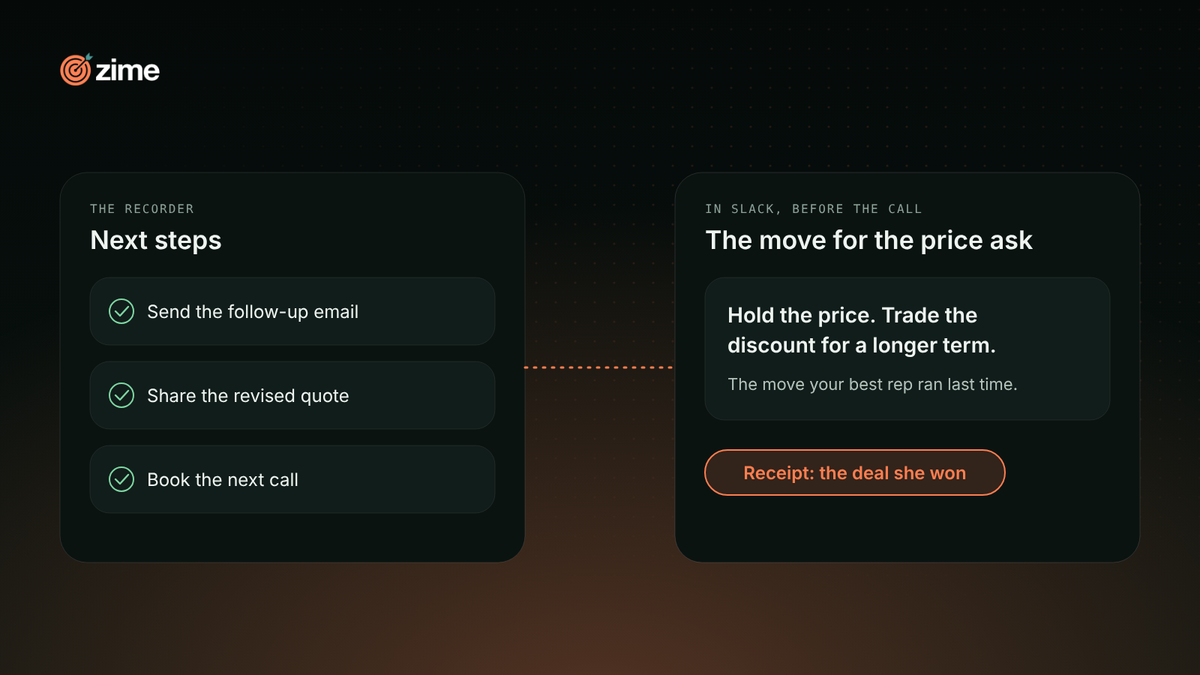

- Your call recorder earns its place. The summary writes itself. The follow-up drafts in a minute. Some tools even show how other reps handled a concern.
- But then the deal gets real. The buyer pushes on price. You need the move that works with this buyer. The suggestion you get could fit anyone, so you wing it.
- And your recordings won't give you that move. Your best reps rarely say out loud why they win. Your company's plan for this quarter isn't in the call either. A recording only holds what was said.
- That missing piece is what a Behavior Graph adds. It learns how your best reps win, from the reps themselves. That includes what never shows up in a transcript. It adds your company's plan and past deals, then gives you the move.
- So you stop winging it. The move reaches you in Slack or Teams before the call. It comes with a deal your best rep won with it. Afterwards you can see that you ran it, and whether the deal moved.
Wednesday night. An AE, ten calls into a deal, learns that procurement wants a price cut before it signs on Thursday. Every call is on record, captured by an AI notetaker or a conversation intelligence tool.
The recorder has done its job. The summaries are sharp, the action items are logged, and the follow-up went out within the hour.
So he asks the assistant what to do about the discount. The answer would fit any buyer. His manager does not join calls, so he posts in the team channel and gets three different answers by nine.
What he wants to know is simpler. What would our best rep do on this call, and why should I trust it? Start with her.
What your best rep would do
Say she answers a price push with a longer term instead of a lower price. She has three reasons, and she has never said any of them out loud.
- The buyer. Procurement has to show savings, so a longer term is a win it can report.
- The history. She traded term for price on the last deal like this, and it closed.
- The plan. Leadership said this quarter that it wants longer terms.
The AE needs exactly that, tonight. He cannot reach her. No manager on the call means nobody to ask in the moment. The rep decides alone.
Why the answer keeps slipping away
His recorder, an AI notetaker like Fireflies or Otter or a conversation intelligence tool like Gong, was supposed to close that gap. It was built to record what was said, so it does not, and the gap widens every quarter.
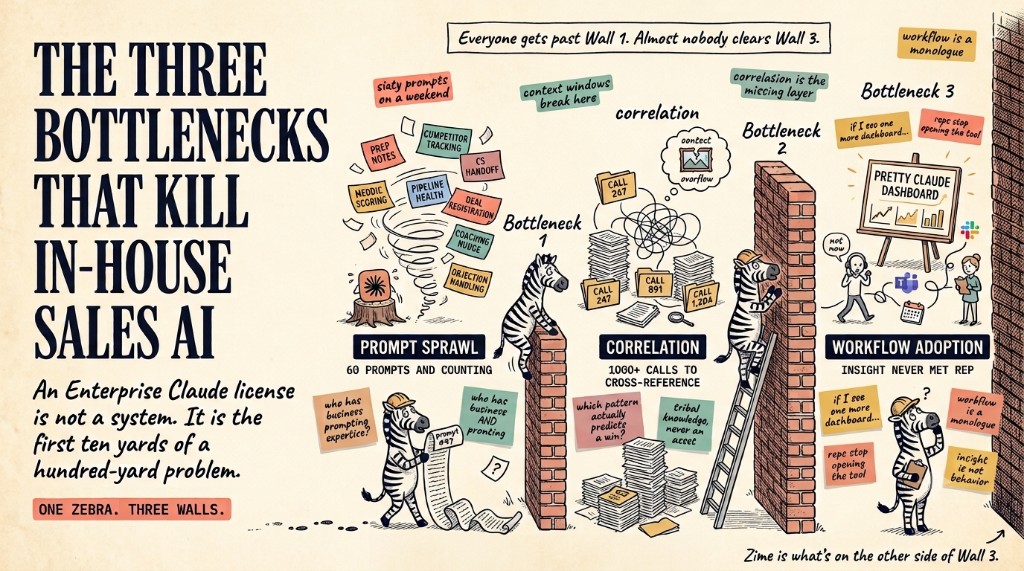
- Every deal differs. A new product, a new buying group, a new competitor. The move that wins one account dies at the next.
- The portfolio keeps growing. More products, more rivals, more buyers to handle.
- Every call adds a record, not a move. Ten recordings give ten summaries of what was said.
- The plan moves each quarter. Last quarter's answer is already stale.
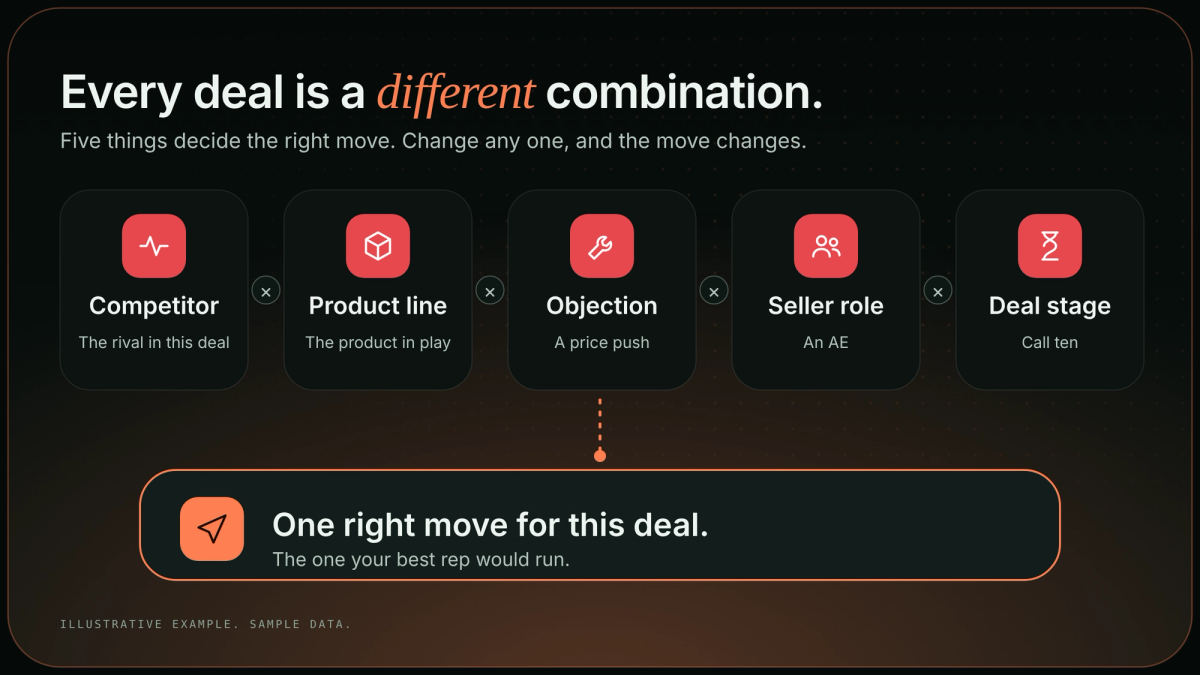
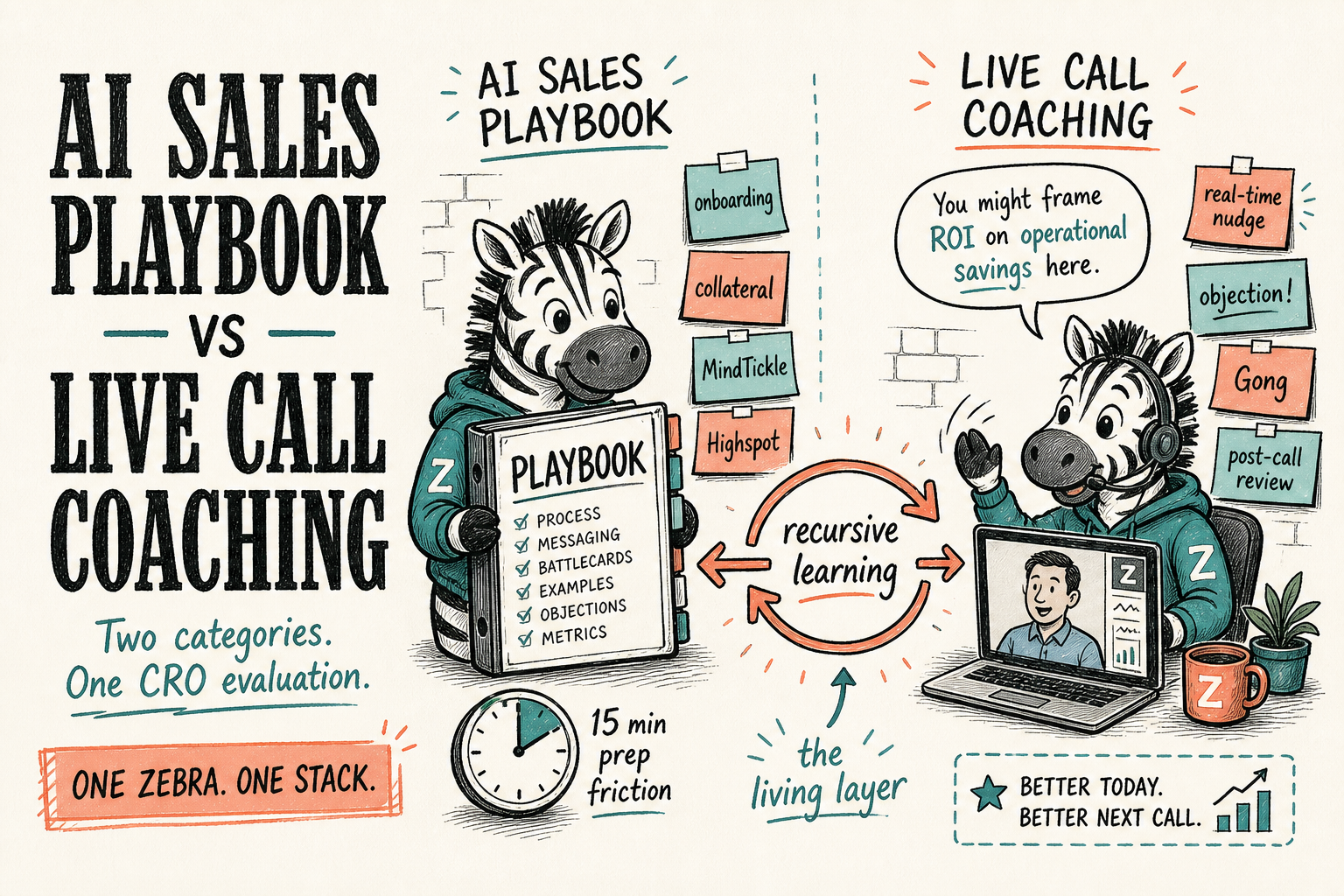
So he tries the routes he has. Each answers a different question than hers.
- The call summary. It records what was said and agreed. The tell: you could paste its advice into any other deal.
- The assistant inside the recorder. It shows how other reps handled a similar concern. The tell: it reports what reps said, with no win behind it.
- Your own AI chat on the transcripts. Quick, and good on one call. The tell: you paste the same calls in again each time it loses the thread.
- Asking around. It works when someone is free. The tell: three answers by nine.
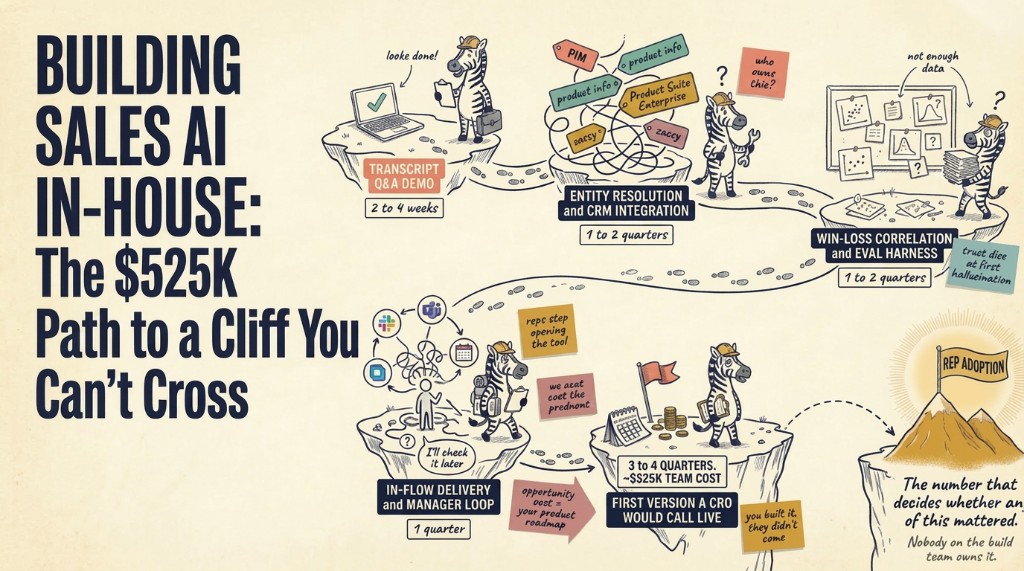
Then he stops opening them. Ameeth Dubey at Atomicwork described an earlier attempt that used ChatGPT:
"We tried building with ChatGPT. The only problem is adoption."
Ameeth Dubey, Atomicwork
The tool existed. Running it is the part that stalled.
What no recording holds
Go back to her three reasons: the buyer, the history and the plan. None is in a transcript. She never says how she reads the buyer. A recording cannot say whether the move won the last deal like this one. And leadership never reads its plan out on a call.
A recorder keeps a receipt for a fact: the buyer said this, on that call. A move needs a receipt for a win: this rep ran it and took the deal. Both systems recommend a next step. Only one has a win behind it.
Chitresh Yadav leads more than 100 SEs across four regions at Versa Networks, which sells against ten named competitors. He shows the gap from inside a live call:
"If I hear something like our competitors, Fortinet or Palo Alto or Zscaler, I'm thinking whether my rebuttal to those were inline to our battle card."
Chitresh Yadav, VP and Global Head of Sales Engineering, Versa Networks
He needs the company's line as well as the words said. The rep is not the problem. The source is.
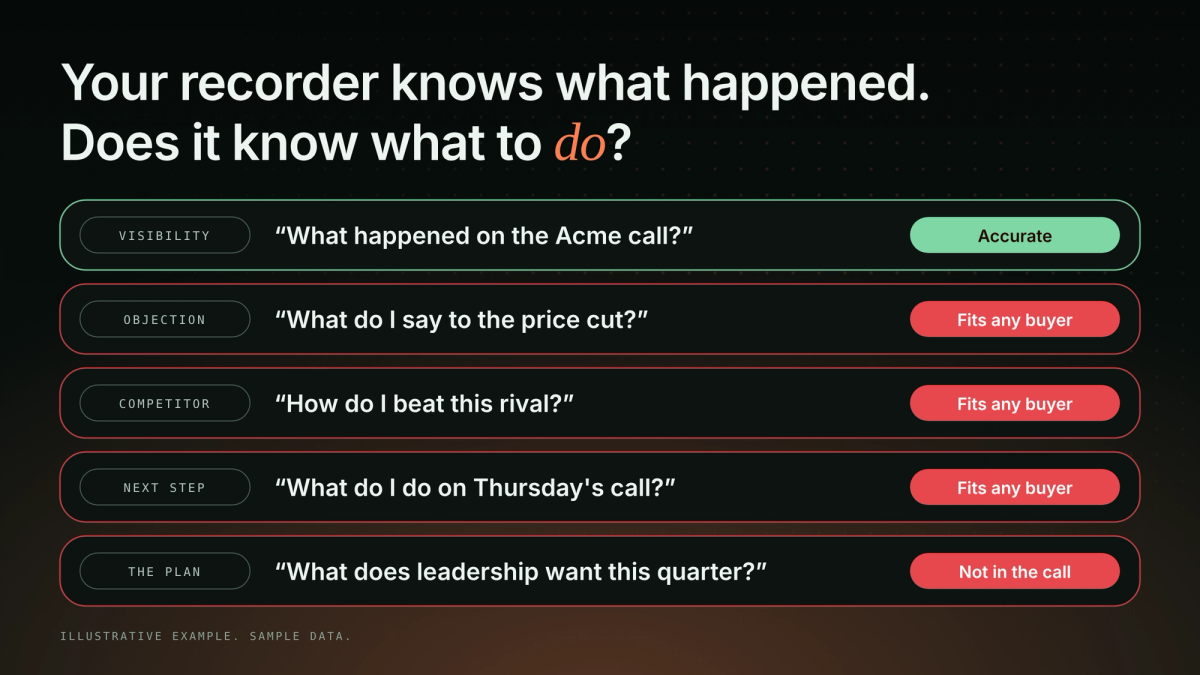
Ask the assistant what happened in an account, and it is accurate. Ask it how to handle the discount, the competitor or the next step, and the answer reads the same for every deal. Ask what leadership wants this quarter, and the call has nothing to give.
The table below lines up three routes against six things a rep needs on the next call. Every route suggests a next step, because all three kinds of tool recommend one. Only one route also carries the reasons best reps never say and the plan for the quarter. The table rates classes of tool, not any one product, and products within a class differ.
| What a rep needs on the next call | Recorder and its assistant | Your own AI chat | Moves from your best reps |
|---|---|---|---|
| Suggests a next step | ✓ | ✓ | ✓ |
| Shows how other reps handled it | ✓ | ✓ | ✓ |
| Holds the whole account | Partial | Partial | ✓ |
| Includes the reasons best reps never say | ✗ | ✗ | ✓ |
| Matches this quarter's plan | ✗ | ✗ | ✓ |
| Comes with a deal it won | Partial | ✗ | ✓ |
Where the move comes from
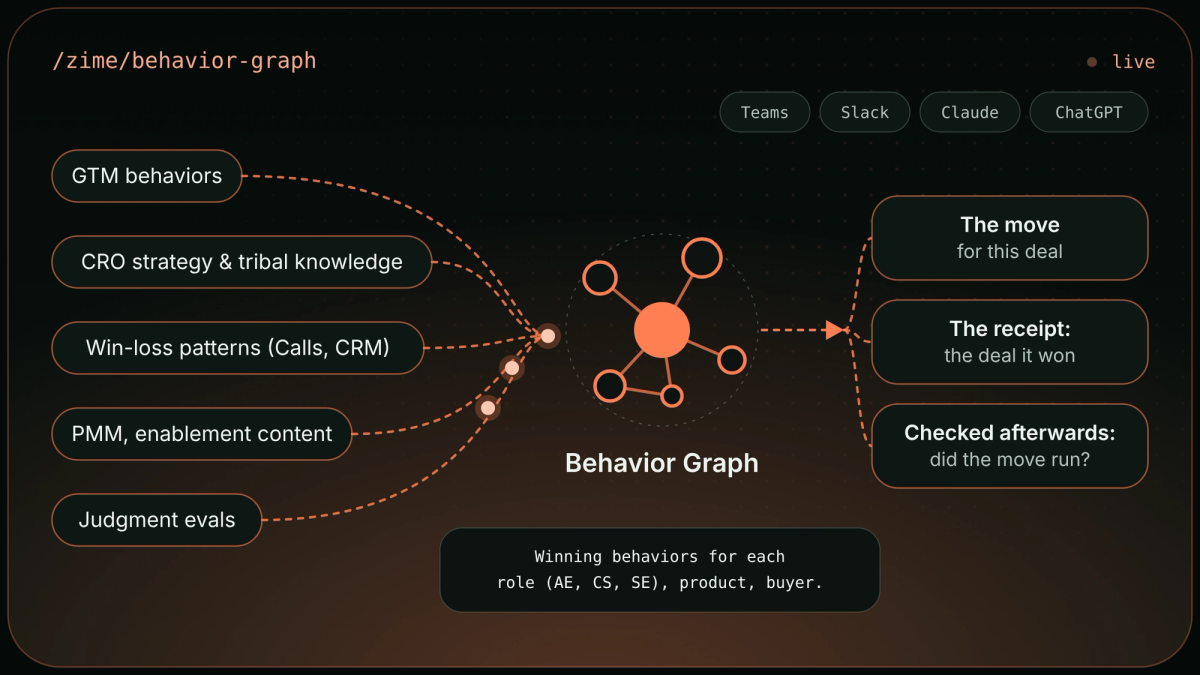
It comes from the people who already win this situation, with a company willing to stand behind them. Call it the move your best reps actually run, backed by your company. Zime is Behavioral AI for Sales Execution: it puts the winning moves of your best reps in front of every rep, before the call. It builds them in a model called the Behavior Graph. Three things go in:
- Your best reps' judgment, elicited from your best people including what never shows up in a transcript.
- Your CRO's plan for this quarter.
- Your past deals, and how each one ended.
What comes out is a Behavior: the specific move a rep runs in a given situation, with a receipt attached. The receipt is the winning deal the move came from. A recorder tells him what was said. A Behavior tells him what won. It is the last column of the table above.
HFS Research profiled Zime in July 2026 and named the gap: the CRO's plan does not convert to execution, so reps revert to old habits. Versa Networks shows the other side. Its SEs run technical evaluations with no manager on the call. Within three months, 79% were running the right technical discovery, up from 20% at the start. That counts behaviors run on live deals, not logins.
Versa also reports a 12% increase in technical wins, a separate measure. Zime's own adoption figure is 80% of eligible reps within 90 days.
At Bureau, product updates and objection guidance sat in Jira, Confluence and spreadsheets. Its Founder and CEO, Ranjan R Reddy, described what changed:
"We improved our ARR by 10% with Zime seamlessly getting our product releases to our sales team in the form of just-in-time Actions."
Ranjan R Reddy, Founder & CEO, Bureau Inc.
That is the delivery half of the job: the right guidance in front of sales, in the moment. Bureau also reports a 30% increase in deal conversions.
Now run Wednesday night again. Same AE, same ask from procurement. This time a prep note is waiting in Slack before the call. It names the risk and the win condition, then gives three moves. One is what his best rep ran the last time a buyer pushed on price, with the deal she won attached. One comes from this quarter's plan.
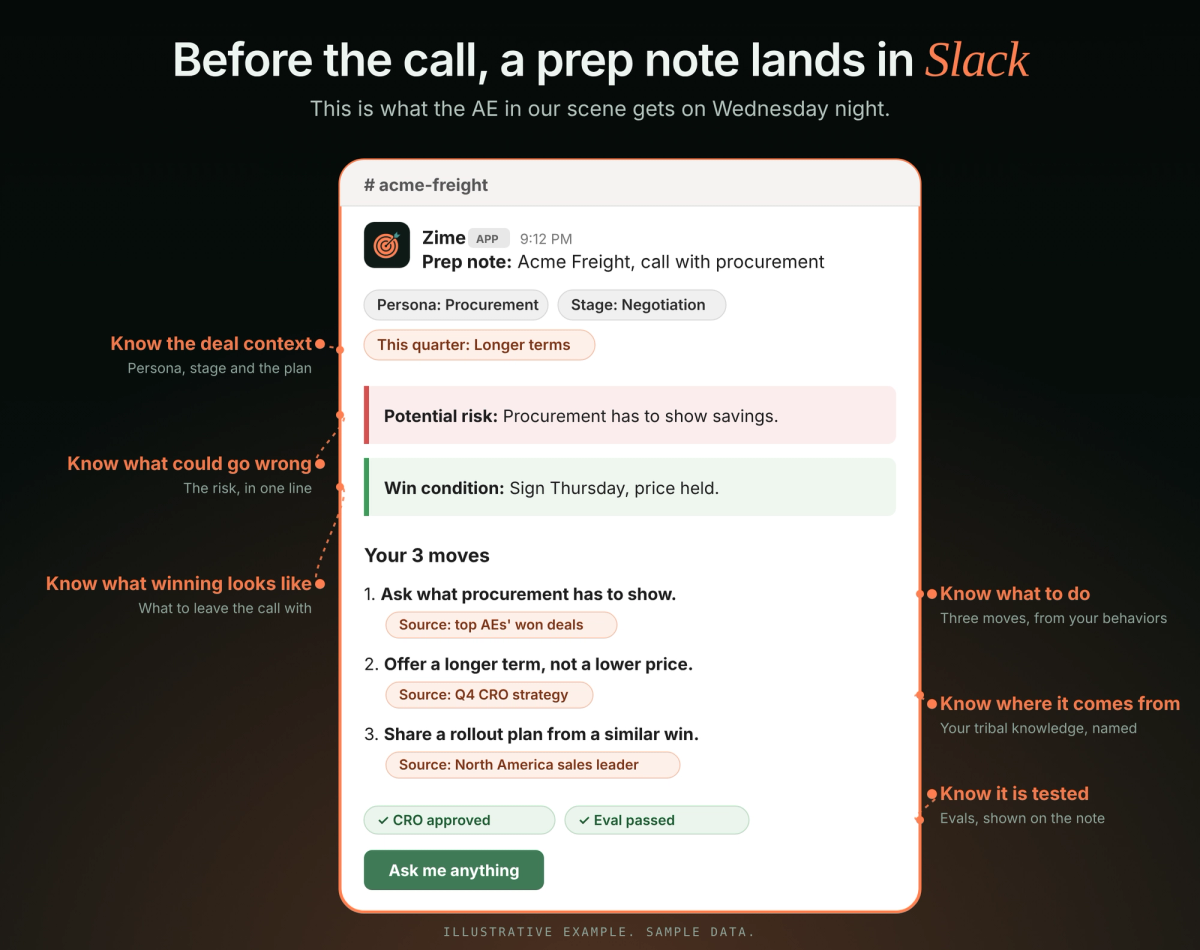
Here is a sample note in plain text, with invented details:
- Risk: procurement has to show savings.
- Win condition: sign Thursday with the price held.
- Move 1: ask what procurement has to show. Won: an enterprise renewal in EMEA. Source: top AEs' won deals.
- Move 2: offer a longer term instead of a lower price. Won: an APAC renewal that closed on a longer term. Source: Q4 CRO strategy and your best rep's play.
- Move 3: share a rollout plan from a similar win. Won: a multi-site rollout in North America. Source: a sales leader.
He reads it in two minutes and runs it on Thursday. His manager was not on the call and did not need to be. The team channel stays quiet, and the best rep was never pinged. He trusts it because it already won, and his company stands behind it. It never assumes he misread his deal.
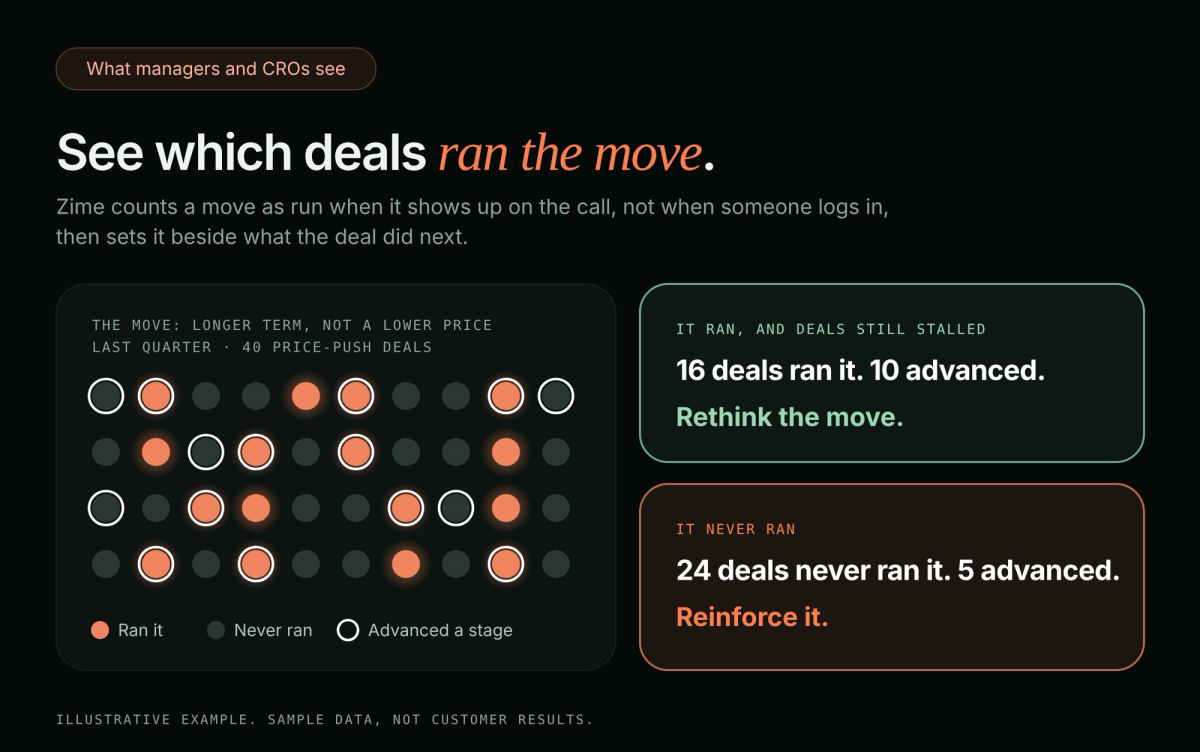
Afterwards he can see three things, because Zime counts adoption as behaviors run. That he ran the move. Whether the call followed this quarter's plan. What the deal did next.
When each fits. A recorder is the right tool for the record: what was said, who agreed to what, and when. If your deals close in one call and the answers are already written down, or every deal looks like the last, a recorder on its own may be enough. The move earns its place when deals run across many calls and the answer changes with the buyer, the objection and the quarter. And no customer result is published yet for a move that holds the whole account across many calls. What is published is behaviors run, in the Versa figure above.
Four tests for any tool, this one included
- Does it reach me before the call? Pass: it waits in the app I already use. Fail: I open another app and ask.
- Is it for this buyer, this objection, this stage? Pass: it names my situation. Fail: I could paste it into any deal.
- Whose move is it? Pass: I can see the rep and the deal it won. Fail: it says "best practice."
- Does it hold the whole account? Pass: it uses earlier calls. Fail: it knows only the last one.
What your manager and CRO get
They see the same record. The manager sees which behaviors ran on the call and which one a rep skipped, so pipeline review and the next 1:1 start from the call. The CRO sees which deals ran the plan and what each one produced. If it ran and deals still stalled, the plan needs a rethink. If it never ran, it needs reinforcing. Zime checks calls and CRM notes for this.
Brent Bair, a regional sales leader at Versa Networks, described the effect on his team:
"As I look at my team, the adoption rate has improved. I think it's become ingrained in our sales DNA..."
Brent Bair, Regional Sales Leader, Versa Networks
That is the manager's view: whether the team runs what the company wants run.
Get the move before the call.
Keep the recorder you have. Zime adds the moves your best reps run, each with the deal it won, in Slack or Teams before you dial. Bring one live deal and one objection, and see the move it becomes.
Not ready to book? See a live prep note →
FAQ
I have recordings and summaries of all my calls. How do I figure out the right next step for my deal?
Add what a recording cannot hold: the move your best reps run in this exact situation, backed by your company's plan for the quarter. That move is judgment elicited from your best people through FDE-run interviews and RLHF, including what never shows up in a transcript. FDE-run means Zime's forward-deployed engineers interview them. RLHF means they then score and correct each move. Zime turns it into a Behavior, a move with a winning deal behind it, sent before your call.
My recorder already shows how other reps handled it. Isn't that the same?
Close, and useful, so keep it. Both systems recommend a next step. The difference is where it comes from: what reps said on calls, or how your best reps decide and what your company wants this quarter.
Why would I trust it over my own read of the deal?
It carries your CRO's strategy and your best reps' judgment, with the evidence of it succeeding before. You still make the call. Why reps run a recommendation is covered in a longer post.
Is this one more tool to open?
No new app. Behaviors, the moves Zime sends, reach reps in Slack, Teams or Claude before the call. Your part is to read it and decide. The case for guidance inside the flow of work is in a longer post.
What is the difference between an AI notetaker, conversation intelligence and Zime?
An AI notetaker, like Fireflies or Otter, records, transcribes and summarizes a call. A conversation intelligence tool, like Gong, also analyzes calls across a team. Keep either one: it is your record of what was said. Zime adds what a recording cannot hold, the move your best reps run in this situation, sent before your call.
Will my manager see everything I do?
Ask any vendor before you roll it out, and get the answer in writing: who can see what I run? On other reps' deals, Zime sends you the move and the judgment another rep used, not that deal's confidential details.