Our messaging changes every quarter. How do we stop reps pitching last quarter's version?

- You did the rollout right. The new message got a kickoff, a refreshed deck and new battlecards. Reps practised it and passed certification. Enablement can show every box ticked.
- But none of that tells you which version reps ran on this week's calls. Certification shows a rep can say it once. Content opens show the deck was viewed. Neither shows what came out when the buyer pushed back.
- And last quarter's version does not retire itself. It lives in old decks, saved notes, a top rep's habits and the colleague a rep asks before the call. A message is a slide. What changes on a call is the move each role makes, and nobody turned this quarter's slide into that move for the AE and the SE.
- That missing step is what a Behavior Graph adds. It is a model of how your company wins: your best reps' tribal knowledge, including what never shows up in a transcript, plus this quarter's CRO strategy and your past deals. It turns the new message into the move each role runs, before the call, with a won deal behind it. When the strategy changes, the moves change, and last quarter's stop reaching reps.
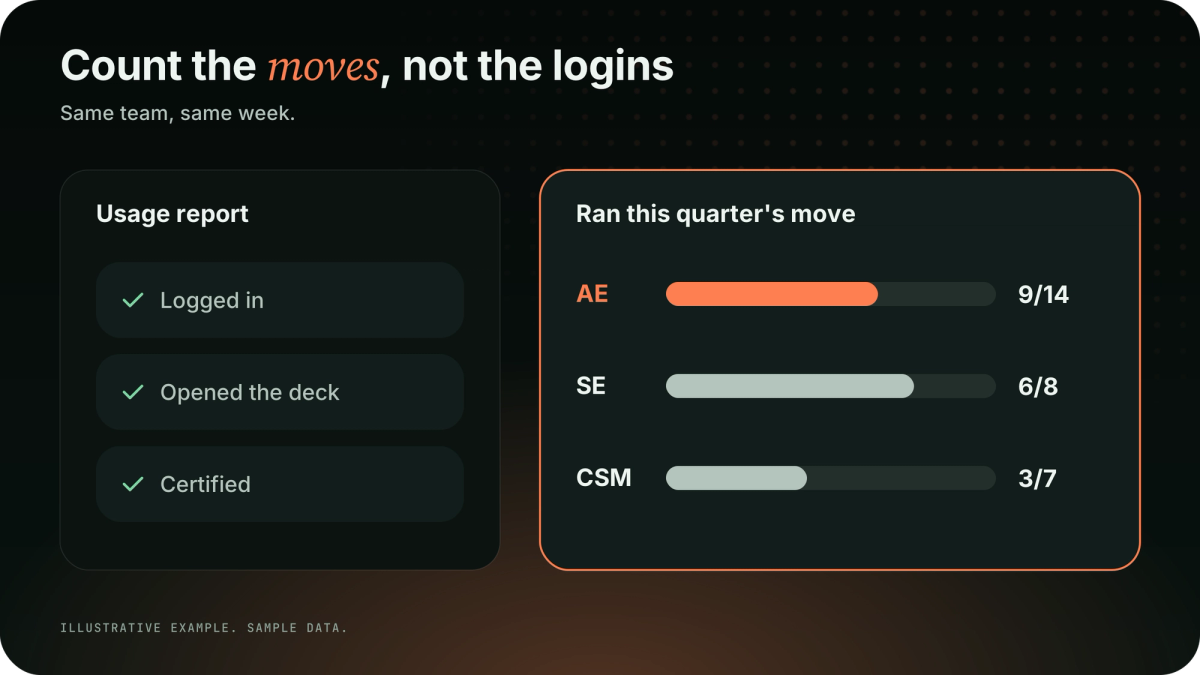
- So you check it every week, not at quarter end. Count the moves reps ran on live calls against this quarter's version, by role. That is programmatic adoption, not logins or certification scores. Versa Networks got 79% of its SEs running the right technical discovery within three months, up from 20%.
Maya Chen is three weeks into a new quarter. She is the CRO, and at kickoff she changed the message: stop leading with price, lead with one platform and one rollout. On Tuesday she plays a recorded call from her largest competitive deal.
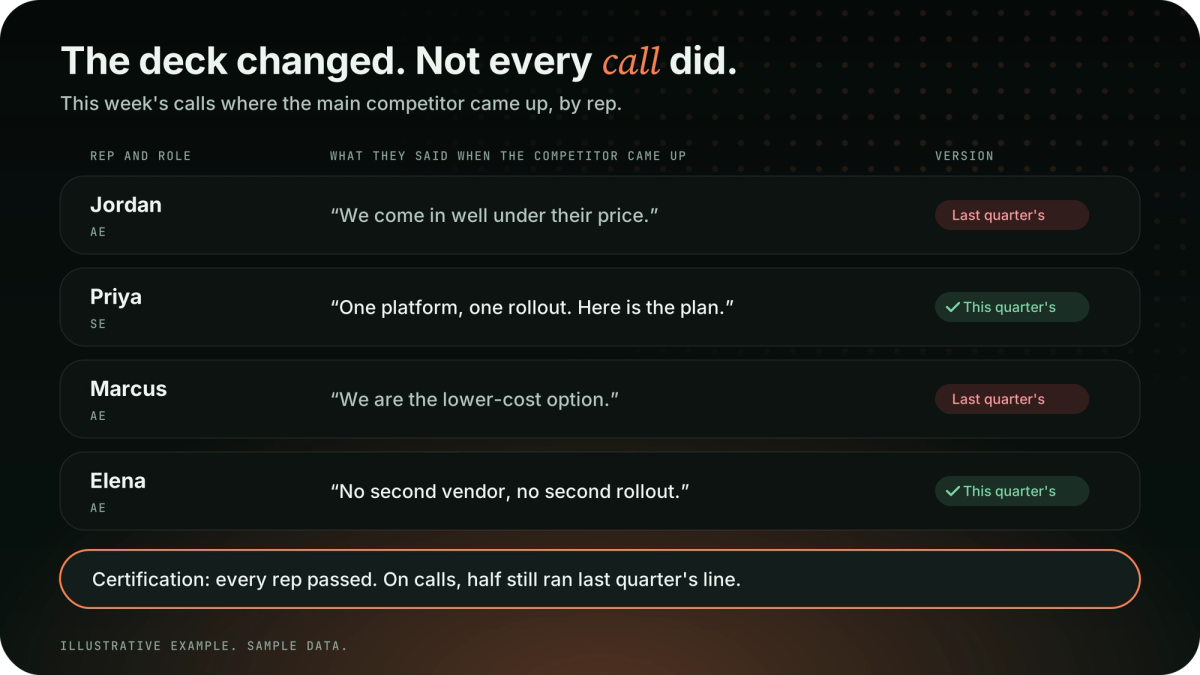
The buyer names the competitor. Her AE, Jordan, answers in one breath: "We come in well under their price."
That is last quarter's line.
Maya messages Sam, her enablement lead. Sam's report is clean.
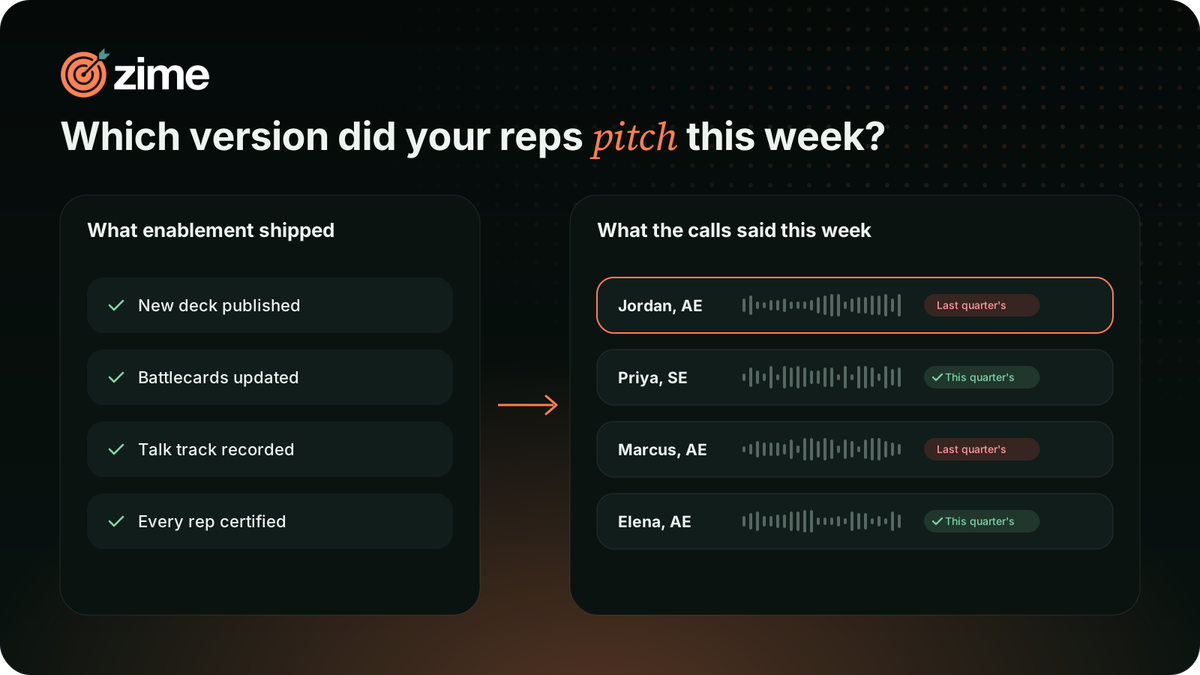
The deck shipped. The battlecards changed. Every rep passed certification. Sam ran the rollout well.
So Maya holds one call and a report that cannot say more. She cannot see which version the other forty reps ran this week. How would she know? And how does this quarter's version reach each rep's next call?
What your rollout reports can see
Each fix Sam ran is real, and each has a tell.
Certification proves a rep can deliver the message once, to a grader, with no buyer pushing back. The tell: high scores, flat competitive win rates.
Practice and roleplay build the reflex. The tell: reps sound sharp in practice and revert when a buyer names a rival.
Champions and spiffs create early wins. The tell: the same five reps win them.
Updated content keeps the deck current. The tell: opens rise, and the old line still turns up. Call tracking counts whether the new words were said. The tell: the words appear at the wrong stage, or from the wrong role.
The table below sets out what each method shows. Only one approach shows which version each rep ran this week.
| What you can see | Sessions and certification | Practice and roleplay | Content updates | Call tracking for mentions | Moves per role |
|---|---|---|---|---|---|
| A rep can say the new message | ✓ | ✓ | ✗ | ✗ | ✓ |
| The new words were said on calls | ✗ | ✗ | ✗ | ✓ | ✓ |
| Each role gets its move, in its own deal | ✗ | Partial | ✗ | ✗ | ✓ |
| Last quarter's move stops reaching reps | ✗ | ✗ | Partial | ✗ | ✓ |
| Which version each rep ran this week | ✗ | ✗ | ✗ | Partial | ✓ |
Seeing which version each rep ran, by role, is the capability Maya needs. Sam's methods stop short of it.
In Maya's week, certification said Jordan was ready and the content report said he opened the new deck. Neither showed him going back to price.
Hermann Ebbinghaus measured on his own memory, in 1885, how fast new material fades without repetition. A kickoff is one repetition. HFS Research describes the sales version: the CRO's plan does not convert into execution, so reps revert and win rates stall.
The picture below is Maya's week: every rep certified, half the calls on last quarter's line.
If the old line is still running, look at where it lives.
Where last quarter's version lives
Last quarter's message never left. It sits in saved decks, call notes and email templates. It sits in the colleague Jordan asks before a call, who won with the old pitch.
If your team built an agent on last quarter's deck, it answers well, in last quarter's words.
A message is a slide. What changes on a call is the move each role makes.
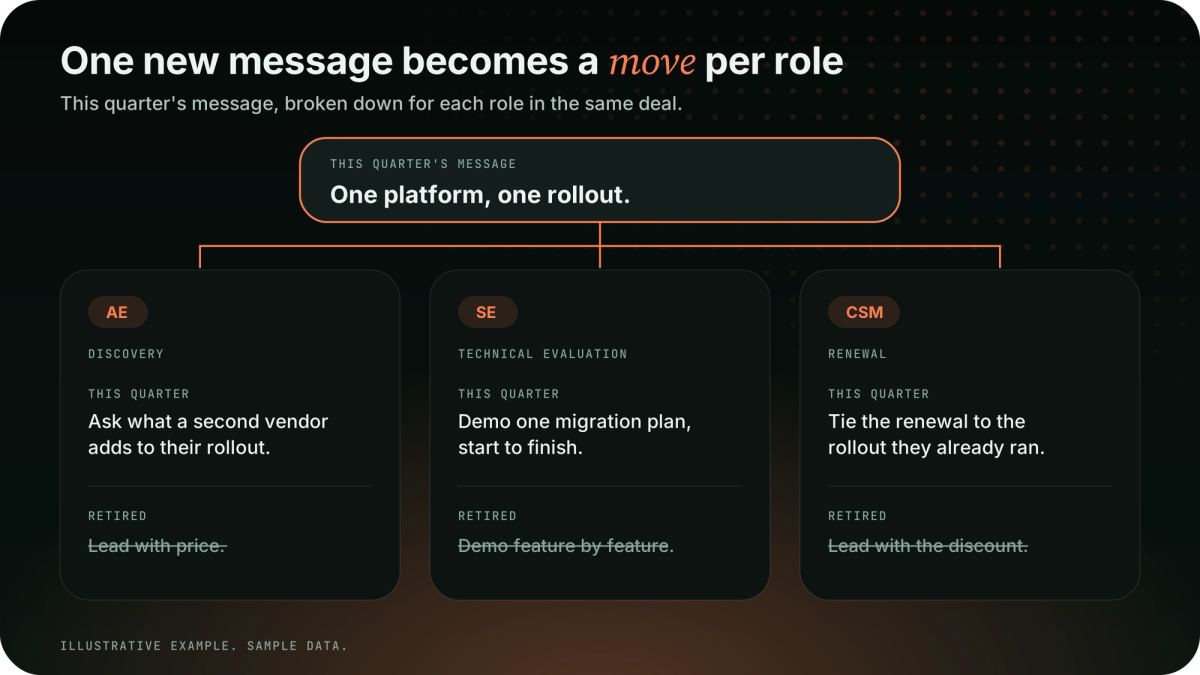
"One platform, one rollout" means one thing to an AE in discovery. It means another to an SE in a technical evaluation. Nobody wrote either move down.
So each rep translates the slide alone, and under pressure falls back to what worked last quarter. The same gap makes it hard to keep rep behavior consistent across complex deals.
Chitresh Yadav runs sales engineering at Versa Networks. That is 100+ SEs over four regions and ten named competitors.
His SEs take calls without a manager on the line. He told Zime what he listens for:
"If I hear something like our competitors, Fortinet or Palo Alto or Zscaler, I'm thinking whether my rebuttal to those were inline to our battle card."
Chitresh Yadav, VP and Global Head of Sales Engineering, Versa Networks
His question is not whether the battlecard changed. It is whether the rebuttal on the call matched it.
Here is that turn for one message, across three roles.
So the fix has two halves.
Turn the message into moves, then retire the old ones
Martin Mackay, CRO at Versa Networks, sets the playbook for more than 200 reps. He named the first half plainly:
"I wanted Zime to understand my playbooks and coach reps. No other tool does this."
Martin Mackay, CRO, Versa Networks
He wanted the system to know his current playbook and use it in each deal.
Zime does that with a Behavior Graph. It is a model of how your company wins. It holds your best reps' tribal knowledge, elicited from your best people, including what never shows up in a transcript.
FDE-run interviews are Zime's forward-deployed engineers interviewing your best reps. RLHF means scoring and correcting each move until those reps would run it. The graph adds this quarter's CRO strategy and the context of your past deals. Out come Behaviors: the move for this role, stage and competitor, with the won deal behind it.
When Maya changes the message, Zime's FDEs encode it into the graph, and the Behaviors change with it. The Enterprise Sales Harness releases, refreshes and retires them from one hub. Last quarter's move stops reaching reps and the agents your team built.
The new one arrives before the call, in a prep note in Slack, Microsoft Teams or Claude. Reps get no new tool.
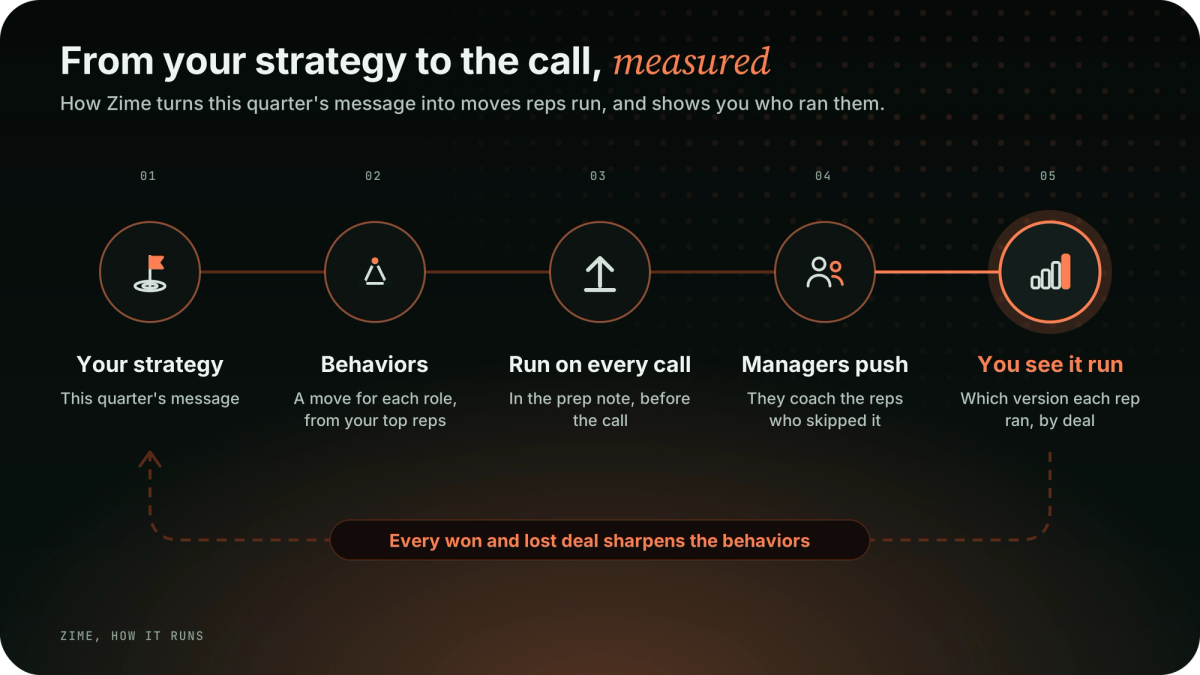
Here is the whole loop. You set the strategy once. Zime turns it into Behaviors for each role, built from your top reps, and delivers them before every call. Managers see who skipped a move and coach to it. You see which version each rep ran, deal by deal, and every won and lost deal sharpens next quarter's moves.
Bureau sells identity and fraud decisioning to banks and fintechs, across several products. Its product updates, pricing and objection guidance sat in Jira, Confluence and spreadsheets.
Ranjan R Reddy, its founder, put the result this way:
"We improved our ARR by 10% with Zime seamlessly getting our product releases to our sales team in the form of just-in-time Actions."
Ranjan R Reddy, Founder & CEO, Bureau Inc.
The release reached each seller inside the deal, not on a slide.
One number we cannot give you yet: how fast a changed message reaches every rep. Zime has not published one. Ask any vendor for theirs, measured on your own calls.
Now run Maya's week again. On Monday, Jordan's prep note carries the AE move: ask what a second vendor adds to the buyer's rollout. It shows the deal a top AE won with it.
Priya, the SE on the deal, gets hers: demo one migration plan, start to finish. On Tuesday the buyer names the competitor. Jordan asks the rollout question.
Sam's report lists which reps ran this quarter's move, on which deal. Sam coaches the reps who did not. No refresher session. On Friday, Maya sees who still runs the old line. Her strategy runs in every deal without another kickoff.
Check it every week
The table below lists four tests you can run without a new tool. If any one fails, last quarter's version is still live in your deals.
| Test | How to run it | Pass | Fail |
|---|---|---|---|
| The competitor test | Pull five calls from this week where the main competitor came up. | Every rep used this quarter's line. | Any rep used last quarter's. |
| The two-role test | Ask an AE and an SE what the message changes in their next call. | Each names a different move. | Both repeat the headline. |
| The leftovers test | Search shared decks, notes and internal agents for last quarter's line. | Nothing in use returns it. | Something still serves it. |
| The weekly count | Count reps who ran the new move on a live deal, out of those whose deals called for it. | The share rises each week. | You can only count logins. |
The weekly count is the one to repeat. It measures adoption, not exposure.
Zime calls it programmatic adoption: Behaviors run on live deals, tied to the strategy that authorized them and the deals they moved.
Versa set a new technical discovery standard for its SEs. At the start, 20% ran it. Within three months, 79% of SEs were running the right technical discovery.
Brent Bair, a regional sales leader at Versa, watched it on his own team:
"As I look at my team, the adoption rate has improved. I think it's become ingrained in our sales DNA ..."
Brent Bair, Regional Sales Leader, Versa Networks
It was counted in deals, so his team could see it change.
At Bureau, Kapil Bhagat, AVP of Sales Strategy, owned the discovery standard. Showing who skipped it changed what reps did:
"So this monitoring led to execution ... Having a dashboard where non adherence is called out improves execution."
Kapil Bhagat, AVP, Sales Strategy, Bureau Inc.
Seeing the skip moved execution. The same check works when you turn a win-loss finding into a step every rep runs.
For the board at day 90, Zime's own benchmark is 80% of eligible reps within 90 days: the reps whose deals call for the move.
Make this quarter's message the one reps run.
Keep your enablement, content and call recordings. Zime turns this quarter's message into Behaviors each role runs, retires last quarter's, and shows who ran them. Live in 7 days on your own data. Bring one messaging change and see the moves it becomes. Book a demo →
FAQ
How do you reinforce new sales messaging so reps actually use it on calls?
Turn the message into the move each role makes in its deals. Deliver it before each call, retire last quarter's move, and check calls weekly for which version ran. Zime does this with a Behavior Graph, a model of your best reps' tribal knowledge, your CRO strategy and your past deals. Adoption is counted as moves run in deals, not logins.
We already track keyword mentions on recorded calls. Isn't that enough?
It shows the new words were said, not whether the right role said them at the right stage. It also misses a rep falling back to last quarter's line under pressure. Count the move run in the deal, by role.
What happens when our strategy changes mid-quarter?
Zime's forward-deployed engineers encode the new CRO strategy into the Behavior Graph, the model that turns it into moves for each role. The Enterprise Sales Harness retires the old version for reps and agents from one hub.
Will reps feel policed if every call is checked?
We have no published answer yet. Ask any vendor whether reps see the evidence their manager sees, and get it as help before the call, not a score after.