Reps don't read enablement content. How do you get guidance to them without another doc or tool?

- Your guides are good. Many already sit in Slack, the CRM or a search bar. Keep them.
- But the hard part is adoption. Reps either run the guide on the call or they do not. Views and completions cannot tell you which.
- And a better file will not get it adopted. Reps pull a file when a buyer asks. They have seconds. They act on a move your CRO and best reps would stand behind.
- That is what a behavior graph adds. It is the model that turns your CRO strategy into a move for each role and deal. Zime elicits it from your best people's tribal knowledge, including what never shows up in a transcript. You see it run on the call.
- So keep what you bought and add the move reps run. The move arrives in Slack, Teams or Claude. Each week, count the calls where a rep did what the guide said. That count is adoption.
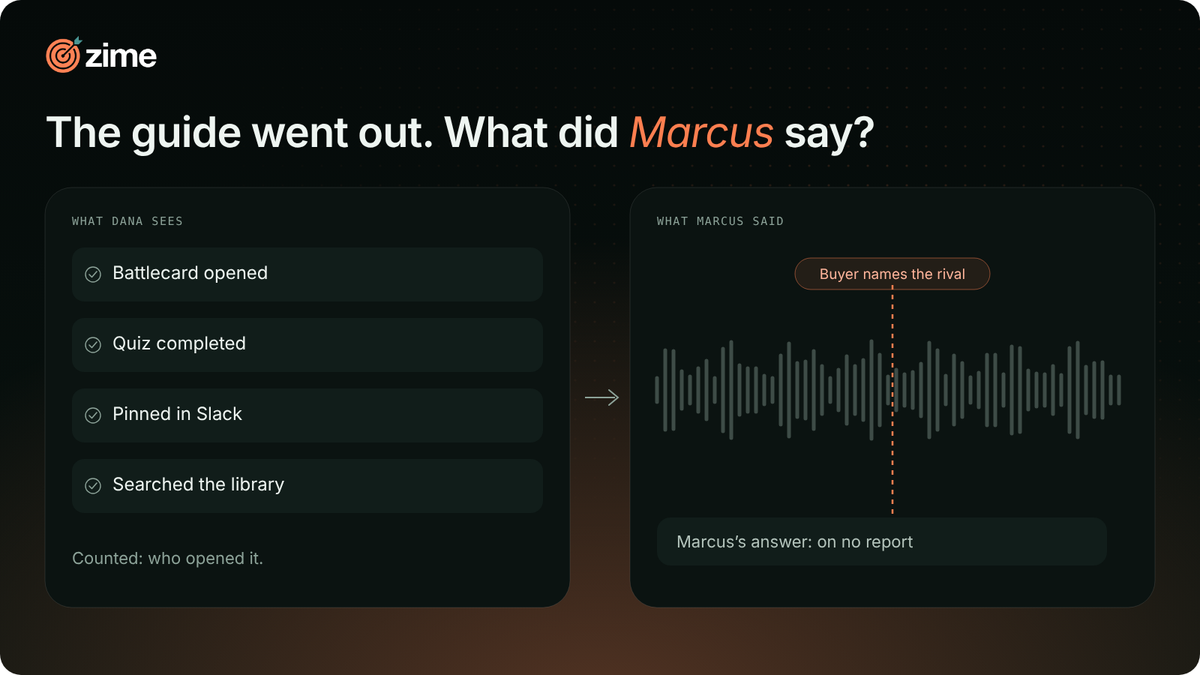
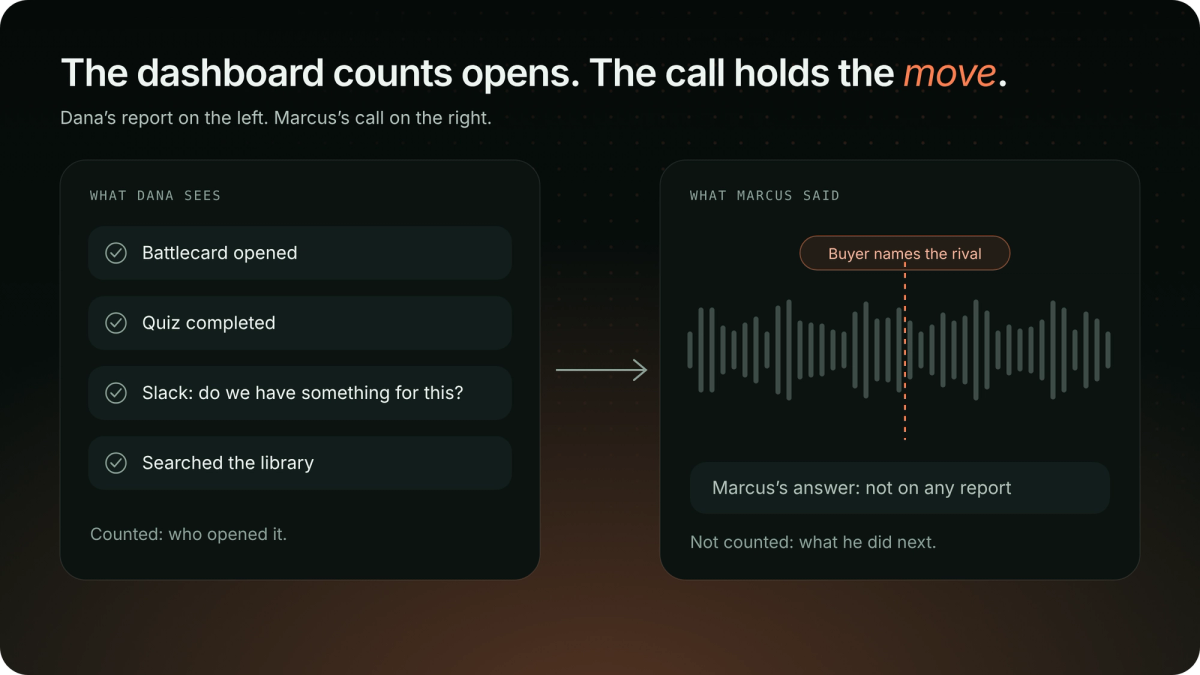
Dana runs enablement for a software team. On Monday she posts the new battlecard in Slack and pins it. By Friday most of the team has opened it. Two reps have asked in the channel, "Do we have something for the new competitor's pricing?"
The card answers that question. Nobody scrolled up.
Her CRO, Elena, asks the one thing the report cannot say. When a buyer names that competitor, what does Marcus answer? And how would Dana know?
Dana's report is clean. Opens are up. The quiz is done. She cannot hear a single call from it.
What her dashboard can see
Dana's dashboard cannot see what a rep did with the guide on the call. Everything she bought is real. A cleaned-up library helps reps find things. A platform puts the card inside Slack or the CRM. Training builds skill. Call scorecards check a list. A model over the library answers fast. Managers coach the reps they can reach. Keep all of it.
Each one moves the file closer to the rep. None shows what the rep says when the buyer pushes back. The table below checks each approach against what Dana wants to know. The line that separates them is whether the rep did the move on the call.
| What you can see | Library clean-up | Platform in the flow of work | Training | Call scorecards | Model over the library | A move per deal, checked on calls |
|---|---|---|---|---|---|---|
| Reaches the rep inside the tool they use | ✗ | ✓ | ✗ | Partial | Partial | ✓ |
| Shows who opened it | Partial | ✓ | ✓ | ✗ | Partial | ✓ |
| Gives the move for this deal | ✗ | Partial | Partial | ✗ | Partial | ✓ |
| Shows the rep did the move on the call | ✗ | ✗ | ✗ | Partial | ✗ | ✓ |
Kenny Cao is Senior Director, Head of Go-To-Market Strategy and Operations at Skan AI. His team had a new sales deck and a new value proposition. On a Zime call in October he said what he wanted to learn.
"I want to understand how the team is delivering against the deck and against the new value proposition, right? It is more of an enablement understanding versus whether they've done it."
Kenny Cao, Senior Director, Head of Go-To-Market Strategy and Operations, Skan AI
He separates two things: what enablement understood, and whether the team did it. A dashboard answers the first.
Chitresh Yadav runs sales engineering at Versa Networks, over 100 SEs across four regions. His dashboard shows everything.
"This is the dashboard I typically see, and it is drowning me. When I go to my org level, I'm drowning because it shows everything."
Chitresh Yadav, VP and Global Head of Sales Engineering, Versa Networks
Visibility was not his shortage. What the SEs ran was.
Where the chain breaks
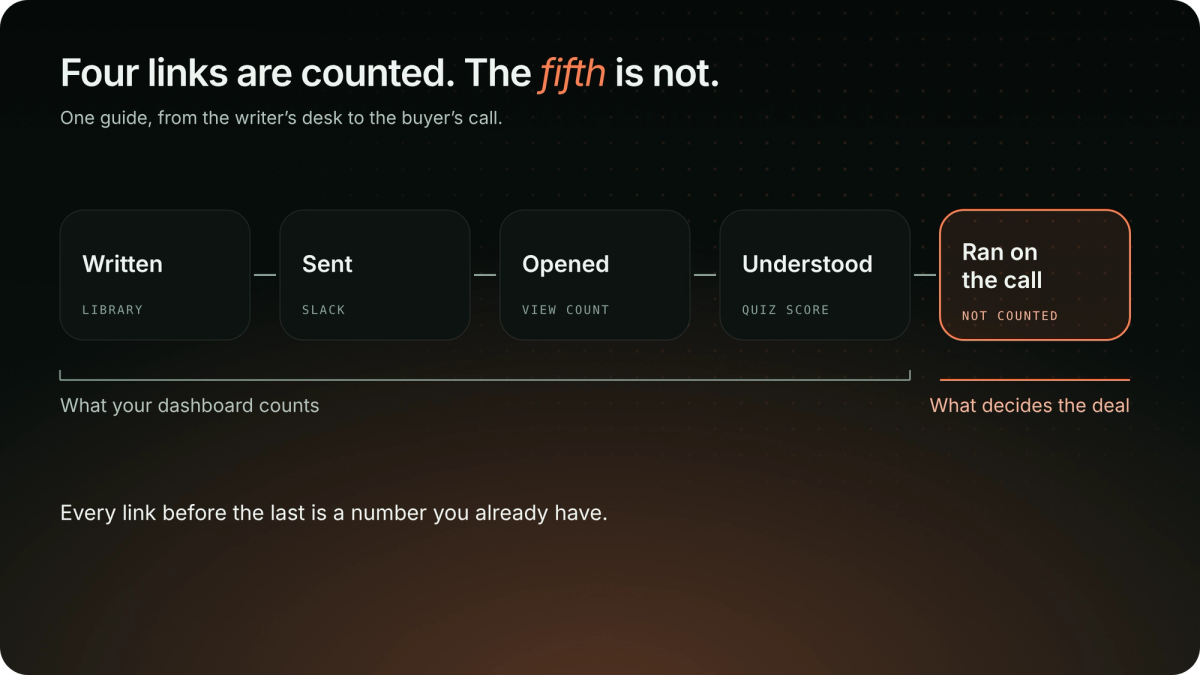
Follow one guide from Dana's desk to the buyer's call. It is written, sent, opened and understood. That is four links, and Dana has a number for each. The fifth link is whether the rep ran it on the call. Nobody counts that one. The buyer feels it.
This is not only a findability problem, and it is not laziness. A rep reaches for a file when a buyer asks and the clock is running. Fix stale content too, then check whether the fixed version ran. G2's enterprise review data found the average share of users who fully adopted an AI agent fell from 68% in 2024 to 55% in 2026. That covers enterprise agents, not sales tools. HFS Research saw the sales version in July 2026: the CRO's plan does not convert into execution, so reps revert and win rates stall.
A guide names a topic. A rep needs a move: what to say to this buyer, against this rival, at this stage. The best rep's move lives in tribal knowledge and in what your CRO decided this quarter. Nobody wrote it down.
Strategy doesn't get adopted. Behaviors do. A behavior is the specific move a rep makes in this deal, such as showing total cost before price.
You can test this before you buy anything. Pull ten recent calls where the buyer raised your guide's topic. Count the reps who did what the guide says. Then split the same ten by whether they opened it. If opening does not predict doing, the file was never the gap. For a cleaner read, give the next guide to a random half of the team a week early and compare the halves. Then ask three reps where they went the last time they needed that guidance. A colleague is a failing answer.
The table below runs both tests on ten sample reps. Opening the guide did not predict running it.
| Group (ten sample reps, illustrative) | Reps | Reading |
|---|---|---|
| Opened the guide and ran the move | 3 | Opening and doing agree |
| Opened the guide and did not run it | 4 | Read it, said something else |
| Did not open it and ran the move | 2 | Experience carried it |
| Did not open it and did not run it | 1 | The gap you expected |
A cleaner file will not change that.
Send the move, not the file
A rep needs the move for this deal, written down by the people who win. Zime's forward-deployed engineers interview your best reps, then score and correct each move until those reps would run it. That is how your best people's tribal knowledge is elicited through FDE-run interviews and RLHF, including what never shows up in a transcript. A behavior graph is the model that holds those moves and your CRO strategy, and gives each role and deal its move. Each move carries a receipt, the won deal it came from.
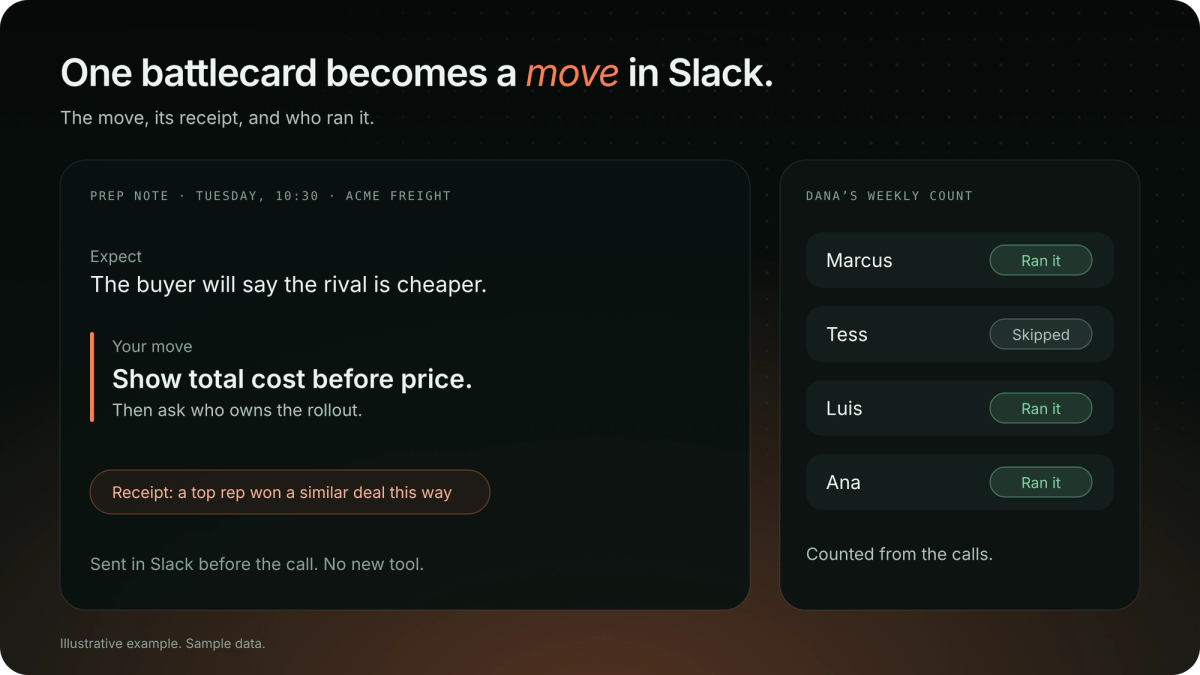
The move for that rival arrives in Slack, Teams or Claude before the call, in a prep note. There is no new doc or tool. Your platform recommends content too. The difference is the source: a file someone wrote, or the move your best reps run.
Bureau sells identity and fraud decisioning to banks and fintechs across several products. Its product updates, pricing and objection guidance sat in Jira, Confluence and spreadsheets. Its founder described what changed.
"We improved our ARR by 10% with Zime seamlessly getting our product releases to our sales team in the form of just-in-time Actions."
Ranjan R Reddy, Founder & CEO, Bureau Inc.
The release reached each seller inside the deal, not in another document.
You could write moves by hand. It is a different job from writing a guide. It means one move per role, product and rival, redone each time your CRO strategy changes. Zime's estimate is 8 to 12 months and 200+ .md files, plain text files that each hold one move. Keep everything you bought. Stop hand-writing the move. The case for guidance inside the flow of work is in this comparison of coaching and workflow guidance.
What changes on the call
Run Dana's week again. On Monday, Marcus's prep note carries the move for this rival: show total cost before price. The receipt shows the deal a top rep won that way, so Marcus has a reason to trust it. Elena has authorized it, so he is covered in front of the buyer. On Tuesday the buyer names the competitor, and Marcus runs it. Dana did not post another file. She did not chase anyone in Slack. Her weekly count lists which reps ran the move on which deal, and she coaches the rest. On Friday, Elena sees her CRO strategy running in the deals, without another kickoff.
Count the calls where a rep ran the move, out of the reps whose deals called for it. That count is adoption. Zime calls it programmatic adoption: moves run on live deals, tied to the CRO strategy that authorized them and the deals they moved. Zime's own benchmark is 80% of eligible reps within 90 days. The table below sets out three weekly checks with pass and fail.
| Check | How to run it | Pass | Fail |
|---|---|---|---|
| Opened versus ran | Split last week's reps by who opened the guide and who ran the move. | Opening predicts running. | Reps who opened it did not run it. |
| The weekly count | Count the reps who ran the move, out of those whose deals called for it. | The share rises each week. | You can only count opens. |
| Half first | Give the next guide to a random half a week early and compare the halves. | The early half runs it more. | The halves match. |
The weekly count is the check to repeat.
Versa Networks counted this way. 79% of SEs were running the right technical discovery within three months, up from 20% at the start. Brent Bair, a regional sales leader at Versa, watched it on his own team.
"...the adoption rate has improved. I think it's become ingrained in our sales DNA..."
Brent Bair, Regional Sales Leader, Versa Networks
It was counted in deals, so his team could see it change. The same check works on a win-loss finding, as in how to run a win-loss analysis beyond CRM loss reasons.
One number we cannot give you: Zime has published no like-for-like comparison of enablement-written guidance against moves taken from tribal knowledge. The Versa count above is what is published. If you have fewer than ten reps, one product and one motion, a pinned guide and a weekly look at five calls may be enough.
Turn one ignored guide into a move. Keep everything you bought. Zime turns the guide reps ignore into the move each role runs. It is elicited from your best people's tribal knowledge, including what never shows up in a transcript. And it shows who ran it. Live in 7 days on your own data. Bring one guide reps ignore and see the move it becomes. Book a demo →
FAQ
Why do reps ignore the enablement content we create, and how do we get guidance to them without another tool?
Reps pull a file when a buyer asks and the clock is running. Send the move for the deal, taken from your CRO strategy and your best people's tribal knowledge, including what never shows up in a transcript. Deliver it in Slack, Teams or Claude before the call, and count the calls where it ran.
Our platform already delivers content in the flow of work. Isn't that enough?
It solves reach, and you should keep it. It does not show what the rep said on the call. Add the move for the deal and a weekly count of the calls where it ran. Both recommend. The difference is the source.
Will reps feel policed if we check calls?
We have no published answer. Ask any vendor whether reps see the same evidence their manager sees.
Will senior reps and regions that resist being told what to do run it?
Zime has no cleared answer yet. Ask any vendor for the run rate among its most senior reps and its most independent regions, measured on your own calls.