We're guessing at what separates top reps from the rest. How do you find out from call evidence?

- Your call recordings already show what your top reps do. Open the dashboard and the differences are there. Keep that.
- But a list of differences is not a list of wins. A recording shows what was said. It cannot show whether saying it moved the deal. Three checks on your own calls show how far it carries.
- And more calls will not help. Your best reps know what they never say on a call: why this buyer, why now, what to skip. That is tribal knowledge, and no transcript holds it. So a list built from calls alone stays a slide until reps run it.
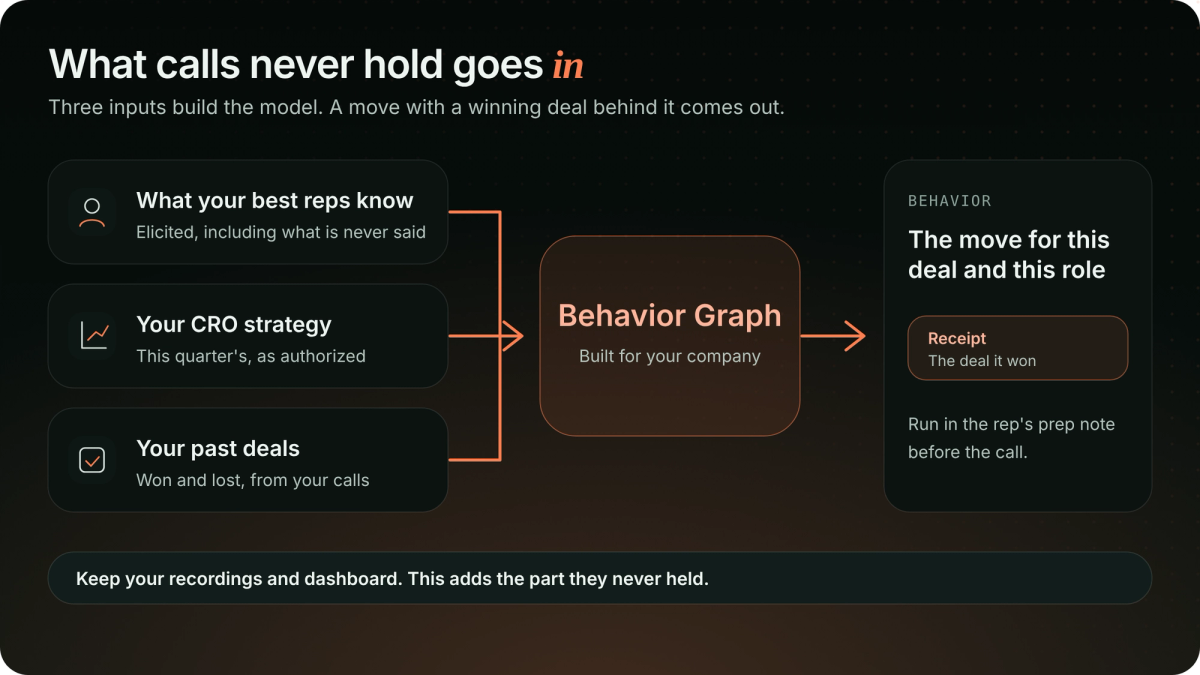
- That tribal knowledge is what a Behavior Graph adds. It is a model that turns your best people's know-how, your CRO strategy and your past deals into behaviors, the move for this deal. The know-how is elicited from your best people through FDE-run interviews and RLHF, including what never shows up in a transcript. That means Zime's forward-deployed engineers interview your best reps, then score each move until they would run it.
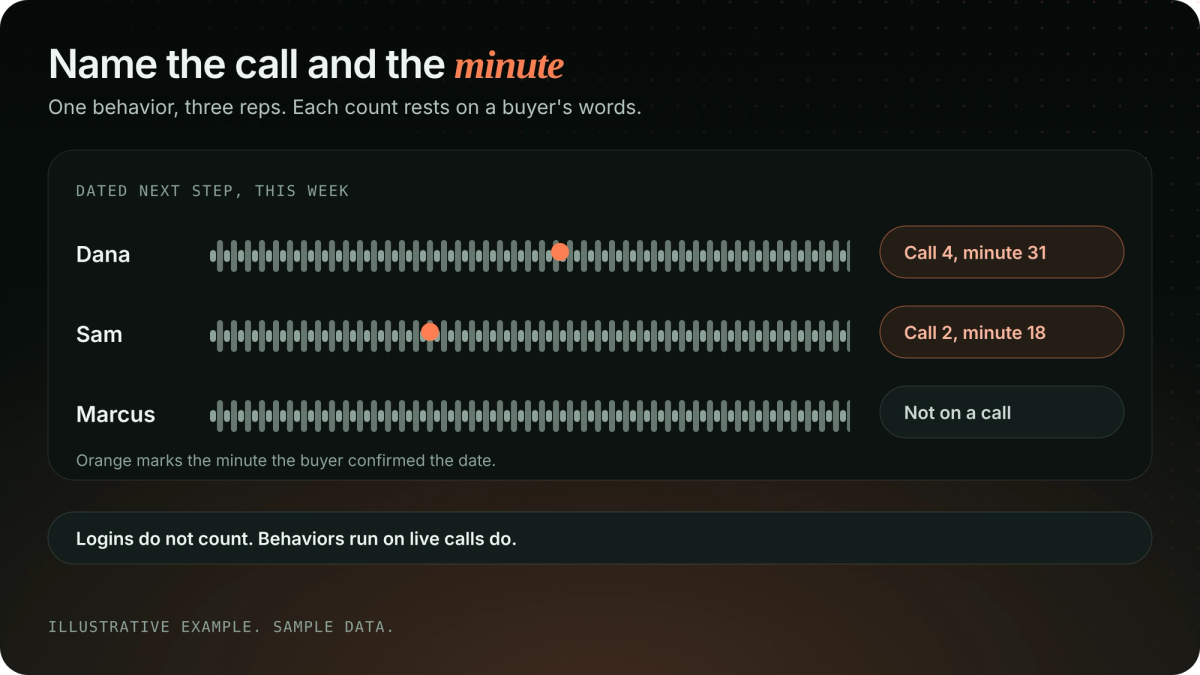
- So you keep what you bought, and you can see whether reps ran it. Your recordings and dashboards stay. You know a behavior ran when you can name the call and the minute the buyer confirmed it. Count them against the CRO strategy and the deals they moved: that is adoption, behaviors run, not logins.
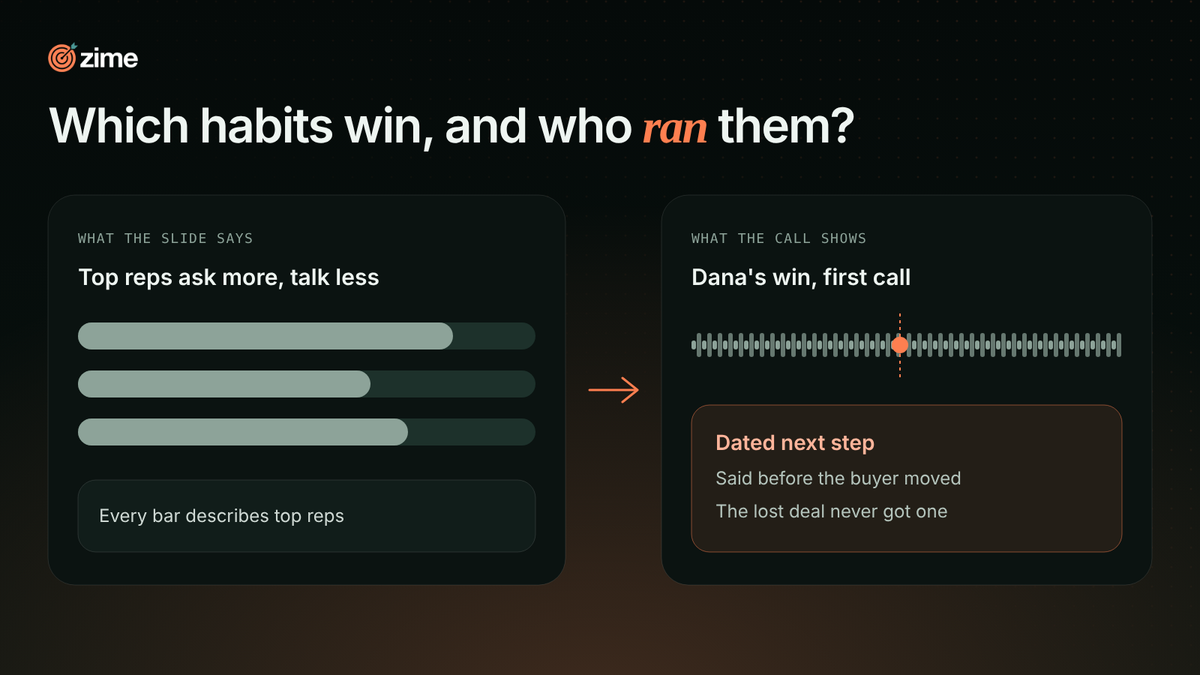
On the Monday after SKO, you ask your enablement lead what your top reps do differently. By Wednesday, Jordan sends a slide with three bars. Dana, Marcus, and Elena ask more questions, talk less, and end calls on a dated next step.
Every bar is true. It comes from your own recordings.
But a slide of habits is not an answer. It does not say which habit wins the deal. It does not say whether Dana would win without it. You can teach the whole list and still not know. So how do you find out, from call evidence, which differences are the ones that win?
Teach the wrong ones, and next quarter's calls may sound the same.
Differences are not wins
A difference between top reps and the rest is where you start. It is not the answer. You have probably tried three ways to get there.
Enablement platforms, role-play, win-loss interviews and CRM fields each earn their place. They answer other questions.
Ask the top rep. Dana will tell you, and mean it. But a reflex is hard to put into words, so you get a slogan. The tell: the advice could hang on any sales office wall.
Sit in on calls. Marcus handles a pricing objection well. But you hear the calls you happened to pick. The tell: a manager can name a favorite call but cannot name a pattern.
Read the dashboard. Talk ratio and questions per call sort every rep in minutes. But they rank what top reps do. They do not say what won. The tell: every bar describes top reps, and none was tested against lost deals.
Martin Mackay is the CRO of Versa Networks, where more than two hundred reps sell against ten named competitors. In June 2026, he told Zime the two things he wanted from a win-loss review.
"...what do the most effective reps do in terms of moving a deal forward and then eventually closing it? And the second is why do we win versus lose?"
Martin Mackay CRO, Versa Networks
He asked two questions. What the best reps do is the first. Why the company wins is the second. A slide of habits answers only the first.
What your calls cannot show
Take one behavior from the slide, such as a dated next step. Pull thirty closed deals from three top reps in one segment and tag each call yes or no. That is about a day in a spreadsheet.
Then three checks.
Same rep. Compare each top rep with her own deals of the same size and segment. If the gap vanishes, it was territory.
Spread. Does it hold for more than one top rep? If one rep carries the total, it is direction only.
Timing. Did it come before the buyer moved? A date the buyer proposed came out of a good call. It did not cause one.
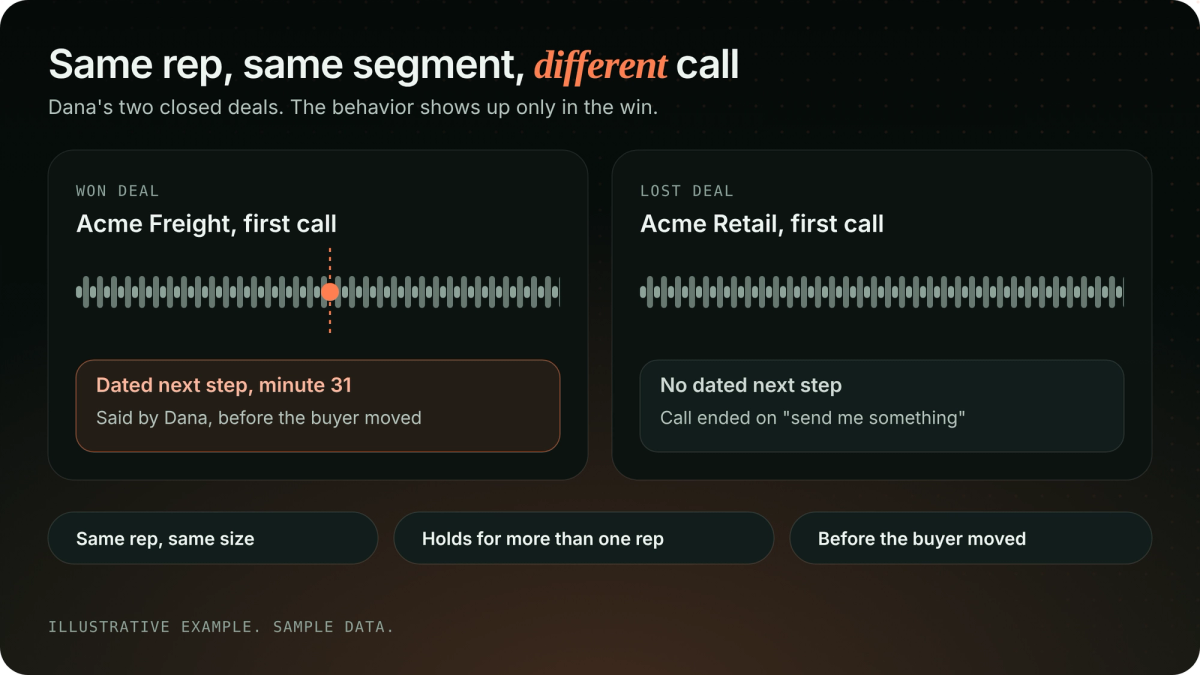
The table below uses illustrative numbers for three top reps. The behavior holds for one of them, and a staggered start settles the rest.
| Rep | With the behavior | Without it | Before the buyer moved? | Read |
|---|---|---|---|---|
| Dana | 5 of 8 won | 2 of 6 won | Yes | Holds |
| Marcus | 4 of 7 won | 3 of 7 won | No, the buyer set the date | Direction only |
| Elena | 3 of 5 won | 3 of 5 won | Yes | No gap |
| Staggered start | 9 of 24 won (pods taught first) | 6 of 24 won (pods taught later) | By design | Cleanest read |
The Dana line carries it: the same rep wins more often with the behavior, and it came first. Marcus is direction only, because the buyer set the date.
A pass tells you only what Dana did. It does not say why she does it with this buyer. Calls, and a context graph built on them, work from what was said. If you have one, keep it. If you are adding one, add it.
Ranjan R Reddy founded Bureau, a no-code identity decisioning platform. In a February 2024 call with Zime, he described a pitch whose next step is that the buyer will test the product. His reaction:
"...I'm like no, but what is the problem? What is the use case?"
Ranjan R Reddy Founder & CEO, Bureau Inc.
That question is a move. A recording holds his words. It does not hold why he asks first. That is tribal knowledge. HFS Research named the gap in July 2026: the CRO's plan does not convert into sales execution.
Add what your best reps know
So a pass tells you which of Dana's habits to teach. It cannot capture the part she never says.
Picture a model that holds three things: what your best people know, your CRO strategy this quarter and your past deals. That is a Behavior Graph, and Zime builds one for your company. The know-how is elicited from your best people through FDE-run interviews and RLHF, including what never shows up in a transcript. That means Zime's forward-deployed engineers interview your best reps, then score each move until they would run it.
Each behavior is a specific move for one motion, role and competitor, with a receipt: the winning deal it came from. Zime's Strategy Studio tests a strategy against your won and lost deals to show which behaviors win. Neither a receipt nor a test proves cause alone, so the staggered start still matters.
The table below sets five approaches against six jobs. Finding differences is crowded, but capturing what was never said and checking who ran it is not.
| Job | Ask the top rep | Sample calls | Call analytics | Agent over your recordings | Behavior Graph |
|---|---|---|---|---|---|
| Finds what top reps do on calls | Partial | ✓ | ✓ | ✓ | ✓ |
| Covers every call | ✗ | ✗ | ✓ | ✓ | ✓ |
| Tests whether a difference wins | ✗ | ✗ | Partial | Partial | ✓ |
| Captures what top reps never say on a call | Partial | ✗ | ✗ | ✗ | ✓ |
| Puts the move in front of a rep on this deal | ✗ | ✗ | Partial | ✓ | ✓ |
| Shows who ran it, on which call | ✗ | Partial | Partial | Partial | ✓ |
The row on what top reps never say carries the argument. Call analytics recommends a move too. The difference is where the recommendation starts.
You can build this by hand. Zime's estimate is that most organizations need 200+ evolving behaviors and that encoding them takes 8 to 12 months. The Signal profiled a CRO at Hatch: eight months in, the know-how is still hand-built, a Sales Bible from 409 calls of one rep. With a few reps and one motion, your three checks may be enough. What is not yet published is a measured comparison of what call analysis finds with what a best rep adds from interviews.
Count what reps actually run
Run the same Monday next quarter. Jordan sends no bars. The page lists three behaviors, each with the reps who ran it and the call and minute where the buyer confirmed it. Dana sees her reflex written as a move with her own winning deal attached, so she checks it. Marcus and Elena see which of their own calls carried it. Sam gets that move in his prep note before the call. He trusts it. You see which parts of your CRO strategy ran, and on which deals. Ask any vendor whether Dana sees the same evidence you do.
Kapil Bhagat is AVP, Sales Strategy at Bureau, where reps follow pre-call and post-call actions in their messaging app. In May 2024, on a call with Zime, he said it in one line:
"Having a dashboard where non adherence is called out improves execution."
Kapil Bhagat AVP, Sales Strategy, Bureau Inc.
He is describing a count of who ran a step, called out by name. That is adoption here: behaviors run, not logins.
Versa Networks counted the same way for its sales engineers. HFS Research separately cited Versa's 10% increase in win rates. Keep your recordings, your dashboard and your enablement stack, and count what reps run.
See which top-rep habits win. Keep your recordings and your dashboard. Zime adds what your best reps know and your CRO strategy, and counts who ran it on the call. Live in 7 days on your own data. Bring last quarter's closed deals from three top reps in one segment, and see the behavior that separated them. Book a demo →
FAQ
How do you find out what your top reps do differently from call evidence? Pull closed deals from three top reps in one segment and tag one behavior yes or no from each call. Then run the same-rep, spread and timing checks. What they never say on a call is tribal knowledge. Zime elicits it through FDE-run interviews and RLHF, including what never shows up in a transcript. That means its forward-deployed engineers interview your best reps, then score each move until they would run it.
How do you know a difference is why they win, not just what winners do? One comparison cannot tell you. Compare each rep with her own deals, require the gap to hold for more than one top rep, and check the behavior came before the buyer moved. For a clean read, let a random half of the pods start first.
How many top reps' calls do I need before I trust a pattern? Read it rep by rep, never pooled. Count how many reps show the gap, and treat a rep with fewer than three deals on either side as direction only.
Doesn't my call analytics tool already find what top reps do? Yes, and it recommends a move too, so keep it. The difference is where the recommendation starts. A Behavior Graph, a model of your best people's know-how, your CRO strategy and your past deals, adds what was never said.