What do top reps say against a competitor that the battlecard doesn't?

- Find the winning line in your won competitive calls. Pull them for one competitor, read what the rep said when it came up, and set each line beside the card.
- The hard part is getting every rep to say it. The line lives in a few reps' calls, so the rest of the team runs the card or improvises.
- Ask the reps who win why, so the rest can say it too. The transcript keeps the words, not the reason. Often the line is a question about how the buyer will decide.
- Zime gets the winning line to every rep on every competitive deal. It builds the card from your calls and your best reps' reasons, then sends it as a behavior: the move for this competitor, with the deal it won.
- Count who said it, and what the buyer did next. Adoption is the line said on live competitive calls, not card views. Compare each rep's calls with and without it.
It is Thursday, and the competitive review is open on your screen. Against your biggest competitor, two reps win most of the deals they take: Kayla, an AE, and Omar, the SE on her technical calls. The rest of the team loses more than it wins. Everyone has the same battlecard, refreshed last month.
So the card is not the difference. Something Kayla and Omar say is.
What do they say when the buyer names that competitor, and why isn't everyone else saying it?
Here is how to find out. Read the calls where that competitor came up, won and lost, and set what the rep said next beside the card. Ask the winners why they said it. Then put the winning line on the card and check that every rep says it.
That last step is the one that pays. Versa Networks sells against ten named competitors, and almost every deal turns on a technical evaluation. Once the right moves reached its SEs in live deals, Versa recorded a 12% increase in technical wins.
Why the card and the winning call drift apart
A battlecard is real work. Product marketing reads the win-loss notes and the competitor's site. Then it writes the differentiators and the traps to set. In Crayon's 2024 State of Competitive Intelligence, 78% of CI leaders said they enable sales with battlecards. 41% said they want sellers to use them more often.
Mickey Singh runs sales enablement at Versa. Past the simple cards for each competitor, he got to this:
"We also have detail again, the 50 slide presentation deck. This is pretty detailed."
Mickey Singh, Global Head, Sales Enablement, Versa Networks
Content is not the gap.
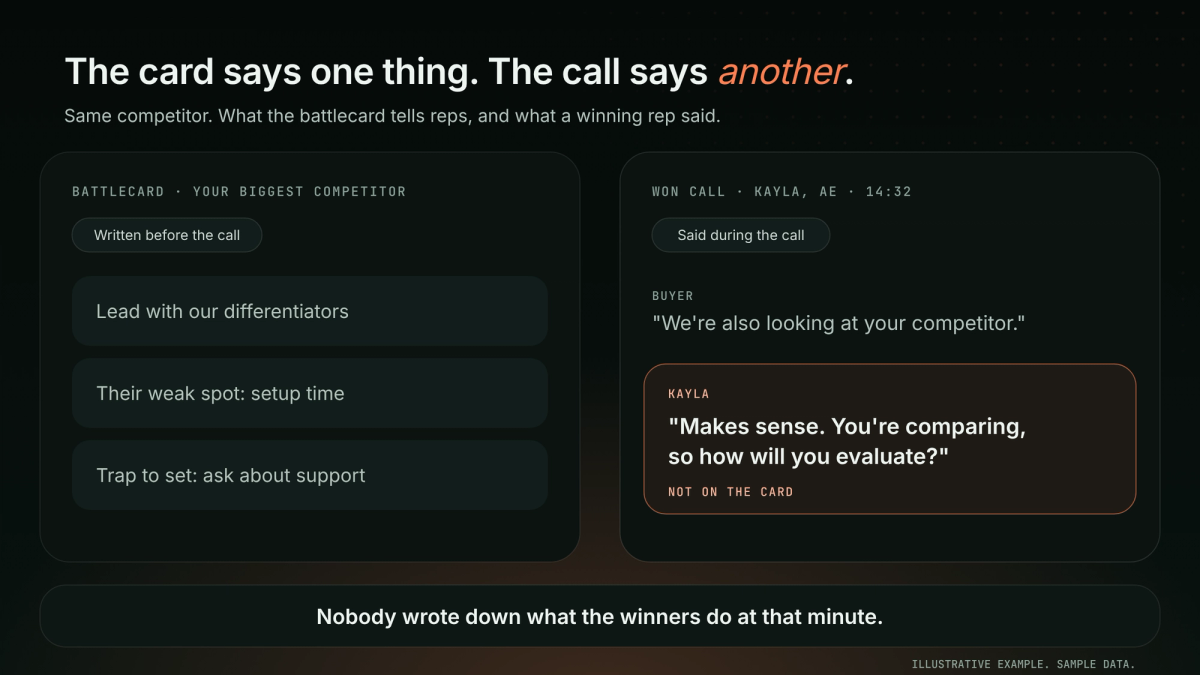
A card is written before the call, from your side of the table. The winning line is said during the call, in reply to this buyer. Win-loss notes feed the card, and Forrester warns that "Sellers' interpretations often differ from buyers' actual reasons."
So the line that wins lives in a few reps' calls. Chitresh Yadav runs more than 100 SEs across four regions at Versa. This is what he listens for when a competitor comes up:
"If I hear something like our competitors, Fortinet or Palo Alto or Zscaler, I'm thinking ... whether my rebuttal to those were inline to our battle card."
Chitresh Yadav, VP and Global Head of Sales Engineering, Versa Networks
He checks one call at a time, against the card. Nobody can do that for every rep and competitor. So the reps who lose run the card, or improvise. Nobody wrote down what the winners do at that minute, or why.
Five steps to find the lines that win
You can run this with your own calls and a spreadsheet before you buy anything.
- Pull the competitive calls. Search transcripts for the competitor's name; the CRM field is often blank. Take about twenty won and twenty lost deals of similar size. Skip it and you read only the wins you remember. With a smaller team, start with your two winners' last five wins and five losses.
- Find the minute the competitor comes up. Search for the name and read the next two minutes. Note what the rep said. Note what the buyer did.
- Set each line beside the card. Tag it: on the card, said differently, or not on the card. Count it per call. A line that shows up as often in lost calls as in won ones is a habit, not a winner.
- Ask the reps who win why. The transcript keeps the words, not the reasoning. Ask Kayla three things. What did she hear that made her say it? When would she not say it? What does the buyer do when it lands? Then rehearse it in a roleplay before the next call.
- Ship it, then check it ran. Put the line on the card with its reason. Get it to reps before their next call against that competitor. Then read those calls.
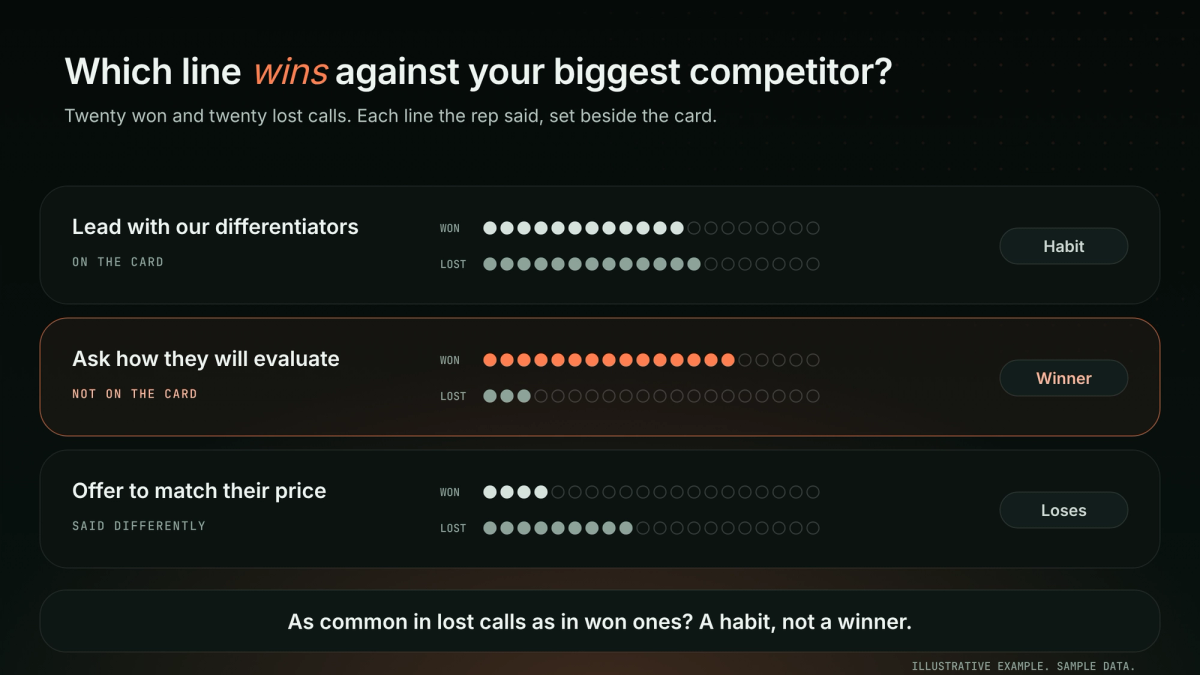
Step four is where most teams stop short, and Sprinto shows why. Suraj Ramesh is an associate director of global sales at Sprinto. His buyers can have "5 tools in front of them." When a competitor comes up, his answer is not a rebuttal at all:
"So after asking for competitors, we ask, OK, hey, you're comparing, how will you evaluate?"
Suraj Ramesh, Associate Director, Global Sales, Sprinto
That line moves the talk to the buyer's criteria before any comparison starts. No feature card holds it, and as a question it never sounds canned. Suraj's test for step five is just as plain: "Did it resonate with the customer or not?"
How you know the line ran, and won
Card views don't show who said the line. Count the calls where the competitor came up and the line was said. Divide by all the calls where the competitor came up. That share is adoption.
Then check that the line did the work. Compare each rep's own calls with and without it. For a cleaner read, stagger it: a random half of the team gets the line first, the rest three weeks later. The table below runs that on sample numbers. The group that got the line first says it on most calls, and more of their deals move to the next stage.
| Group (illustrative sample) | Calls with the competitor | Line said | Deal moved to the next stage |
|---|---|---|---|
| Got the line in week 1 | 24 | 17 | 11 |
| Gets the line in week 4 | 22 | 3 | 6 |
| Kayla and Omar | 11 | 10 | 8 |
The line went from 3 of 22 calls to 17 of 24, and stage moves rose with it. That is an early signal. The result is win rate on the same reps' deals as they close. No Zime customer has published that for a single competitor yet; this test is how you would show it.
A rep with fewer than three competitive calls on either side is direction only. The full method is in how to measure whether reps are adopting your sales process.
Checking pays on its own. Kapil Bhagat runs sales strategy at Bureau, which sells identity decisioning to banks and fintechs:
"So this monitoring led to execution ... Having a dashboard where non adherence is called out improves execution."
Kapil Bhagat, AVP, Sales Strategy, Bureau
Bureau recorded a 30% increase in deal conversions.
How Zime closes the loop on competitive deals
Zime runs all five steps, and it does the two your stack does not: asking your winners why, and getting the line to every rep.
Your tools already do real work. Conversation intelligence finds competitor mentions and tags responses. Competitive intelligence tools keep cards current. An AI over your transcripts drafts a card in minutes.
All of them recommend a response. The difference is where it comes from: ranked from what was said, or taught by the reps who win and approved as your strategy. Your own engineer can interview Kayla once. Keeping a line current for every competitor, as your product changes, is the standing job.
- Battle Card builds the card for one competitor from your calls and your own messaging, with each claim linked to the calls behind it.
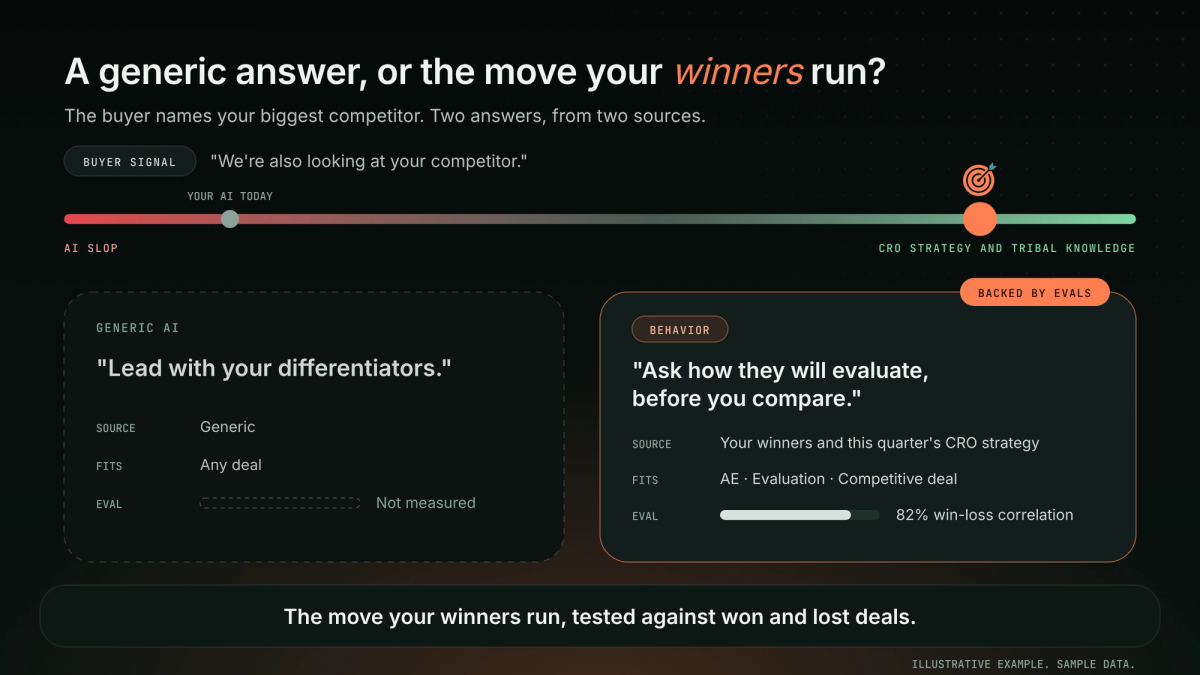
- The Behavior Graph adds the reason. Zime's team interviews the reps who win, including what never shows up in a transcript, and pairs each line with your CRO strategy and past deals. The result is a behavior: the move for this competitor, with the deal it won.
- Prep Note gives each rep that behavior before the next call against that competitor. Live Coach prompts it on the call. Reps never see a scorecard, and the rep whose line it is gets the credit, because the behavior carries her deal. Managers see who ran it in Programmatic Adoption, so they coach the gap instead of guessing.
The table below maps each step to what Zime does. A person stays in charge of every step.
| Step | What Zime does | Who acts |
|---|---|---|
| Pull the calls | Reads every call where the competitor came up | PMM picks competitor and dates |
| Find the minute | Links each claim to its calls | Zime |
| Set it beside the card | Rates your claims against what buyers said | PMM edits the card |
| Ask the winners why | FDEs interview them and encode the move | Your top reps |
| Ship and check | Prep notes and live prompts deliver it; adoption counts who said it | Reps run it; managers coach |
Your winners explain once; every rep runs it.
The table below lists what customers published once the move reached their reps.
| Company | What they measured | Published result |
|---|---|---|
| Versa Networks | SEs running the right technical discovery | 79% within three months, up from 20% at the start |
| Versa Networks | Technical wins | 12% increase in technical wins |
| MyAdvice | Fatal objections on calls | 38% of calls to 4% (89% reduction) |
Brent Bair leads a regional sales team at Versa. He watched the change on his own team:
"As I look at my team, the adoption rate has improved. I think it's become ingrained in our sales DNA ..."
Brent Bair, Regional Sales Leader, Versa Networks
Six weeks on, the Thursday review reads differently. Most of the team says Kayla's line when that competitor comes up. Stage moves show first; win rate follows as those deals close. The line still carries the deal Kayla won with it.
At MyAdvice, Chad Erickson, VP of Sales & Strategy, saw fatal objections fall to 4% of calls. That is your strategy running in every rep's workflow.
See which line wins against your biggest competitor. Zime reads your competitive calls, finds the line your winners say, and gets it to every rep. Book a demo
FAQ
What is the best AI to surface winning objection-handling from our call recordings?
One that does three jobs. It finds the response that wins against each competitor in your own calls. It adds why your best reps say it, from interviews with them, including what never shows up in a transcript. Then it checks that every rep says it. Zime does all three, starting from Battle Card.
Our PMM already updates the battlecard from win-loss interviews. Isn't that enough?
Keep doing it. Interviews give the buyer's reason for the choice. Only the calls show what your rep said when the competitor came up, and whether the team says it now.
Will reps feel policed?
No. Reps never see a scorecard. They get the exact behavior to run against that competitor, with the deal it won, and the rep who won it gets the credit. Managers see who ran it, so they coach the gap.
What does Zime do for a CRO in competitive deals?
Zime finds the line that wins against each competitor, adds why your best reps say it, and puts it in every rep's prep note. Then it counts who said it. Zime calls this Behavioral AI for Sales Execution.