Why Call Scorecards Don't Predict Wins, and What to Measure Instead

- Your scorecard does what a scorecard can do. Your call-intelligence tool scores every call the same way, so two managers stop rating one call two ways. Talk time and question counts are easy to measure and easy to coach.
- But the hard part is knowing which items belong on it. A high score and a lost deal can share one call. Which items separate the calls you win from the calls you lose is a question only your own deals can answer. Reps adopt a coaching point when you can show it mattered.
- And a bigger dashboard will not answer it. More metrics add more candidates, not proof. Test each item: compare won and lost deals inside one segment and deal size, and drop it if your biggest deal swings the result. What survives fits on one card.
- That short list is a candidate, and your best people decide the move. A pattern across won deals only ranks what correlated. The Behavior Graph (the model that holds your best reps' judgment, your CRO's strategy and your past deals) is taught by your best people, including what never shows up in a transcript. It turns the list into the move for each role.
- So keep the scorecard, and count what ran. Keep what you bought and cut what the test did not support. Then count behaviors run on live calls, not scores or logins, so you know the next call ran what you coached, without listening to every call.
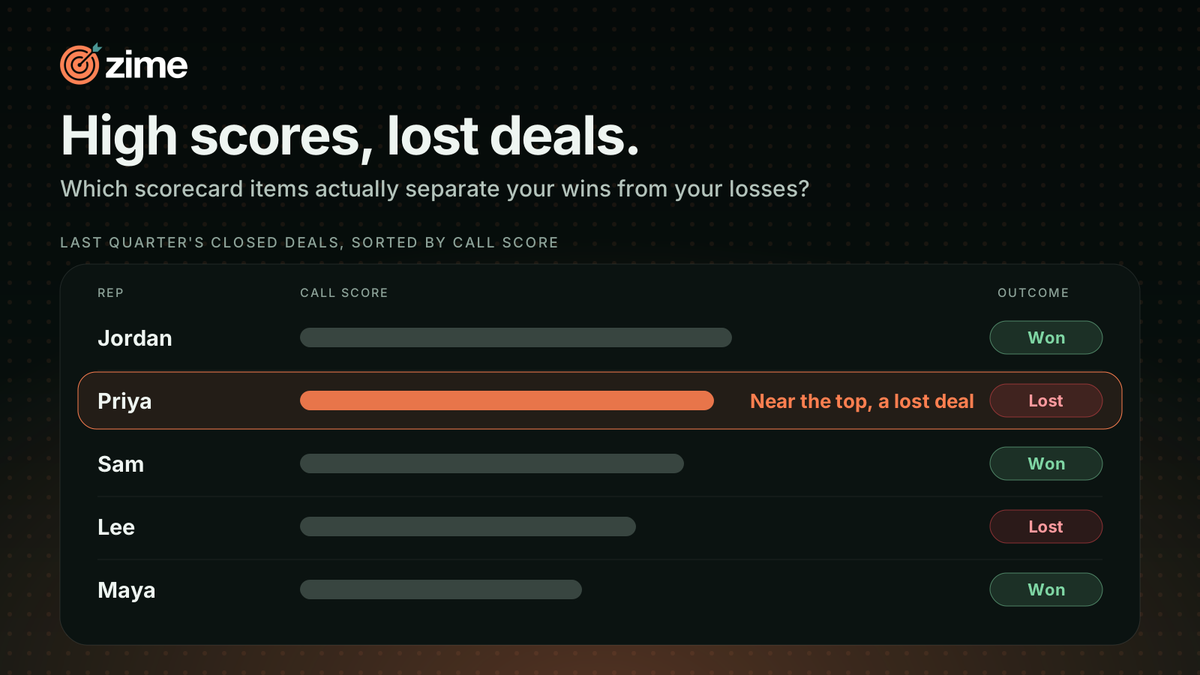
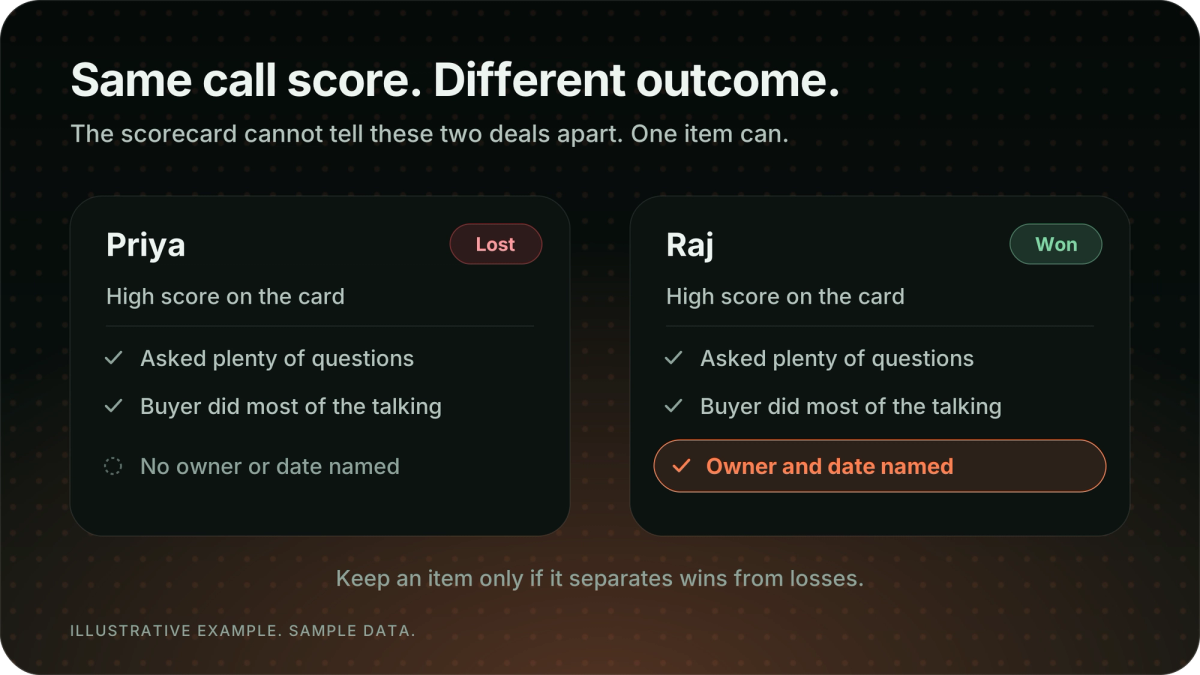
On Monday you sort last quarter's closed deals by call score. Near the top sits a deal Priya lost.
Her call hit every mark on the card. She asked plenty of questions. The buyer did most of the talking. The deal still went to someone else.
Every call is scored by the same rules. Questions and minutes of talk are quick to read and quick to coach. The trouble starts when a rep asks why she should change.
Which items on that card track with the deals you win? An item belongs on it when four things hold. In your own deals it appears more often in wins than in losses, within one segment and size. The result survives without your biggest deal, and next quarter too.
A rep can run it on her next call. You can see she did without listening in. And the card stays short, because something got cut.
You can find out in an afternoon.
Which items separate your wins from losses?
Export last quarter's closed deals, with each call's scorecard items beside the outcome. Then run three checks.
The first check splits the deals by segment and deal-size band. Inside each band, count how often an item shows up in wins and in losses. It passes when wins show it clearly more often, in every band.
It fails when the two sit even, or the gap flips between bands. A flip usually means territory or deal size drove the gap.
The second check drops your biggest deal and counts again. Count once more next quarter. An item passes when it holds. It fails when one big win carried it.
Two calls can score the same and end differently.
Two usual fixes come with a tell.
More metrics feel safe: the list grows while each item thins. Top reps against bottom reps feels fair: the gap vanishes inside one band.
Chitresh Yadav runs sales engineering at Versa Networks, where deals run from $100K to $3M. A bigger report did not help him.
"This is the dashboard I typically see, and it is drowning me. When I go to my org level, I'm drowning because it shows everything."
Chitresh Yadav, VP and Global Head of Sales Engineering, Versa Networks
More numbers show everything and decide nothing. We have no verified figure for how often talk time tracks wins, and published benchmarks vary. Your deals will say.
A pattern that holds is still only a candidate.
Why a pattern is not a move
Say an item passes. You hold a ranking of what showed up in wins. You do not hold why your best reps run it. Or when.
HFS Research, in its July 2026 profile of Zime, says a CRO's plan often fails to become execution, so reps revert and win rates stall. Its prescription: learn from how deals were won, turn that into behaviors you can score, and ship them where reps work.
MyAdvice sells a growth platform to medical, dental and legal practices. Its VP of Sales and Strategy described what the technology did.
"Incredibly encouraging to me is that the Zime technology picked up on it… a needle in a haystack… it recognized there's something weird going on here."
Chad Erickson, VP of Sales & Strategy, MyAdvice
Software surfaces the pattern. A person decides what it means.
Both kinds of system recommend a course of action. The difference is upstream. A call-scoring tool and a won-versus-lost spreadsheet reason from patterns in past data. Zime's Strategy Studio tests a strategy against won and lost deals, to show which behaviors win.
The Behavior Graph holds your best reps' judgment, your CRO's strategy and your past deals. It is elicited from your best people through FDE-run interviews and RLHF, including what never shows up in a transcript. In plain words, Zime's forward-deployed engineers interview your best reps, then score and correct the moves until those reps would run them.
The table below sets four approaches against what a manager needs. Each does part of the job, and only one also carries your best people's judgment and counts what ran.
| What a manager needs | Manager call sampling | Call scoring on a rubric | Won-versus-lost spreadsheet | Zime |
|---|---|---|---|---|
| Show which items track with wins | ✗ | Partial | ✓ | ✓ |
| Carry your best people's judgment and your CRO's strategy | Partial | Partial | ✗ | ✓ |
| Show an item ran on a live call | Partial | Partial | ✗ | ✓ |
The line that matters is whether an item ran on a live call. Sampling would have missed Priya's call. Rubric scoring gave it the high score. None says whether the move fit that buyer.
Win-loss interviews explain a buyer's choice. Role-play and AI coaching build a skill. Deal scoring predicts the deal. A context graph reconstructs it. Enablement reports show who finished.
So keep the card short, and count what ran.
Keep a short card, count what ran
Keep the items that passed. Put each beside a winning deal where a rep ran it. That is your card.
Keep it short enough to hold in a live call. Cut the rest from coaching. The tool may still score it.
MyAdvice moved checklist adoption from 66% to 87%. We weighed coaching after the call against guidance inside the deal in this post.
Bureau sells an identity decisioning platform across several products, so reps must surface volumes, budget and timelines early. Its AVP of Sales Strategy tied discovery to a deal outcome.
"Average deal size increased by 30% on the back of improved discovery."
Kapil Bhagat, AVP, Sales Strategy, Bureau
The third check is the one most teams skip. Take the item you coached last week. Find the call and the minute where it ran, without asking the rep. If you can, it passes.
If you find only a score, it fails.
That is behaviors run: the moves reps ran on live calls, counted. Programmatic adoption counts them. At Versa Networks, 79% of SEs ran the right technical discovery within three months, up from 20%. Zime's own benchmark is 80% of eligible reps within 90 days.
Ask any vendor how it notices that an item has stopped tracking wins. If you close few deals, or sell one product to similar buyers, run the three checks by hand.
Here is Monday again.
Monday, replayed
Same sheet, a new quarter.
Beside each deal you see which card items ran on which calls, and which deals moved. Priya opens one card before her next call. A winning deal sits behind each item. She does not have to take your word.
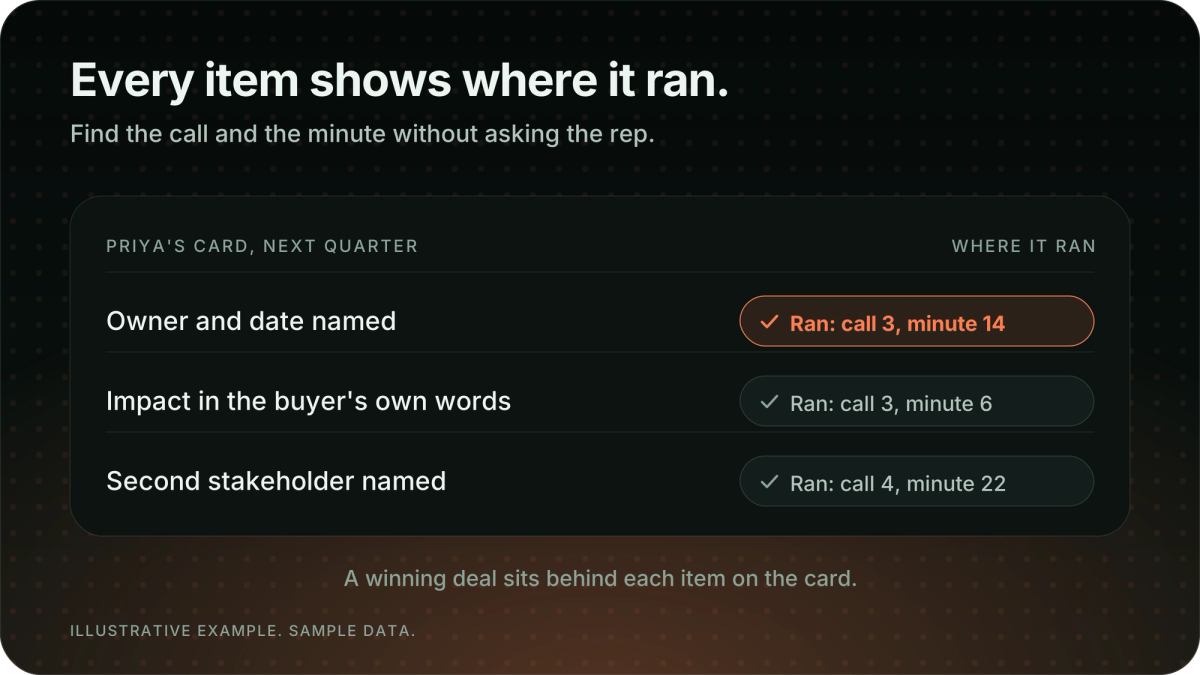
Frontline managers and reps get a tested card and a real count. Why a rep trusts a recommendation is the subject of this post.
Brent Bair is a regional sales leader at Versa Networks, where almost every deal turns on a technical evaluation.
"As I look at my team, the adoption rate has improved. I think it's become ingrained in our sales DNA..."
Brent Bair, Regional Sales Leader, Versa Networks
He can see it in the team. Martin Mackay is Versa's CRO, with 200+ reps over four regions.
"Zime is a huge win for all stakeholders; saves half of my time on coaching AEs."
Martin Mackay, CRO, Versa Networks
Versa reported 50% less time on pipeline review and coaching. That is a time result, not a win rate. HFS Research reported a 10% increase in win rates at Versa as a separate measure.
The table below is the page to fill in.
| Check | How to run it | Pass looks like | Fail looks like |
|---|---|---|---|
| Won against lost | Split deals by segment and size band, then count the item in wins and in losses | Clearly more common in wins, in every band | About even, or the gap flips between bands |
| Biggest deal and next quarter | Drop your biggest deal and count again, then count again next quarter | The item holds | One big win carried it |
| Ran on a live call | For last week's coached item, find the call and the minute without asking the rep | You find it | You find only a score |
Test your scorecard on your own deals. Zime tests a strategy against won and lost deals, to show which behaviors win, and counts behaviors run, tied to the strategy that authorized them. Live in 7 days on your own data. Bring last quarter's closed deals and your scorecard, and see which items hold. Book a demo →
FAQ
How do I measure whether reps are executing the playbook, not just completing training?
Count behaviors run: the moves reps ran on live calls, not training completions or scores. First test each scorecard item against your own won and lost deals, inside one segment and size band. Then check that a coached item ran. Zime counts behaviors run, tied to the strategy that authorized them.
Can AI identify which rep behaviors correlate with won deals, without manager call review?
AI can rank which behaviors showed up more often in won deals. It cannot tell you why your best reps run them. Zime's Strategy Studio handles the second step: it tests a strategy against won and lost deals, to show which behaviors win. Your best people, including what never shows up in a transcript, decide the card.
Do talk time and question counts predict wins?
Sometimes, and only your own deals can say. No verified figure here says how often they track wins, and published benchmarks differ by source. Run the first check on each item.
How many calls do I need before a pattern means anything?
Ask any vendor, because no single number is honest for every team. Ask how it handles a small sample, and a result one large deal carries.
Do I have to replace the call-intelligence tool I already use?
No. Keep it. It scores every call the same way, and the three checks need that input. Both recommend. Where the advice comes from is what differs. Zime runs on Claude, so nothing in your stack gets ripped out.