Why do technical sellers ignore your internal sales AI while business users adopt it?

- Your sales AI works for half the field. Account executives and CSMs use it to recap meetings and draft follow-ups. Those answers sit in your calls and CRM, so the agent gets them right.
- But your SEs ask a different question. They ask which discovery fits this buyer's stack, or how to win a proof of concept against a named competitor. Your battle cards say what to say about that competitor, not which move your best SEs make in this deal.
- That move has to come from your best SEs. Interviews capture their choices, including what never shows up in a transcript, and score them until those SEs would run them. Zime's Behavior Graph holds them, with this quarter's CRO strategy and your past deals.
- So keep the agent you built, and give SEs that move. It reaches them in the prep note, and the next call's transcript shows whether they ran it.
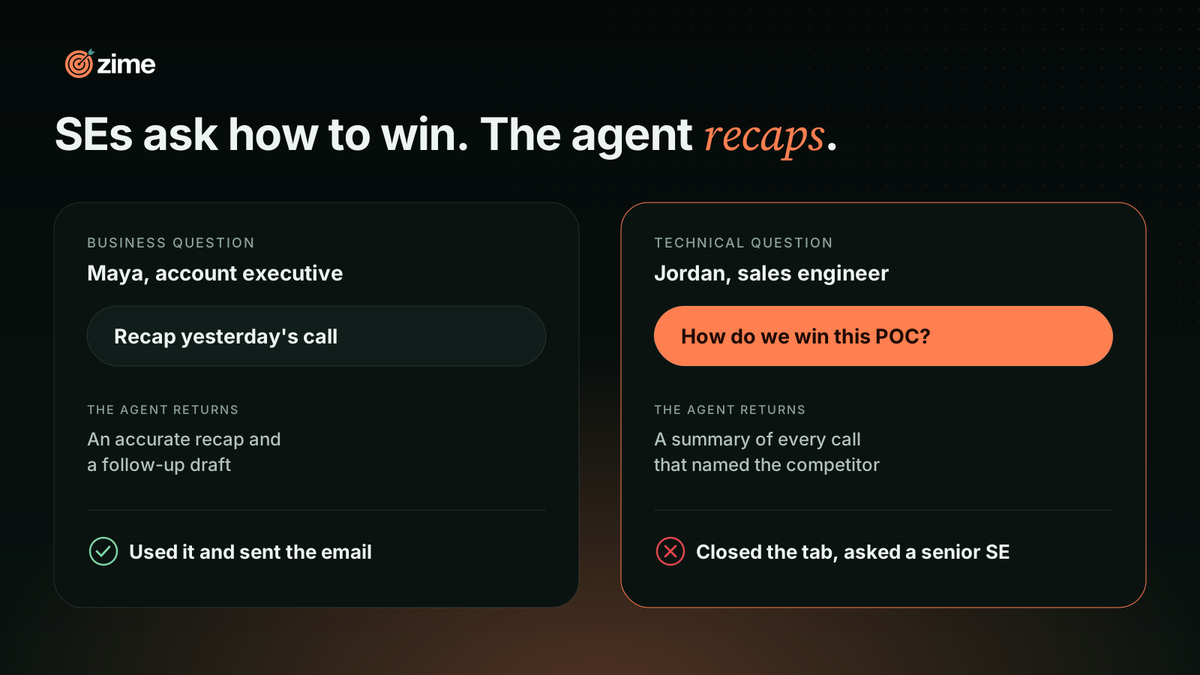
Tuesday, 8:40 a.m. Maya, an account executive, asks your sales agent to recap yesterday's call and draft the follow-up. The email goes out two minutes later.
At 9:15, Jordan, a sales engineer, asks it how to win Thursday's proof of concept against your biggest competitor. He gets a summary of every call that named them. He closes the tab and messages a senior SE.
You built that agent, and it is good work. It runs on Claude, reads your recordings and CRM over MCP, and your business users come back weekly.
Then you split the dashboard by team. The SE line barely moves. The few SE tickets say the answers are too generic for a buyer's network team.
G2's enterprise review data found the average share of users who fully adopted an AI agent fell from 68% in 2024 to 55% in 2026. Your logs show who stopped. They do not show what SEs needed. So what do your SEs ask that your business users never do?
What SEs ask that business users don't
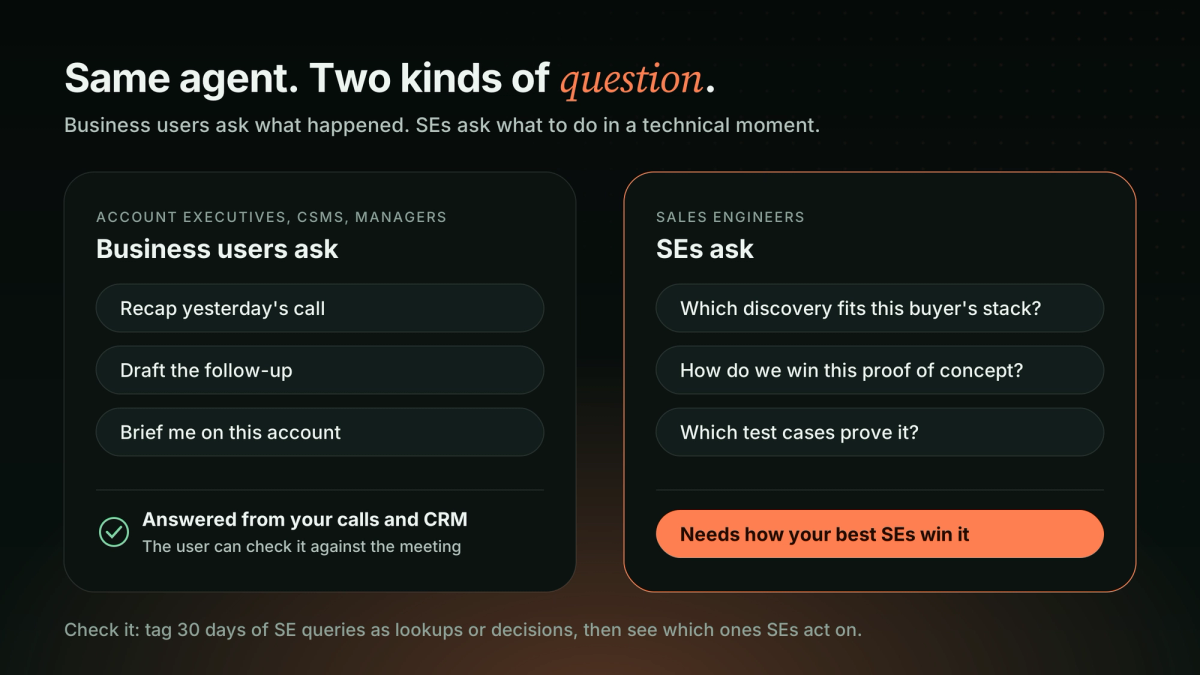
Sort the queries by the job behind them. Business users ask what happened. The answer sits in your recordings and CRM, and they can check it against a meeting they attended.
An SE asks what to do in a technical moment. Which discovery questions surface this buyer's stack? How do we win this proof of concept? That answer is how your best SEs win the technical round.
Those moments decide deals. Versa Networks sells networking and security to enterprise network teams. Its 100+ SEs cover four regions against ten named competitors. 60% of Versa's fatal objections were technical or product fit.
Chitresh Yadav runs that SE organization and already ran AI in Claude for follow-ups and prep notes. Listening to SEs face a named competitor, he wanted something narrower.
"...whether my rebuttal to those were inline to our battle card."
Chitresh Yadav, VP and Global Head of Sales Engineering, Versa Networks
No recap answers that. It needs the rebuttal your company stands behind.
The table below sets the two kinds of question side by side. Only the business questions have an answer in your data.
| Who asks | They ask | Where the answer lives | What the agent returns |
|---|---|---|---|
| Account executive | Recap the last call and draft the follow-up | The recording and the CRM | An accurate recap and draft |
| Sales engineer | Which discovery fits this buyer's stack? | Your best SEs' heads | A generic checklist |
| Sales engineer | How do we win this proof of concept? | Your best SEs' rebuttals and the CRO strategy | Every call that named the competitor |
The proof-of-concept question carries the split. Every past mention comes back, and none of it is the move.
Check this in your logs this week. Tag thirty days of SE queries as lookups (what happened) or decisions (what to do now), then see which answers SEs acted on.
Pass: SEs act on lookups and drop decisions, so the gap is content. Fail: they drop both, so check speed and access first.
Why your battle cards don't answer it
You may be thinking you did write it down. The SE wiki, the battle cards and the technical playbook are all indexed, and retrieval over your calls and docs finds them.
Look at what they hold. A battle card says what to say about a competitor. It does not say which question to ask next on this buyer's stack, or when to change the test plan.
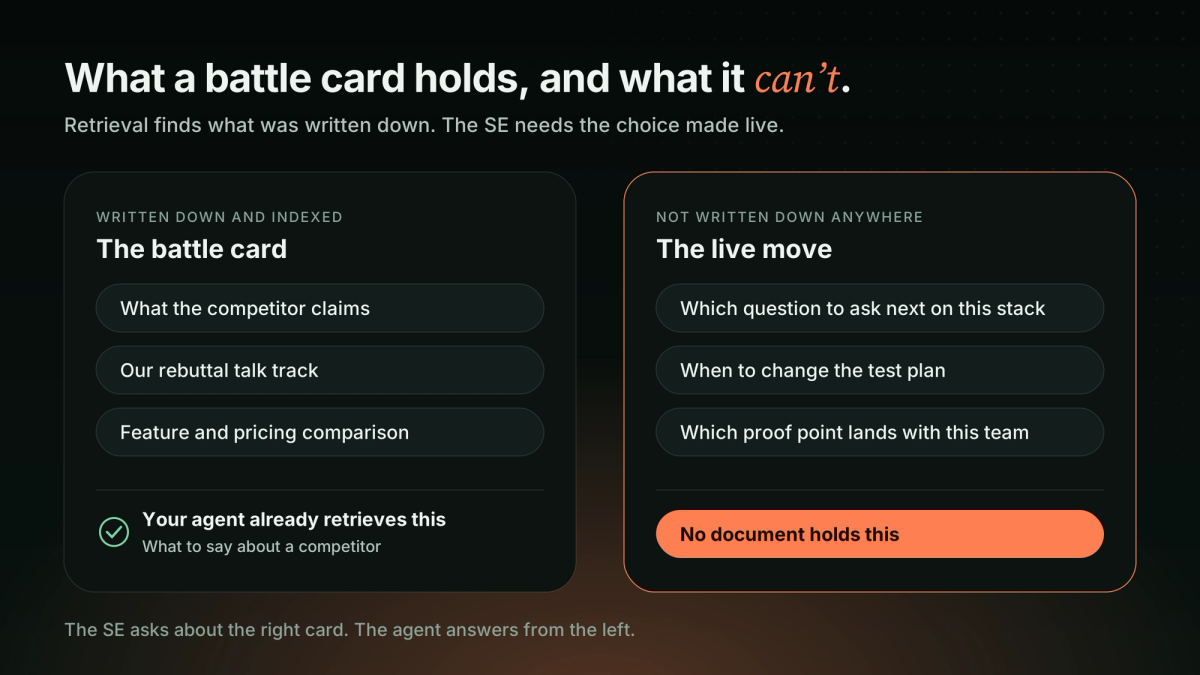
Your agent answers from what someone recorded or wrote. The recap is in the recording. The technical move is not. Your best SE picks her next question from something the buyer said two answers ago.
Nobody writes down a reflex.
Chitresh put the limit in one line.
"...not to the human level ... there is a context that you need to build in."
Chitresh Yadav, VP and Global Head of Sales Engineering, Versa Networks
He means how his best SEs read a network and choose the next test.
An SE also checks every answer against how the buyer's network works, in front of its engineers. Generic fails in one read. Developers show the same reflex.
In Stack Overflow's 2025 Developer Survey, 46% of developers said they do not trust the accuracy of AI tools' output, up from 31%. Those are developers, not SEs, but the habit carries.
The split is not attitude. Your SEs stopped where the data runs out.
A second test: put your agent's answers to five recent SE questions beside your best SE's answers, and show both, unlabeled, to two other SEs.
Pass: they cannot tell them apart. Fail: they pick your best SE every time. That gap is the tribal knowledge your agent never received.
Why writing it down yourself keeps slipping
You could close it yourself. Sit with your three best SEs, write their discovery and rebuttals into skills, and wire them into the agent. That is work you know how to do, and starting there is a reasonable call. For one product and a short competitor list, it holds up.
Past that, three facts get in the way. The input lives in people, so collecting it is interviewing and scoring. It multiplies across products, competitors and SE roles. And it moves with every release and every change in CRO strategy.
Bureau, which sells a multi-product identity platform to fraud and risk teams, lived the release side. Its product updates and objection guidance sat across Jira, Confluence and spreadsheets.
"We improved our ARR by 10% with Zime seamlessly getting our product releases to our sales team in the form of just-in-time Actions."
Ranjan R Reddy, Founder & CEO, Bureau Inc.
The gain came from each release reaching the seller inside the deal.
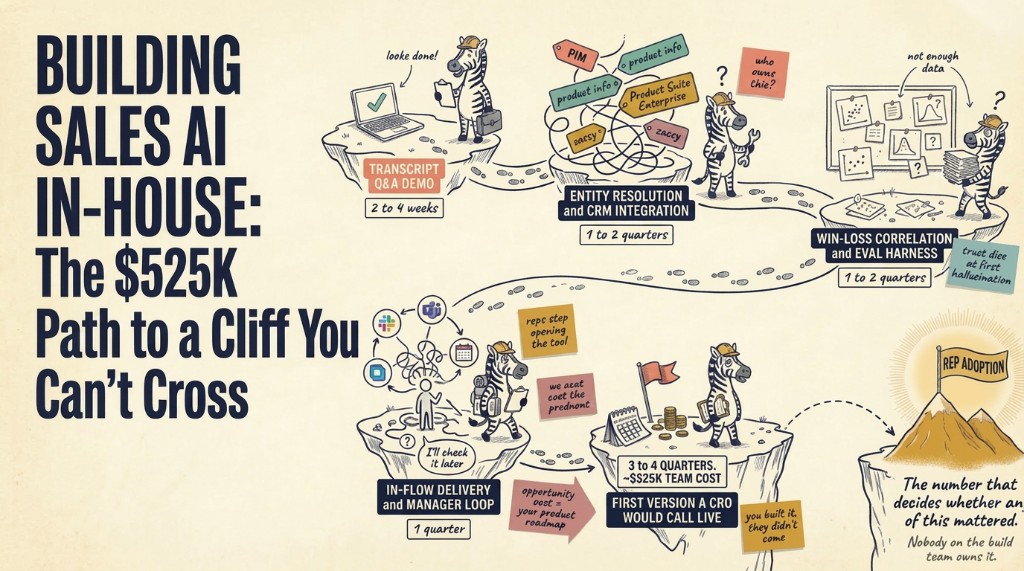
Chitresh also scoped the in-house version as a 12- to 24-month build and about $1 million of GTM engineering. He chose Zime instead. Peter Kim, Head of GTM at WestBridge Capital Management, named the cost of building anyway.
"...inadvertently, you've become a builder ... a dangerous place to be ... spend a ton of ops cycle time on that."
Peter Kim, Head of GTM, WestBridge Capital Management
The fuller math is in Should you build GTM agents in-house on Claude, or buy a platform?
That input is what Zime's Behavior Graph holds: a model of how your best SEs win each technical moment, built from three inputs. The first is how your best SEs win, elicited from your best people through FDE-run interviews and RLHF, including what never shows up in a transcript.
In plain terms, Zime's forward-deployed engineers interview your best SEs and score the moves until those SEs would run them. The second input is this quarter's CRO strategy. The third is your past deals.
Out come behaviors: the specific technical move for this deal, with the won deal behind it. Zime runs on Claude and is built to sit inside an agent stack like yours. Nothing you built gets ripped out.
The table below compares the routes teams try. Each answers something well; only one holds how your best SEs win.
| What the route does | Tuning prompts and retrieval | Technical answer tools | In-app adoption prompts | Zime Behavior Graph |
|---|---|---|---|---|
| Answers recaps and product questions | ✓ | ✓ | ✗ | ✓ |
| Reaches SEs where they work | Partial | ✓ | ✓ | ✓ |
| Holds how your best SEs run discovery | Partial | ✗ | ✗ | ✓ |
| Changes with releases and CRO strategy | Partial | Partial | ✗ | ✓ |
| Shows whether the SE ran the move | ✗ | ✗ | Partial | ✓ |
Every route recommends something; the difference is where the recommendation comes from. Technical discovery is the row that decides SE adoption.
How Versa took SE discovery from 20% to 79%
Replay the morning. Maya's recap arrives as before.
At 9:15, Jordan opens the prep note for Thursday's proof of concept. It names the discovery your best SEs run on a buyer leaving an older network stack. It gives this quarter's rebuttal for that competitor, with the battle card attached, and the won deal each move came from.
On Thursday, he runs the discovery.
Thursday's transcript then shows whether Jordan asked those questions. Count it across the SE team each week: SEs running the move on live calls, not logins.
Zime calls this programmatic adoption. The first sign the guidance is right is that SEs trust it and run it. The second is whether the deals it touched moved.
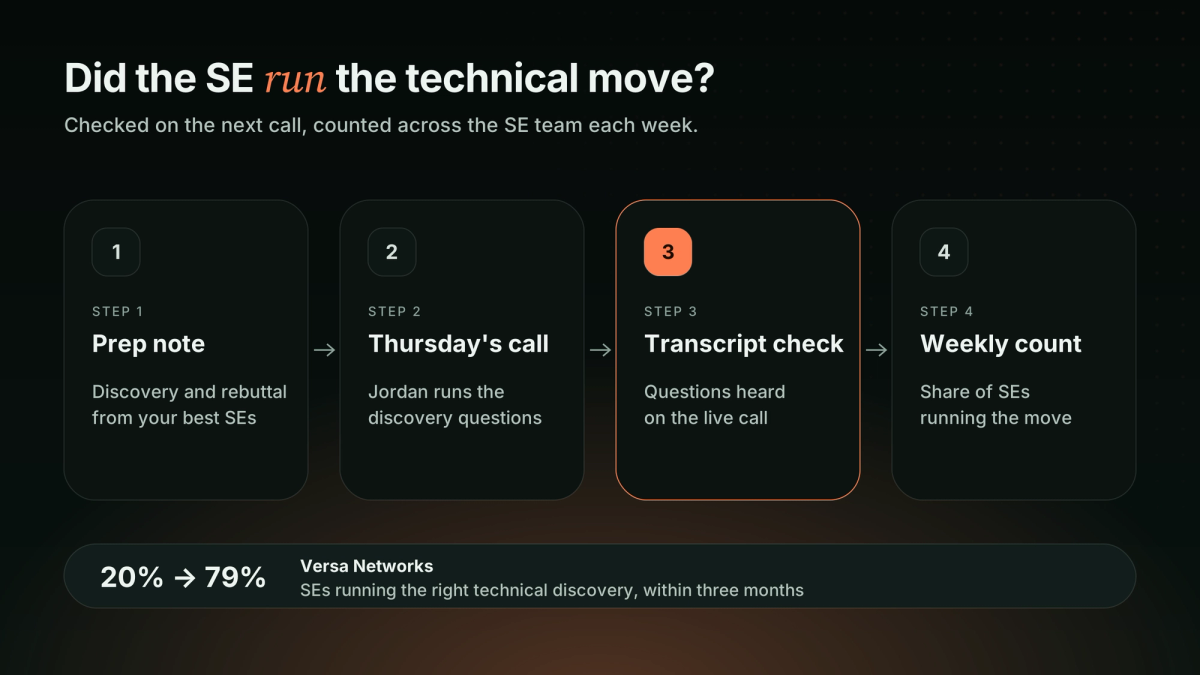
Versa watched that count. It got 79% of SEs running the right technical discovery within three months, up from 20% at the start. It also saw a 12% increase in technical wins. Brent Bair, a regional sales leader there, saw it from the field.
"As I look at my team, the adoption rate has improved. I think it's become ingrained in our sales DNA now..."
Brent Bair, Regional Sales Leader, Versa Networks
If SEs worry about being watched, ask any vendor: does the SE see the same evidence as the manager?
Keep your agent. Give SEs the technical move.
The agent you built stays yours. Zime adds how your best SEs win each technical moment and this quarter's CRO strategy, delivered in the SE's prep note. Live in 7 days on your own data. Bring five technical questions your SEs asked last month, and see the move each becomes.
FAQ
Why do technical sellers ignore internal sales AI tools while business users adopt them?
They ask different questions. Business users ask what happened, and that answer sits in calls and the CRM. Technical sellers ask what to do in a technical moment. That answer is how your best SEs win, and it was never recorded, so the tool returns something generic. Zime supplies it as behaviors, specific technical moves, from its Behavior Graph: a model of how your best SEs win, built from interviews with them, including what never shows up in a transcript.
How do we know an SE actually ran the technical move?
Check the next call. The transcript shows whether the SE asked the discovery questions the prep note gave. Count the share of SEs who ran it each week. Zime calls this programmatic adoption: moves run on live calls, tied to the CRO strategy behind them.