After the SKO, how do you get reps running the new content and prove its ROI?
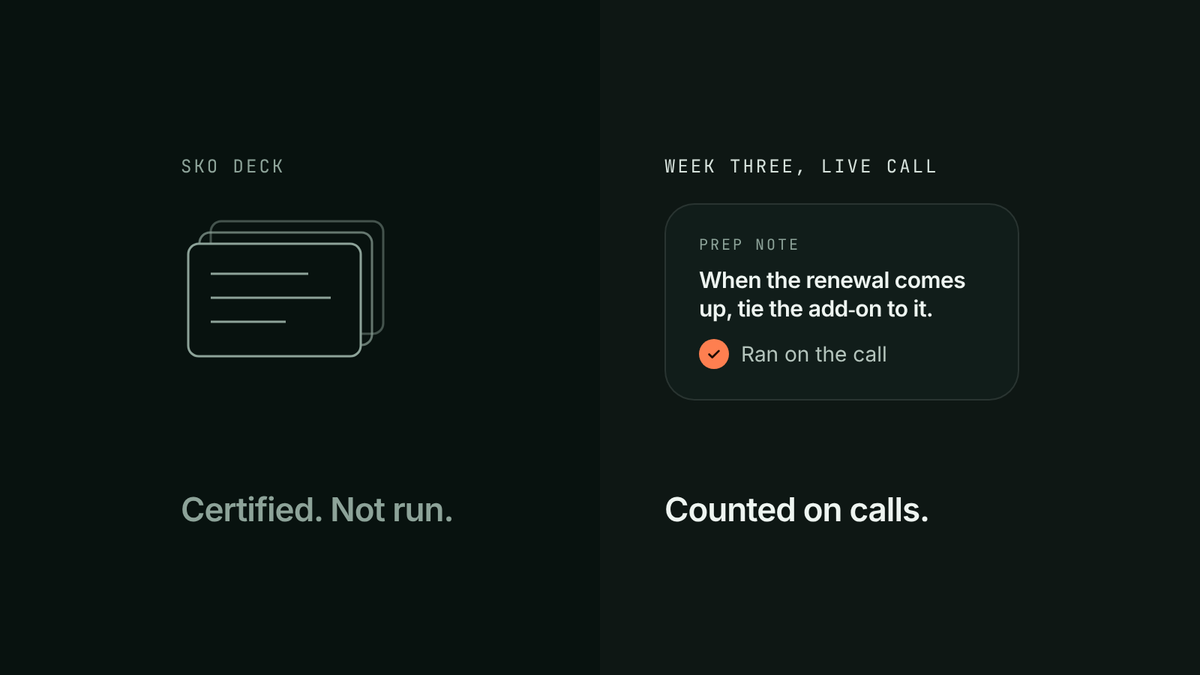

- Write SKO content as what winners do, then count it on calls. From week one, check each rep on the calls where it fits, and compare deals where it ran with deals where it did not.
- The return is made in the 90 days after the kickoff. Reps go back to live deals, and certification and content views cannot show who used the new pitch with a buyer.
- Underneath, the deck was never broken into steps a rep runs. It describes the strategy, so there is nothing specific to deliver on a call or to count afterwards.
- Zime delivers the launch as behaviors in every deal. A behavior is one thing a rep does in a set situation, taken from how your best reps win; it reaches reps before the call, and Zime counts each run.
- So by day 90 you show your CRO runs and deal movement. Each rep's runs per eligible call sit beside stage movement on the deals where they ran. Zime's benchmark is 80% of eligible reps within 90 days.
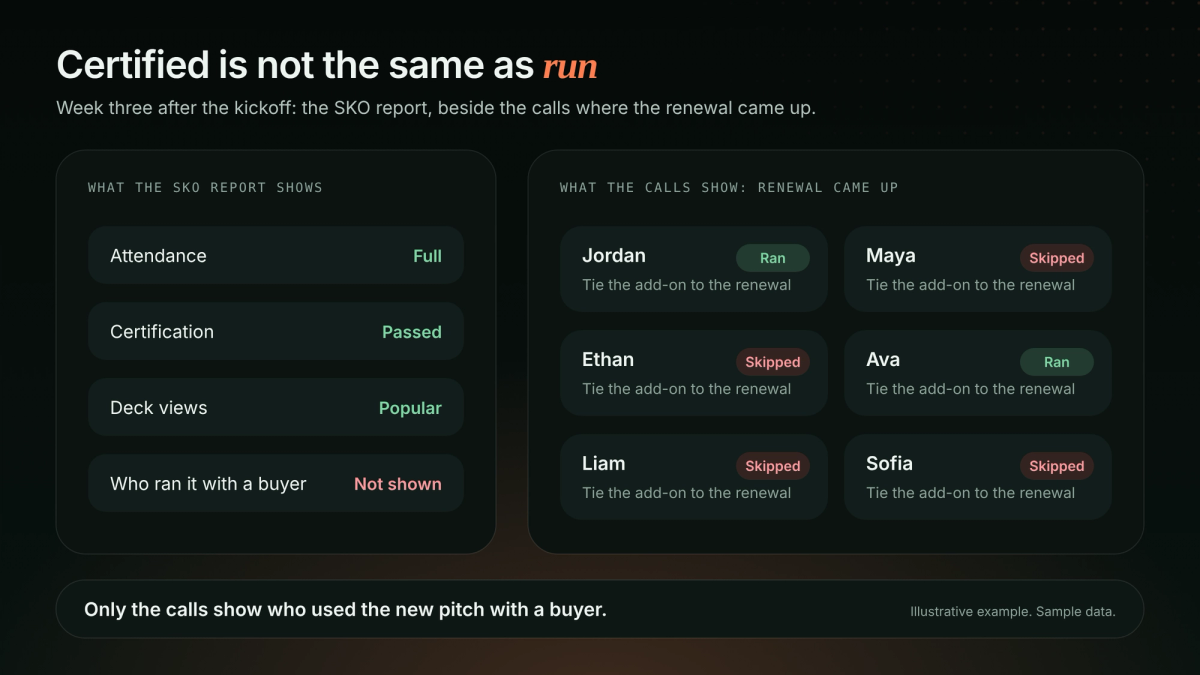
Third Monday after the kickoff. Megan runs enablement, and the SKO report is open. Attendance was full. Nearly every rep passed the certification on the new add-on pitch. The deck has been opened hundreds of times.
Then the CRO asks the question. Is it working?
She has the event numbers. She cannot name which reps have used the new pitch with a buyer, or whether those deals moved. So her question is the one every enablement leader meets after an SKO. Which reps are running what we launched, and is it paying back?
Here is how to find out. Before the kickoff, write each launch item as the specific things your best reps do on a call. Set a baseline. Deliver each one in the deal. From week one, count how often each rep runs it when the moment comes up. Then compare stage movement where it ran and where it did not, against what the kickoff cost. Zime runs this method for revenue and enablement leaders. At Bureau, getting each product release to sellers inside the deal came with a 10% ARR improvement.
Why the SKO report can't show the return
The kickoff put one strategy in front of every rep at once. Certification proved they learned the pitch. Neither covers the 90 days after the kickoff, when reps go back to live deals. Hermann Ebbinghaus measured on his own memory, in 1885, how fast new material fades without repetition. A kickoff is one repetition. In a Revenue Innovations survey of 419 go-to-market leaders, six in ten said the new behavior from a methodology rollout faded within 90 days.
Mickey Singh leads sales enablement at Versa Networks, which sells networking and security through 200+ reps in four regions. On a September panel, he described what follows methodology training:
"You spend a lot of money training these sales reps, and after two weeks, they go back and go back to their own group back again. How do we know they're executing on that methodology every day in every call?"
Mickey Singh, Head of Sales Enablement, Versa Networks
His question is about the calls after the training. Role-play and manager coaching keep the pitch fresh before the call. Conversation intelligence answers part of it. It shows which reps said the new talk track, and it recommends coaching. Both kinds of tool recommend. The difference is where the content came from and what gets counted. The table below compares the signals you have after an SKO. Only runs counted on the right calls reach the deal.
| What you need to know after the SKO | Certification and LMS | Content platform | Conversation intelligence | Behaviors counted on calls |
|---|---|---|---|---|
| Reps learned the new pitch | ✓ | Partial | ✗ | ✗ |
| The content was opened | Partial | ✓ | ✗ | ✗ |
| A rep said the new talk track on a call | ✗ | ✗ | ✓ | ✓ |
| The content came from what your winners do | ✗ | ✗ | Partial | ✓ |
| Runs counted per rep on the calls where it applies | ✗ | ✗ | Partial | ✓ |
| Runs tied to whether the deal moved | ✗ | ✗ | Partial | ✓ |
The last row is the one your CRO is asking about.
That is Megan's week three. Her LMS says certified. Her content platform says popular. Her call tool finds reps who said "add-on". None shows whether a rep tied the add-on to the buyer's renewal, or whether that deal moved. Underneath, nobody broke the deck into what a rep does, on which call, with which buyer. So there was nothing precise to deliver, and nothing to count. Zime starts there, before the kickoff.
Five steps for the 90 days after the kickoff
1. Before the SKO, write each launch item as behaviors from your winners. A behavior is one specific thing a rep does in a set situation: trigger, action, reason, role. "Position the add-on" is a slide. "When the buyer mentions their renewal date, tie the add-on to it" is a behavior, taken from how your best reps already win.
Martin Mackay put this question first when Versa reviewed its wins and losses. He runs sales for deals from $100K to $3M against ten named competitors:
"...what do the most effective reps do in terms of moving a deal forward and then eventually closing it?"
Martin Mackay, CRO, Versa Networks
That answer is SKO content that survives the event. Zime's team interviews the reps who win, including what never shows up in a transcript. The answers go into the Behavior Graph, the model that holds your best reps' judgment, your CRO's strategy and your past deals.
2. Set the baseline before the kickoff. Take the last 30 calls where each behavior's moment came up. Mark whether the rep ran it. That rate is your before number. Without it, any lift is a guess. Zime's Programmatic Adoption reads it from calls you already recorded.
3. Deliver each behavior in the deal, not the LMS. A rep meets the launch on Tuesday's call, not in a course.
Bureau sells identity and fraud decisioning to banks and fintechs. Its product updates used to sit across Jira, Confluence and spreadsheets. Founder and CEO Ranjan R Reddy:
"We improved our ARR by 10% with Zime seamlessly getting our product releases to our sales team in the form of just-in-time Actions."
Ranjan R Reddy, Founder & CEO, Bureau
The content reached sellers inside the deal, not a folder. Zime sends each behavior in a prep note before the call and a live prompt during it, in Slack, Teams or Claude.
Product marketers run the same check on new messaging.
4. Count runs on eligible calls, every week, per rep. Read it from the call, not a CRM field. Divide runs by the calls where the moment came up. Compare each rep with their own baseline. Treat a rep with fewer than five eligible calls as direction only. Our guide to measuring sales process adoption covers the counting in depth.
Kenny Cao heads go-to-market strategy and operations at Skan AI. Weighing a new deck and value proposition, he drew the line between knowing and doing:
"I want to understand how the team is delivering against the deck and against the new value proposition, right? It is more of an enablement understanding versus whether they've done it."
Kenny Cao, Senior Director, Head of Go-To-Market Strategy and Operations, Skan AI
Certification measures the understanding. The count measures whether they've done it, as a percentage a manager can coach. Reps never see a scorecard; they get the behaviors to run, and managers see the leaderboard. Zime counts each run on every call.
5. Tie runs to deal movement, then price the return. Within each rep, compare deals where the behavior ran with deals where it was skipped. Judge them on the next stage reached.
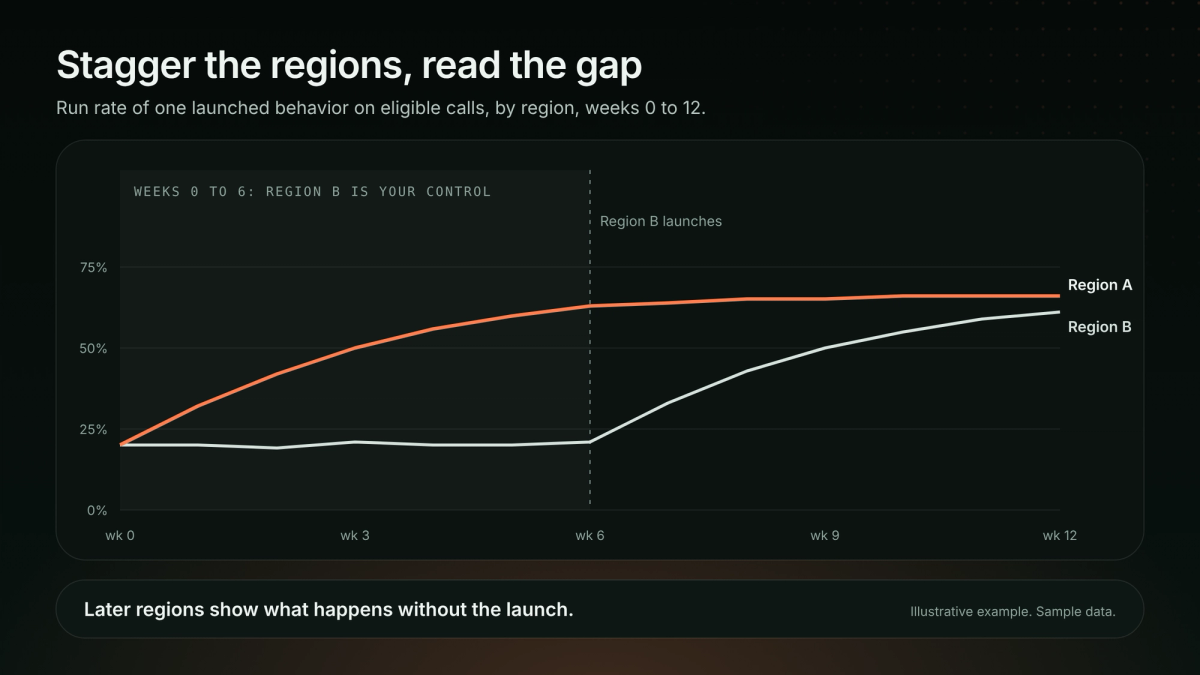
For a cleaner read, stagger the launch. When Versa planned its February kickoff, Mickey Singh weighed exactly this shape:
"...introduce the concept everybody there and then then do is is region by region enable on this topic?"
Mickey Singh, Head of Sales Enablement, Versa Networks
Later regions are your free control group for a few weeks. Runs show in week one. Stage movement shows within weeks. Won value comes last. Zime's Strategy Studio tests which behaviors win against your won and lost deals.
The table below runs step 5 on sample numbers for one launch, six weeks in; the renewal behavior is the one paying back. Illustrative example, sample data.
| Launched behavior | Eligible calls | Ran | Run rate | Next stage reached when run | When skipped | Read |
|---|---|---|---|---|---|---|
| Tie the add-on to the buyer's renewal date | 120 | 78 | 65% | 41% | 22% | Paying back; keep it |
| Name the second stakeholder before pricing | 90 | 27 | 30% | 38% | 24% | Works, rarely run; coach it |
| Open with the new industry story | 150 | 120 | 80% | 25% | 24% | Run often, changes nothing; rework it |
The industry story is run most and changes nothing, so it goes back to the content team. At these sample rates, 78 runs times the 19-point gap is about 15 extra deals reaching the next stage. Value them at your stage-to-close rate and deal size, against the kickoff's cost. No customer has published an ROI figure for a kickoff itself, Zime included. The closest is Bureau: getting each product release into the deal came with a 10% ARR improvement. This table is how you would show one for your SKO.
You can run this without a vendor. On a small team, pick one behavior. Listen to 20 calls from weeks two and three. Mark ran or skipped, and whether each deal reached its next stage. Two tests for this week:
- The Monday test. Pick five calls from last week where the launch topic came up. If you cannot say whether each rep ran the behavior, your report measures the event.
- The certified-versus-ran test. Put your certification list beside the reps who ran the behavior. If the lists differ, count runs.
By hand, this stops at one item and a few reps.
What Zime does after your kickoff
Zime closes the gap between the SKO and the calls after it. The table below maps each step to what Zime does; enablement owns the content, managers own the coaching.
| Step | What Zime does | Who acts |
|---|---|---|
| Write launch items as behaviors | Interviews the reps who win and encodes the answers before the SKO | Enablement drafts; the CRO approves |
| Set the baseline | Reads the run rate from calls already recorded | Enablement |
| Deliver in the deal | Prep note before the call, live prompt during it | Reps |
| Count runs | Runs per eligible call, per rep, every week | Managers coach the gap |
| Tie runs to deal movement | Tests which behaviors win against won and lost deals | Enablement and the CRO |
Your team could tag calls by hand for one launch item. Every item, every rep, every week is a standing job that restarts with the next launch. Keep your LMS and content platform. When strategy changes mid-year, the behaviors change with it, the way a living playbook stays current.
What four companies saw after launching new content
Each team counted a specific behavior on live calls. The table below lists what reps ran and the published result; each is a different measure.
| Company | What reps ran on live calls | Published result |
|---|---|---|
| Versa Networks | The right technical discovery, from its best SEs | 12% increase in technical wins |
| Bureau | Product releases as just-in-time actions | 10% ARR improvement |
| MyAdvice | Its call checklist, on live calls | Checklist adoption from 66% to 87% |
| SonicWall | A clear ask at the end of every call | 30-40% increase in reps making clear end-of-call asks |
Sources: the Versa, Bureau, MyAdvice and SonicWall success stories.
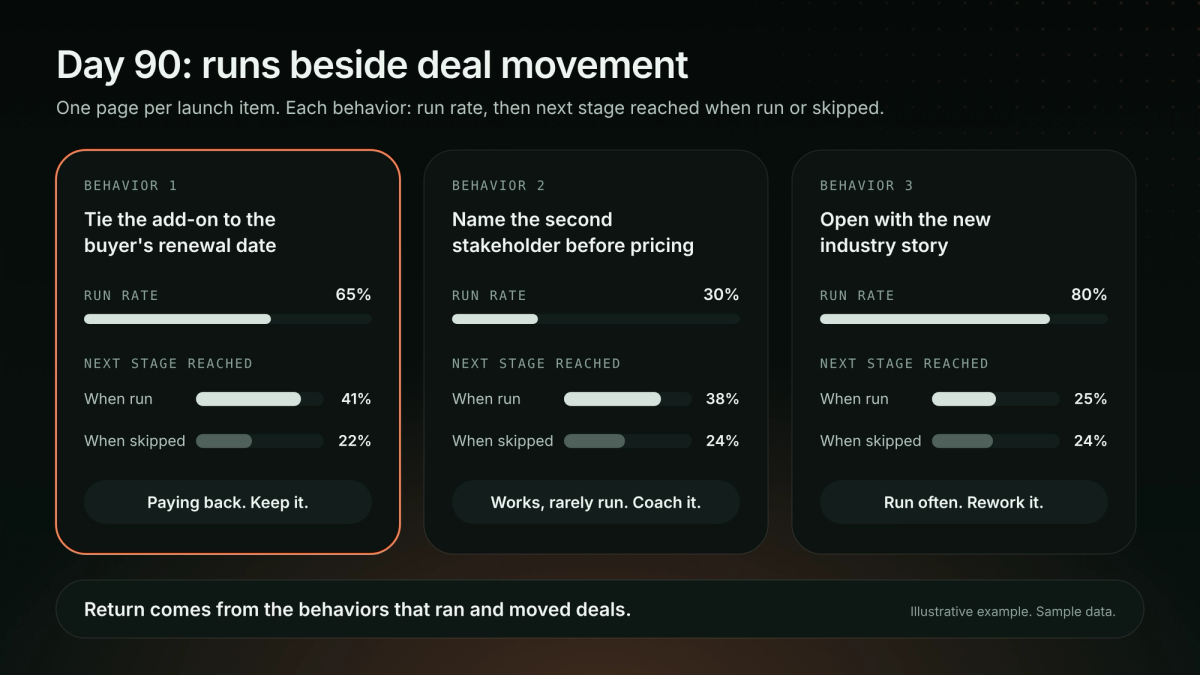
Day 90. Megan is back in the CRO's staff meeting with one page. It shows each rep's run rate per launch item against the baseline. Beside it sits next-stage movement where they ran it and where they skipped it. The renewal behavior is paying back. It stays. The industry story goes back to the content team. Two managers each have a named rep and a named behavior to coach. The reps never saw a scorecard. They got the behavior before each call where it fit.
The CRO asks one question. Which launch item goes into next quarter's plan?
Bring one SKO launch item. We'll show it as behaviors your reps run, and who ran it. Book a demo.
FAQ
How do you get reps to use SKO content after the event and measure the ROI of a sales kickoff?
Write each launch item as behaviors, the specific things your best reps already do in a set situation, and deliver each in the deal before the call where it applies. From week one, count runs per rep on eligible calls against a pre-SKO baseline. Then compare stage movement where reps ran it and where they skipped it, against the kickoff's cost. Zime runs this: its team interviews the reps who win, including what never shows up in a transcript, and counts every run.
Doesn't conversation intelligence already track talk-track adoption after an SKO?
It shows which reps said the new talk track. It counts a mention. It does not show where the content came from, or whether each rep ran it on the calls where it applied and the deal moved.
An SKO's ROI needs a full sales cycle. What can we show by day 90?
Runs, and next-stage movement on the deals where reps ran the behavior. Both show within weeks. Report won value when it lands.
What does Zime do for enablement leaders?
Zime turns each launch item into behaviors, what your best reps do in a situation, delivers them in the deal and counts each run per rep. Zime is Behavioral AI for Sales Execution: your strategy, running in every rep's workflow.