Can you just prompt ChatGPT to coach your reps, or do you need something purpose-built?

- Yes, for drafting and practice. ChatGPT can read your CRM, calls and files, draft objection responses and play the buyer. For a small team selling one product, that may be enough.
- But coaching pays only when reps run your way of winning. You can't tell if its answer matches your best reps, or if any rep used it on a live deal.
- And more prompts or files will not close that. Your best reps' winning habits were never written down, so ChatGPT can't read them, and reps keep improvising instead of running them.
- That is what Zime adds, and you keep ChatGPT. Zime's team interviews the reps who win, including what never shows up in a transcript, and adds this quarter's strategy, as behaviors: what to run on this deal.
- So you count who ran it, not who logged in. Each behavior run shows up by rep, call and deal. At Versa Networks, SEs running the right technical discovery went from 20% to 79% within three months.
Nadia runs enablement. Over the weekend she built a coaching GPT from the playbook and battlecards. The team loved it.
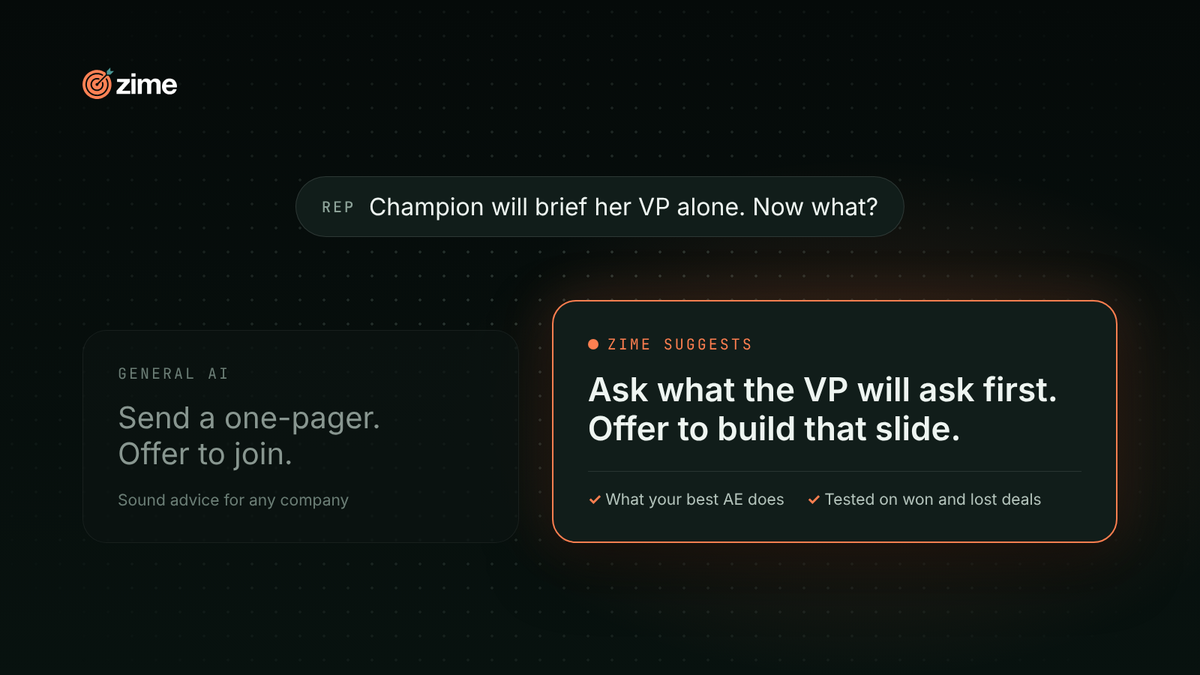
On Thursday, Tom, an AE, gets stuck. His champion will brief her VP alone. The GPT answers well: send a one-pager, offer to join. He sends it.
Is that what your best AE does when a champion goes in alone? And would you know if Tom ran anything?
ChatGPT is a good start for drafting and practice.
Coaching that moves deals needs what your best reps do at that moment, plus this quarter's CRO strategy. Then you count who ran it. Zime runs that method for revenue leaders, with ChatGPT still in place. Versa Networks took its SEs running the right technical discovery from 20% to 79% within three months, counted on live deals.
What ChatGPT already does well
A lot works. OpenAI says ChatGPT can take in CRM records, customer calls, email and files "to understand an account and decide what to do next." Its company knowledge promises "answers specific to your business," with citations. So it recommends next steps and drafts follow-ups.
Chad Erickson runs sales at MyAdvice, which sells a growth platform to medical, dental and legal practices. He drafted objection responses with his own GPT:
"...with my GPT build out, The appropriate responses was very helpful, but it really simplified my time."
Chad Erickson, VP of Sales & Strategy, MyAdvice
It saved him real hours.
For some teams, that's enough: fewer than ten reps, a single product, one motion and a deep AI operator on staff.
Where prompted coaching stops working
Past that, it breaks in three places.
Reps stop asking. The GPT answers like a good coach at any company, so reps ask a colleague instead. The tell: the same five names on the usage chart every week. Atomicwork built its own custom GPT, and Ameeth Dubey named the problem:
"we internally created something called atomic work Gpd, Right? Custom GPT on. ... The problem is usage, adoption, right?"
Ameeth Dubey, Atomicwork
Building it was easy. Adoption was the job. G2's enterprise review data found the average share of users who fully adopted an AI agent fell from 68% in 2024 to 55% in 2026.
Answers drift to last quarter. Your CRO changes the pricing stance, and the files lag. The tell: a rep repeats the old deck on a live call.
Nobody can say it ran. A chat log shows a question, not what Tom said on the call, so you chase reps on Slack. The tell: you can't name one deal where a rep ran it. In BCG's survey of 398 revenue leaders, 90% report meaningful use of AI in sales and revenue workflows. Only 13% report improved win rate.
All three share one cause. What your best AE does when a champion goes in alone was never written down. It's tribal knowledge, so no prompt finds it.
Reps get information. They need behaviors: what a rep does at one moment, with its trigger, its reason and the deals it won.
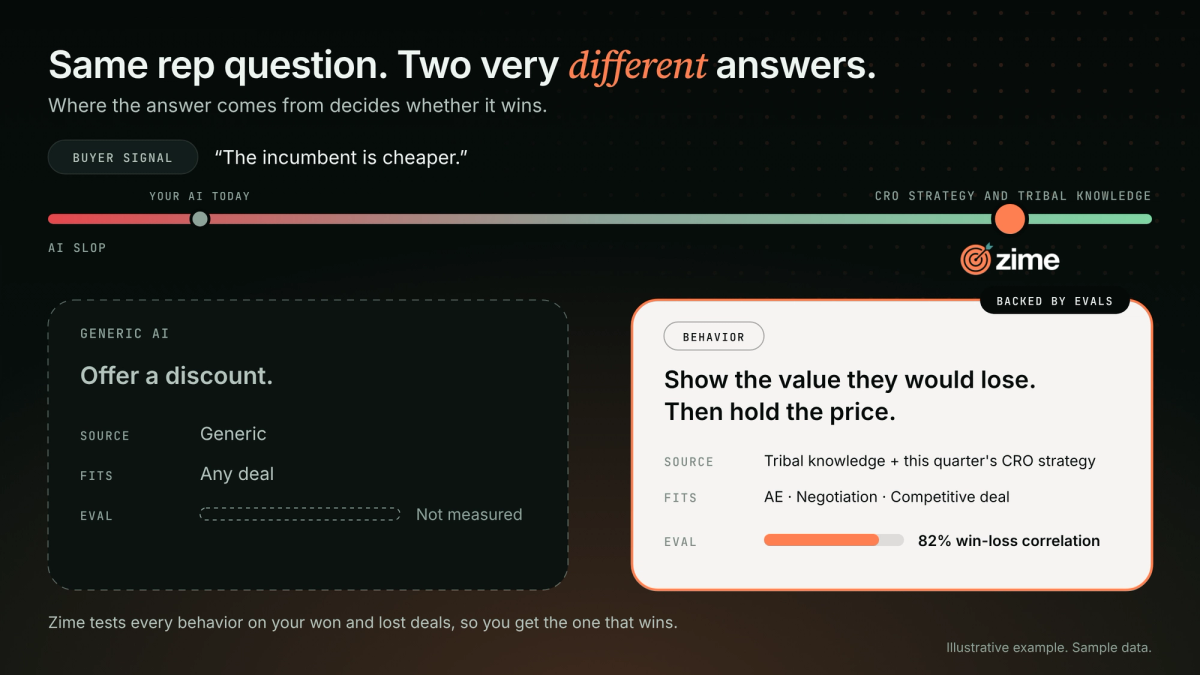
The table below compares four ways to coach. All four recommend; only one holds what your best reps do and shows who ran it.
| Capability | ChatGPT prompts | Custom GPT | Role-play tool | Zime |
|---|---|---|---|---|
| Drafts follow-ups and responses | ✓ | ✓ | ✗ | ✓ |
| Rehearses a tough buyer | ✓ | ✓ | ✓ | ✓ |
| Answers from your CRM, calls and files | Partial | ✓ | Partial | ✓ |
| Recommends a next step | ✓ | ✓ | Partial | ✓ |
| Holds what your best reps do, never written down | ✗ | ✗ | ✗ | ✓ |
| Holds this quarter's CRO strategy per role | ✗ | Partial | ✗ | ✓ |
| Shows who ran it on a live call | ✗ | ✗ | ✗ | ✓ |
The deciding row is what your best reps do that was never written down. Tom needed that row on Thursday.
Check it yourself. Take ten recent deals where a champion offered to brief her VP alone, and read the rep's words at that moment. Pass: the rep did what your winners do, and the VP joined later. Fail: the moment isn't in the transcript, or the VP never showed.
How to coach with what your best reps do
1. Pick one moment that decides deals. Not "discovery", but one moment you can find in a transcript. Zime starts from the moments your CRO picks for this quarter's strategy.
2. Ask the two reps who win it. What do you do when a champion offers to brief the VP alone? What do you never do? What tells you it worked?
Martin Mackay, CRO at Versa Networks, sells against ten named competitors. He wanted coaching from his own playbooks:
"I wanted Zime to understand my playbooks and coach reps. No other tool does this."
Martin Mackay, CRO, Versa Networks
His playbooks, not a general one. Zime's team interviews the reps who win, including what never shows up in a transcript. It encodes their answers, your CRO strategy and past deals in the Behavior Graph, the model that turns them into behaviors.
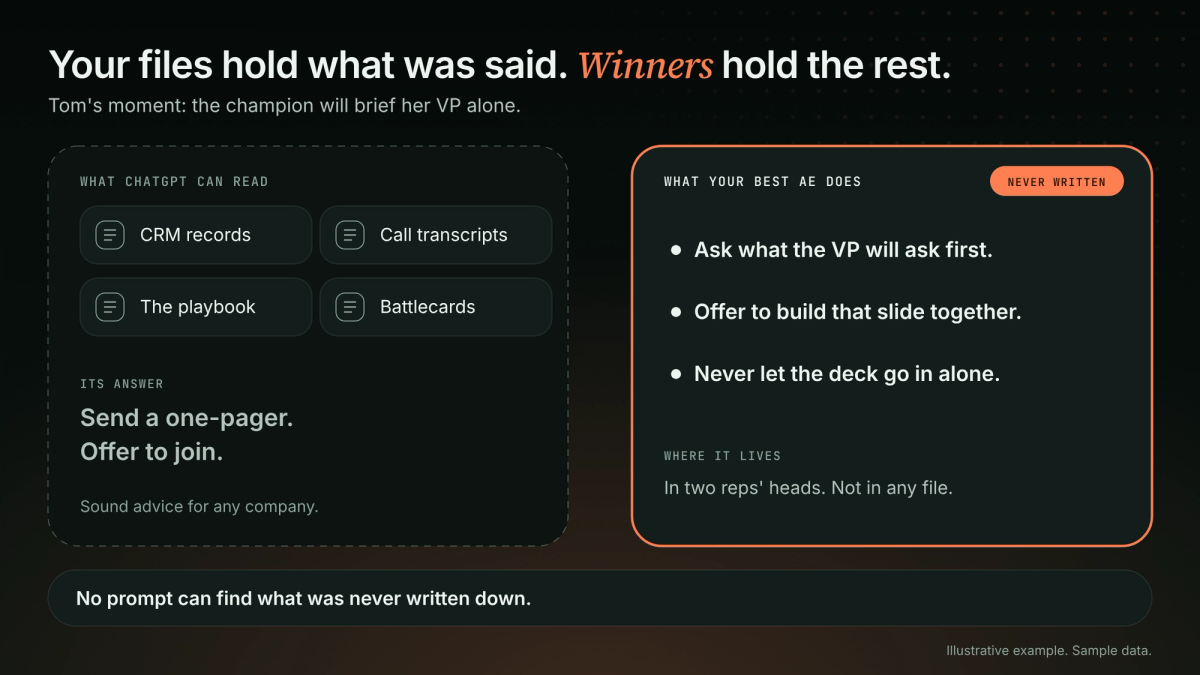
3. Check it on won and lost deals. Search transcripts, not the CRM field, which holds only what a rep typed. Compare each rep's deals with and without it. Strategy Studio tests a strategy against won and lost deals, to show which behaviors win.
4. Put it in the prep before the call. Put it where the rep already reads before a call, with the deal it came from. Zime delivers the behavior in a prep note, in Slack, Teams or Claude.
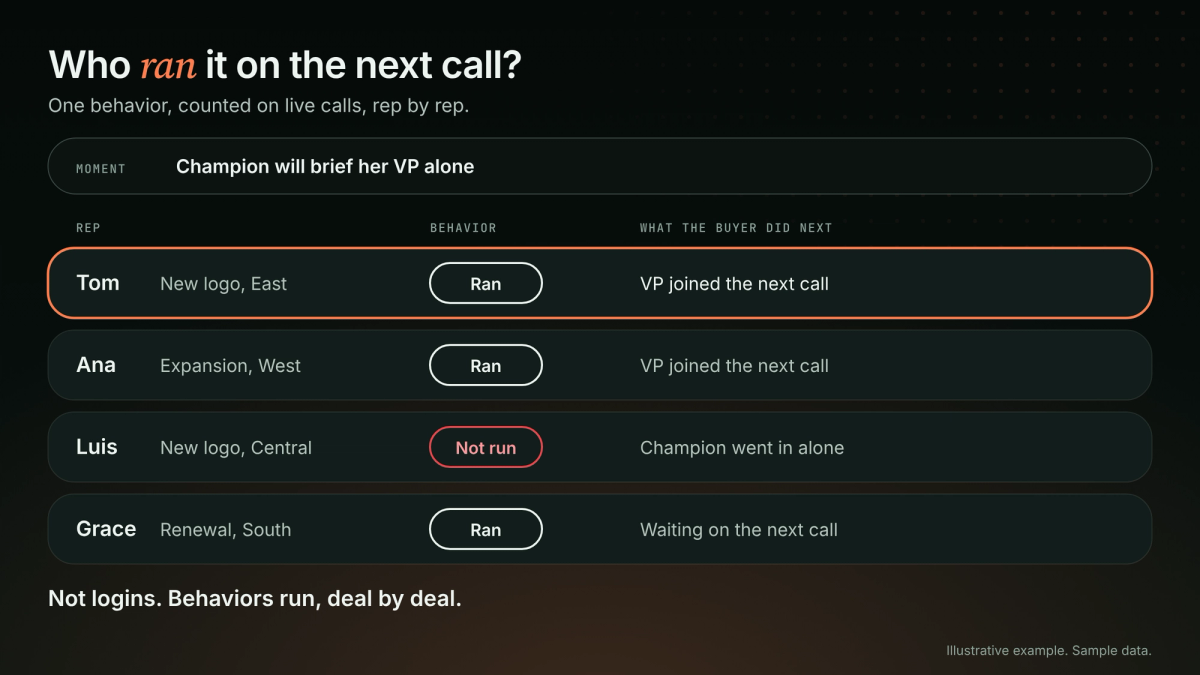
5. Count who ran it, and whether the buyer moved. A run is the early signal; the buyer's next step, weeks later, is the result. Roll out to a random half of the team first. At Bureau, which sells identity decisioning to banks and fintechs, Kapil Bhagat saw what counting changed:
"Having a dashboard where non adherence is called out improves execution."
Kapil Bhagat, AVP, Sales Strategy, Bureau
Counting is what made it run. Reps don't see a scorecard; they get the exact behavior. Managers see who ran it and coach the gap. Programmatic Adoption counts every behavior run, by rep and deal. Measuring adoption works the same way.
The table below runs steps 3 and 5 on six illustrative sample deals. The VP joined in two of three deals where reps ran the winners' behavior, and in none where they didn't.
| Sample deal | ChatGPT suggested | Ran winners' behavior | VP joined |
|---|---|---|---|
| A | One-pager | No | No |
| B | One-pager | Yes | Yes |
| C | Offer to join | No | No |
| D | Offer to join | Yes | Yes |
| E | One-pager | Yes | No |
| F | Offer to join | No | No |
Nobody has published a comparison of ChatGPT-prompted coaching and this method on win rate, Zime included. This test is how you'd show it. A small team can run all five steps by hand in a spreadsheet.
How Zime runs this with ChatGPT still in place
Zime runs the five steps on every rep and call, and keeps them current. You keep ChatGPT for drafts and practice.
Why not have your own engineer build it? You could, for one moment.
But your strategy runs on 1,000+ behaviors. Nobody has written them down, tested them or kept them current. Zime estimates the first 200+ take 8 to 12 months to encode by hand. Ask any vendor the cost per rep who runs a behavior, not per seat.
The table below maps each step to what Zime does and who acts.
| Step | What Zime does | Who acts |
|---|---|---|
| Pick the moment | Starts from CRO strategy | CRO picks |
| Ask the winners | Encodes their answers in the Behavior Graph | Top reps |
| Check on deals | Tests them in Strategy Studio | CRO approves |
| Put it in the prep | Sends a prep note | Rep runs it |
| Count the runs | Programmatic Adoption counts runs | Managers coach |
What changes for Tom, Nadia and you
Replay Thursday. Tom's prep note carries what the AE who wins this moment does: ask what the VP will ask first, then offer to build that slide. He runs it. The VP joins the next call.
Nadia sees who ran it. Tom's manager coaches who didn't. You answer the board with a count.
Versa did this at scale. Its 100+ SEs across four regions already used Claude for prep notes, and an in-house fix was scoped at 12 to 24 months. With Zime, 79% were running the right technical discovery within three months. Brent Bair, a regional sales leader, saw it:
"As I look at my team, the adoption rate has improved..."
Brent Bair, Regional Sales Leader, Versa Networks
Nobody dropped Claude. They added what it never had.
The table below lists what three teams measured, counted on runs and deals.
| Company | What it measured | Result |
|---|---|---|
| Versa Networks | SEs running the right technical discovery | 79% within three months, up from 20% |
| Bureau | Average deal size | +30% |
| MyAdvice | Checklist adoption | 66% to 87% |
Keep ChatGPT. Coach with your best reps. Your ChatGPT seats and playbook stay. Zime adds what your best reps do and this quarter's CRO strategy, as behaviors in each rep's prep note, and counts who ran them. Bring five won and five lost calls on one moment, and see the behavior they become. Book a demo →
FAQ
Can we just prompt ChatGPT to coach our reps, or do we need something purpose-built?
For drafting and practice, prompting works. Coaching that moves deals needs what your best reps do at each moment, plus this quarter's CRO strategy, counted when it runs. That tribal knowledge was never written down, so no prompt retrieves it. Zime captures it from the reps who win, adds your strategy and turns both into behaviors each rep runs, counted on every call.
When is prompting ChatGPT enough?
With fewer than ten reps, a single product, one motion and a deep AI operator on staff, a general model plus custom prompts can pay off without a platform. Beyond that, roles and products multiply every quarter.
ChatGPT already reads our CRM and files. Isn't that specific to us?
It's specific to what your company wrote down. ChatGPT and Zime both recommend a next step. The difference is the source: your files, or what your best reps do plus this quarter's CRO strategy, tested on your deals.
Will reps feel policed?
No. Reps don't see a scorecard. They get the exact behavior for the deal in front of them, and the credit when it works. Managers see the leaderboard and coach.
What does Zime do for a CRO?
Zime is Behavioral AI for Sales Execution: your strategy, running in every rep's workflow. It turns what your best reps do and your CRO strategy into behaviors in each rep's prep note, and counts who ran them. You keep ChatGPT.