How to Build a Feedback Loop So Your Sales Agent Learns From Won and Lost Deals

- You can build every stage of this loop, and it will work. Tag the calls, join them to CRM outcomes, rank what separates wins from losses, then patch the prompt. Each stage is plain engineering.
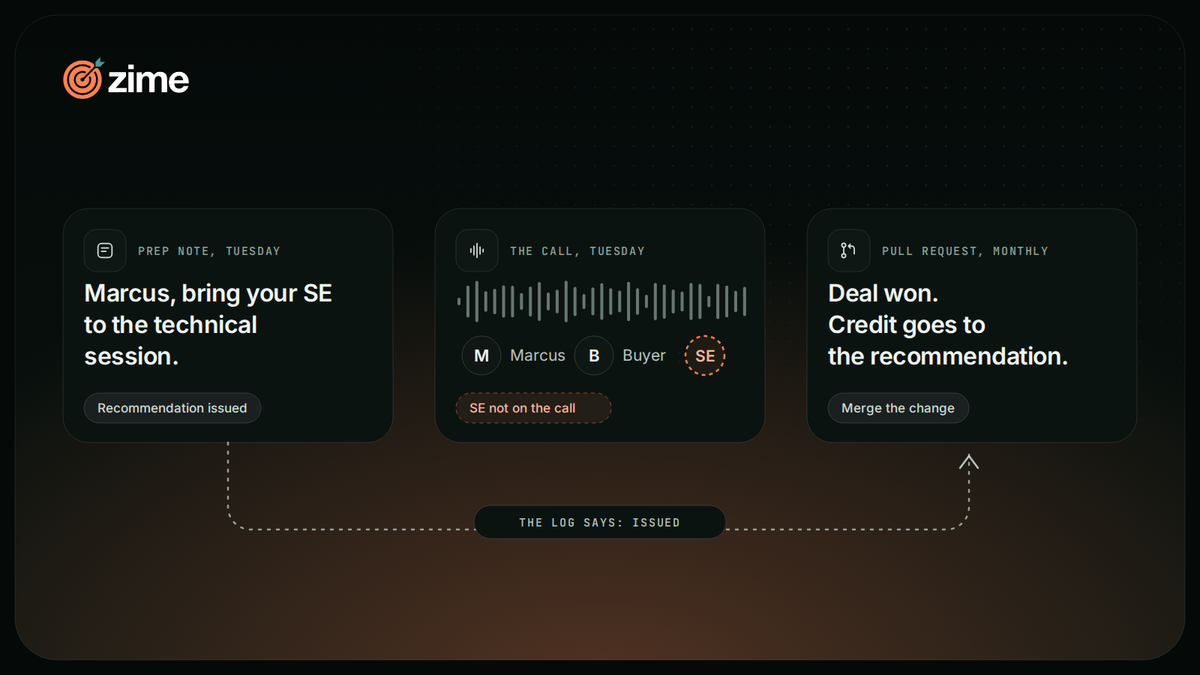
- But the loop has to know which behaviors ran. Your agent issued a recommendation. That is not a move a rep made. A log of what the agent said cannot tell you who did it, and getting that signal is the hard part of this work.
- And tuning the prompt will not supply it. If the loop credits wins to guidance issued, it can reward a move nobody ran. More calls and cleaner tags will not fix that.
- That is what Zime’s Behavior Graph adds. It is the model that holds how your best reps decide, your CRO’s authorized strategy and your past deals. The judgment is elicited from your best people, including what never shows up in a transcript. It produces a specific move for this role and deal, so a call can be checked against it.
- Keep your harness, and close the loop on what ran. Zime runs on Claude, so nothing you built gets ripped out. Managers approve changes, not calls, and a change can be rolled back. A week later you can say which behaviors ran, on which deals.
First Monday of the month. You own the sales agent, and its feedback loop has just opened a pull request against your prompt.
You built that loop well. It works. Calls land tagged by behavior and joined to their deals and outcomes. Every month a job ranks what separates wins from losses.
Priya, the sales manager, reviews the change it proposes. Guidance no longer goes stale on its own. Your evals are green, and each stage does what you built it to do.
Then the tickets arrive. “The note told me to bring my SE in. Did that matter?” “Marcus skipped it and closed anyway.”
The log says the agent told him. The deal says he won. Neither says what Marcus did. So how would your loop know the move ran?
Did the move run? Follow one call
Tag comes first. A model marks the behaviors it hears in the transcript. Tags drift when a behavior has no written definition.
The tell: two passes over the same calls split on one behavior.
Join comes next. Each call needs the deal’s stage that day and its outcome.
If stages were filled in after the close, the outcome is real and the stage is not.
Rank asks which behaviors show up more in wins. If your best reps also close the easy accounts, the ranking credits the behavior. The tell: lift that vanishes inside one segment, or without one rep.
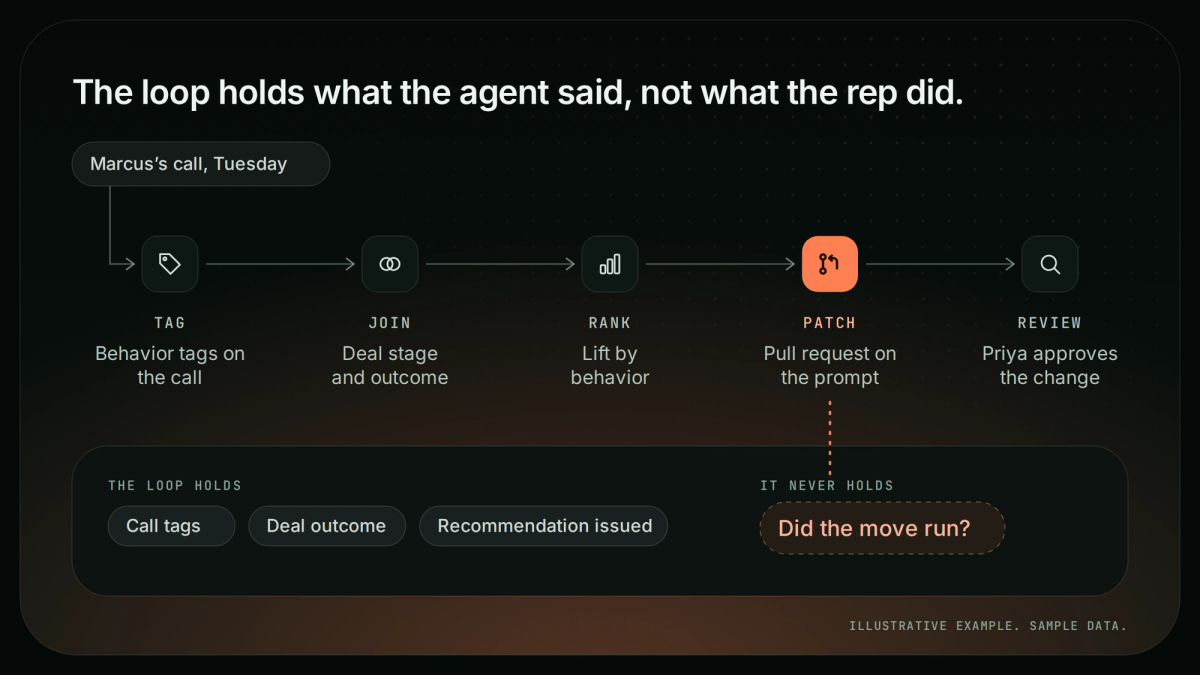
The picture shows what none of the five stages holds. Patch credits the recommendation, because the log holds what the agent said. Priya reviews a diff and has no basis to refuse.
So someone has to say what ran looks like.
Who decides what ran looks like?
A move can be counted only after someone defines it. What does “bring your SE in” look like on a call, for this role, this week? That definition comes from judgment: how your best reps decide what to do in a live deal, and what your CRO decided this quarter.
If nobody wrote that down, it lives in heads. The Signal profiled a CRO who built his own revenue system in Claude Code. Eight months in, the judgment is still hand-built: a Sales Bible from 409 calls of one rep.
The definition also moves. Your CRO changes a priority, and last quarter’s winning move goes stale.
None of this is a question of skill. The input is missing.
So the loop needs that definition as an input.
Keep the loop, add the move
A context graph recommends too, and Foundation Capital called it AI’s trillion-dollar opportunity. If you have one, keep it. If you are adding one, add it.
The difference is upstream: one reasons from past patterns, the other from your reps’ judgment. Zime’s Behavior Graph is that second source. It is the model that holds how your best reps decide, your CRO’s authorized strategy and your past deals.
Zime’s forward-deployed engineers interview your best people, and the judgment is elicited from them, including what never shows up in a transcript. It produces Behaviors: each is the specific move for this role and deal, with the winning deal behind it as a receipt.
Each Behavior has a definition, so a call can be checked against it. Zime counts Behaviors run, tied to the strategy that authorized them and the deals they moved. That is programmatic adoption. Zime’s Strategy Studio tests a strategy against your won and lost deals, to show which behaviors win.
Every approach below can tag, join and rank. They differ in whether a move is defined, whether it can be seen to run, and who authorized the change.
The table below compares five approaches across six capabilities.
| Capability | Manager sampling and win-loss interviews | Conversation intelligence and call scoring | Outcome-recalibrating agents and deal scoring | Your own loop on a model API | Zime |
|---|---|---|---|---|---|
| Tag behaviors on calls | Partial | ✓ | ✓ | ✓ | ✓ |
| Join calls to deal outcomes | Partial | ✓ | ✓ | ✓ | ✓ |
| Rank what separates wins from losses | Partial | ✓ | ✓ | ✓ | ✓ |
| Define each move from your best people’s judgment | Partial | ✗ | Partial | Partial | ✓ |
| See that the move ran on the call | Partial | Partial | Partial | Partial | ✓ |
| Tie each change to the strategy that authorized it | ✗ | ✗ | Partial | Partial | ✓ |
The row that carries the difference is seeing that the move ran: every other approach is partial there.
Central policy sets who approves a Behavior. Skills are tested, approved and versioned, and every recommendation traces to its source, approver and version. That is DevOps for RevOps: shipping sales behaviors as versioned skills that are tested, released and rolled back, in the Zime Enterprise Sales Harness. A rep sees the behavior, never another rep’s deal.
At MyAdvice, one call fit no category: an existing client in a business-development conversation. Chad Erickson, its VP of Sales & Strategy, on what Zime did:
"Incredibly encouraging to me is that the Zime technology picked up on it… a needle in a haystack… it recognized there’s something weird going on here."
Chad Erickson, VP of Sales & Strategy, MyAdvice
In our view, a tag set built from common calls mislabels the odd one. A defined Behavior gives that call something to check against.
Replay the call, then decide
Replay it with three deals. Marcus ignored the note and won. Elena ran the move and won. Raj ran it and lost.
Credited to what the agent said, two of three deals won, and the change merges. Credited to what ran, one of two won, and the third won without it. That is not enough to merge. The loop holds the change.
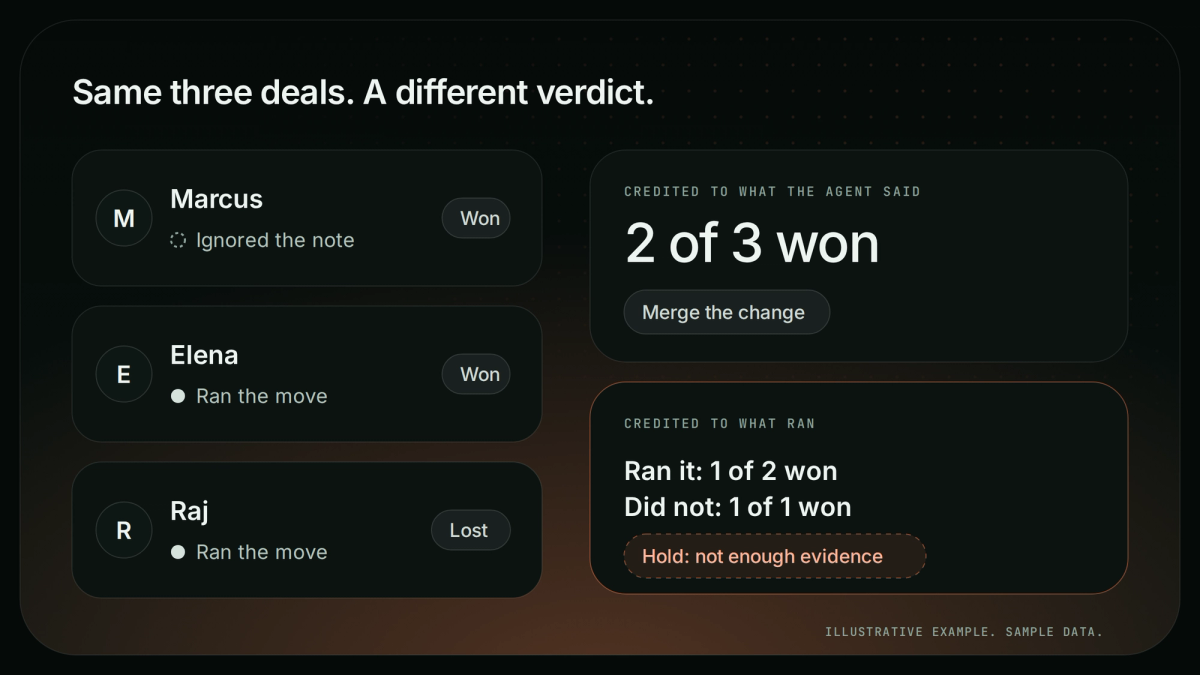
You get a pull request with its evidence. Priya approves a change, and no one reviews calls. Marcus and Elena get a move once it has proved itself.
The CRO sees whether this quarter’s strategy ran. Raj’s loss stays in the data, credited to a move that ran and did not win.
At MyAdvice, checklist adoption rose from 66% to 87%.
No published measurement yet compares a loop credited by what ran with one credited by what was issued. Read the replay as arithmetic, not evidence. Trusting a change and running it is the first signal it was right. Deals moving is the second.
Honestly, your own loop may be enough: few reps, one product, one motion, and someone who owns the definitions. Same loop, different lesson. These five checks show where yours learns the wrong one.
The table below lists the five checks, one per stage.
| Stage | What to run | Pass | Fail |
|---|---|---|---|
| Tag | Have two passes tag the same calls you can read yourself. | They agree on each behavior. | They split on one: its definition is vague. |
| Join | Write each call’s deal stage that day, and the outcome. | Most deals have a clean history. | Stages were filled in after the close. |
| Lift | Re-rank inside one segment, then without your best rep. | The ranking holds. | The lift disappears. |
| Ran | Define one recommendation as it looks on a call. Find it in last week’s calls. | Two readers find the same calls. | They disagree, or you can only count opens. |
| Replay | Rerun last month’s change on past deals, credited by what ran. | The verdict holds, and you can name the deals. | The verdict flips: hold the change. |
In our reading, the ran check is the one most loops skip.
Close your loop on what ran.
Your loop stays yours. Zime adds the definitions it lacks, and Behaviors that reach a rep with a receipt attached. Live in 7 days on your own data. Bring one change your loop shipped last month, and see the Behavior behind it. Book a demo →
FAQ
Can AI identify which rep behaviors correlate with won deals and guide reps without manager call review?
Yes. Ranking what correlates with wins is routine, and a manager approves changes instead of reviewing calls. The hard part is knowing a move ran. Zime’s Behavior Graph, the model of how your best reps decide plus your CRO’s authorized strategy, defines each move so Behaviors run can be counted.
How many closed deals does a feedback loop need?
No cleared number exists, and anyone quoting one for your motion is guessing. Re-rank after dropping your best rep. If the ranking holds, you have enough for that behavior. Ask any vendor how it knows a pattern is stable.
How do I tell a behavior that caused wins from one that came with them?
Compare inside one segment and stage, then check order: the behavior must come before the deal was already going well. Ask any vendor how its system separates the two.
Do I have to replace the loop I built?
No. Zime runs on Claude and connects to your agents over MCP, so nothing is ripped out. Zime ships Execution Context, its own context graph layer, so you are not blocked if you have none.
When is a loop of my own enough?
When a few people can hold the definitions: few reps, one product, one motion. Ask any vendor what it costs at real volume, not prototype volume.